
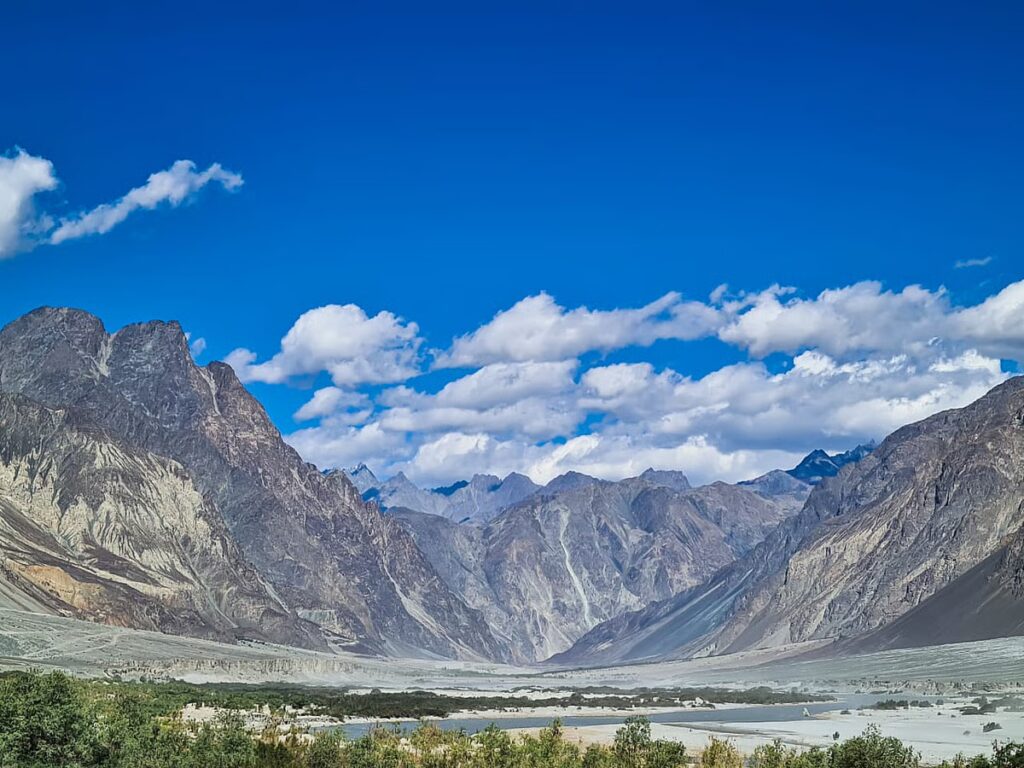
Turtuk is a village at the edge of India, in Ladakh’s Nubra Valley, where the Karakoram range casts long shadows over apricot orchards and stone-walled lanes. Until 1971, it was on the other side of the border. But borders mean little to the winds that have swept through this valley for a millennium. And sustainability means even less as a concept here. Here, it was never a choice. It was survival.
I came to Turtuk as a traveller interested in traditional design and sustainable living. I left with a quiet, urgent lesson for every architect, policymaker and researcher who cares about the future of India’s mountains.
In the oldest part of the village, called Yul, stands the Yabgo Dynasty Palace. No towering gates. No grand announcement. Just a weathered wooden entrance guarded by a carved eagle. The palace was not built to intimidate. It was built to endure.
Stepping inside felt less like entering a museum and more like walking into someone’s memory. The ground floor made up of spaces that spoke of life lived simply. The kitchen with its walls darkened by generations of smoke. The baithak, a sitting room, where families must have gathered on long winter nights, sharing tea and stories. And there was a small courtyard, modest but essential, tying the home together.
One will never fail to notice the windows. They are small and set deep into walls nearly a metre thick. At first glance, they seem inadequate. Then you understand the intention. They keep the freezing Himalayan wind at bay while allowing the precious winter sun to slip through and warm the rooms from within. This is passive solar design, perfected centuries before the term entered any architectural textbook. In an age when mountain towns are installing energy-guzzling electric heaters, often powered by diesel generators or coal-dependent grids, these quiet, intelligent walls offer a zero-energy alternative.
The walls are local stone. The timber is local wood. The carbon footprint of the palace’s construction is effectively zero. Not because anyone was trying to be “green,” but because there was simply no other way. This was very different from the new construction in Ladakh, of concrete hotels with electric heaters, glass facades that leak heat and bathrooms that guzzle water in a cold desert.
Upstairs, the main hall tells a different kind of story. On one wall, a sprawling painting traces the family tree of the Yabgo dynasty. It is of a lineage that ruled Baltistan for over a thousand years. Sepia-toned photographs of rulers in regal attire. Swords that once saw battle. Coins worn smooth by the hands that traded them. Traditional Balti jewellery that once adorned queens.
And in the corner of the hall sits Yabgo Mohammad Khan Kacho, the last king. A long staff rests in his hands. He is dressed simply. No crown. No throne. Just a quiet presence that fills the room. He is the last ruling descendant of a dynasty that once commanded vast territories. Today, his kingdom is a single village that became Indian soil only five decades ago.
He spoke softly, with a passion that came from the heart. He pointed to names on the family tree and faces in the photographs. He gestured toward the windows. The Karakoram range stretched across the horizon. Unchanged. Unmoved. The same peaks his ancestors looked upon a thousand years ago. The same light.
What remains when land and power are gone? In Turtuk, the answer is memory, grace and the courage to keep your doors open.
The palace as a quiet critique
As I walked back down the narrow stone stairs, I realised something. The Yabgo Palace is a quiet critique of everything that is going wrong in India’s mountain regions today.