- Residents in Farkawn, Champhai district of Mizoram have declared a community-managed forest as a sanctuary dedicated to conserving their state bird, the Mrs. Hume’s pheasant.
- This decision was taken after a survey recorded a healthy population of these birds in the area, 20 breeding pairs.
- The decision is also meant to help bring tourism to the village and support livelihoods.
Lurh Tlang Vavu Sanctuary in Farkawn village of Champhai district has become Mizoram’s first community-led forest dedicated to the sole conservation of Mrs. Hume’s pheasant, the state bird of Mizoram. This initiative marks a rare instance of an entire village proactively setting aside forest land for the conservation of a species.
Mrs. Hume’s pheasant (Syrmaticus hymiae) was scientifically discovered in 1881 from Manipur by Allan Octavian Hume, a British naturalist. He named the bird after his wife, Mary Ann Grindall Hume.
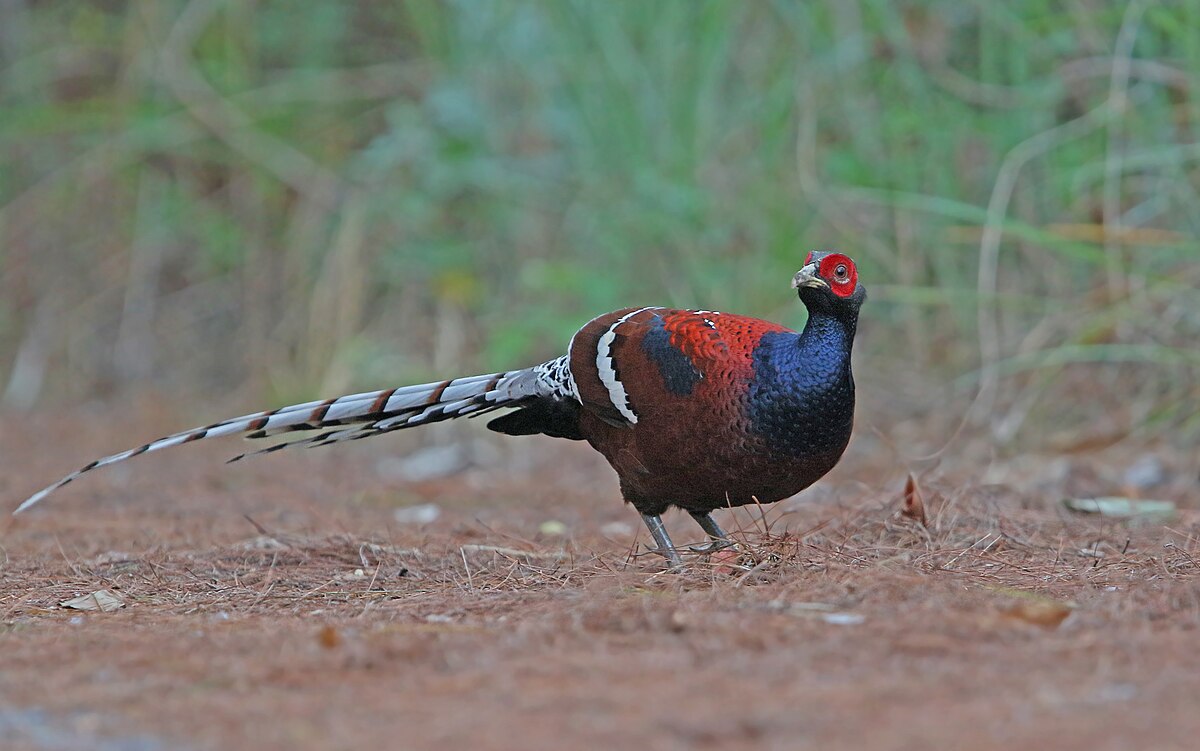
The male Mrs. Hume’s pheasant has a chestnut brown plumage, red patch around the eyes and metallic blue neck feathers with distinct and long, banded tail feathers. The female is patterned in shades of brown, with smaller red patches around the eye. The species is listed as vulnerable on the IUCN Red List. Habitat loss and hunting are major threats to the population. Globally there are between 6000 and 15000 individuals, mainly found in Mizoram and Manipur in India apart from Myanmar and Thailand.
Protecting a rare bird
A joint survey by the local people and Conservation Mizoram, an NGO working on environmental issues, recorded a healthy population of the bird in the region. The survey found 20 breeding pairs, a concentration that is considered high for this rare species.
The people then decided to formally conserve the area to better protect the rare bird as well as generate employment opportunities through tourism. They converted eight square kilometre forest into a protected sanctuary in collaboration with Conservation Mizoram.
Lalawmaia Sailo, Secretary, Conservation Mizoram, told Mongabay-India that Mrs. Hume’s pheasant is a rare bird. “After seeing the resident population of these birds in their village, people of Farkawn decided to dedicate this land for conservation of the state bird of Mizoram,” he added. “Our survey found there is a good population of vavu (Mizo name for Mrs. Hume’s pheasant) in Farkawn. We found more than 20 breeding pairs in a forest area of seven-eight square kilometers, which is a very healthy number. In consensus with local people, the area was demarcated as a sanctuary for vavu.”
The Lurh Tlang Vavu Sanctuary, located on Tlang mountains, was officially opened for tourists on November 21 this year.
As seen in many Northeast states in India, the forest department has minimal control over community-owned forest land.
“Luit Tarh Vavu Sanctuary is entirely a community project, which the forest department is just monitoring and supporting,” Lalbiakchama Chawngthu, Divisional Forest Officer (DFO), Champhai, told Mongabay-India., “It has been put under (categorised as) a Non-Notified Tree Forest, which is community-managed but protected under The Forest Conservation Act 1980. We have an active range office in Farkawn from where we monitor the forest, but it is managed by the locals of Farkawn.”
Apart from Mrs. Hume’s pheasant, the forest has a rich biodiversity. “We found 275 species of birds in this forest,” Sailo said. “The forest also has animals such as serow (Capricornis sumatraensis), grey goral (Naemorhedus goral), civet (Viverricula indica), golden jackal (Canis aureus), dhole (Cuon alpinus), barking deer (Muntiacus muntjak), porcupine (Hystrix indica) etc.”
For now, these efforts to protect the bird and associated species limits the threat of hunting. Camera traps are also installed in the area to help monitor the bird. As the government-mandated protected forests cover only a small portion of the bird’s potential habitat, these kinds of community-led protection efforts can lead to the conservation of these birds in the long term.
Balancing conservation and livelihoods
Farkawn, one of the largest villages in Champhai district has a population of 4,000, along with 800 households. Its location along the India-Myanmar border also makes it a strategically important village.
Jhum or shifting cultivation remains its main occupation, with locals growing crops such as rice, brinjal, ladies finger, ginger, chillies etc. Mithuns (Bos frontalis) are mainly reared for meat. Now, tourism in the sanctuary can generate livelihoods and open up a new avenue of income.
The sanctuary received its first visitors, two tourists from Bengaluru, on the day of the inauguration in November 2025.
“They were actually going to Murlen National Park in Champhai, but drove here after hearing about our sanctuary,” said Lalneihsanga, a resident of the village and a member of the sanctuary’s management committee. Farkawn currently has a tourist lodge and a travellers’ inn to accommodate tourists.
Banner image: The male of the Mrs. Huma’s pheasant species. Image by Christoph Moning via Wikimedia Commons (CC BY SA 4.0).