After Hugo Chávez’s election in 1998, net emigration from Venezuela began to increase. It was a relative trickle at first. The people leaving were, broadly speaking, the well-off, the business class, those who wanted to protect their investments and properties. Next, as the economic outlook worsened, came the middle class, looking for better opportunities, and many of those who went to Colombia could be more accurately described as returnees: the children and grandchildren of Colombians who’d emigrated a generation or two earlier, now claiming their citizenship in order to start over. Both of these groups included dissidents, victims of the ever-tightening repression. Each disappointing election lost by the opposition (or, more recently, stolen by Maduro) prompted many who no longer believed that change was possible to leave.
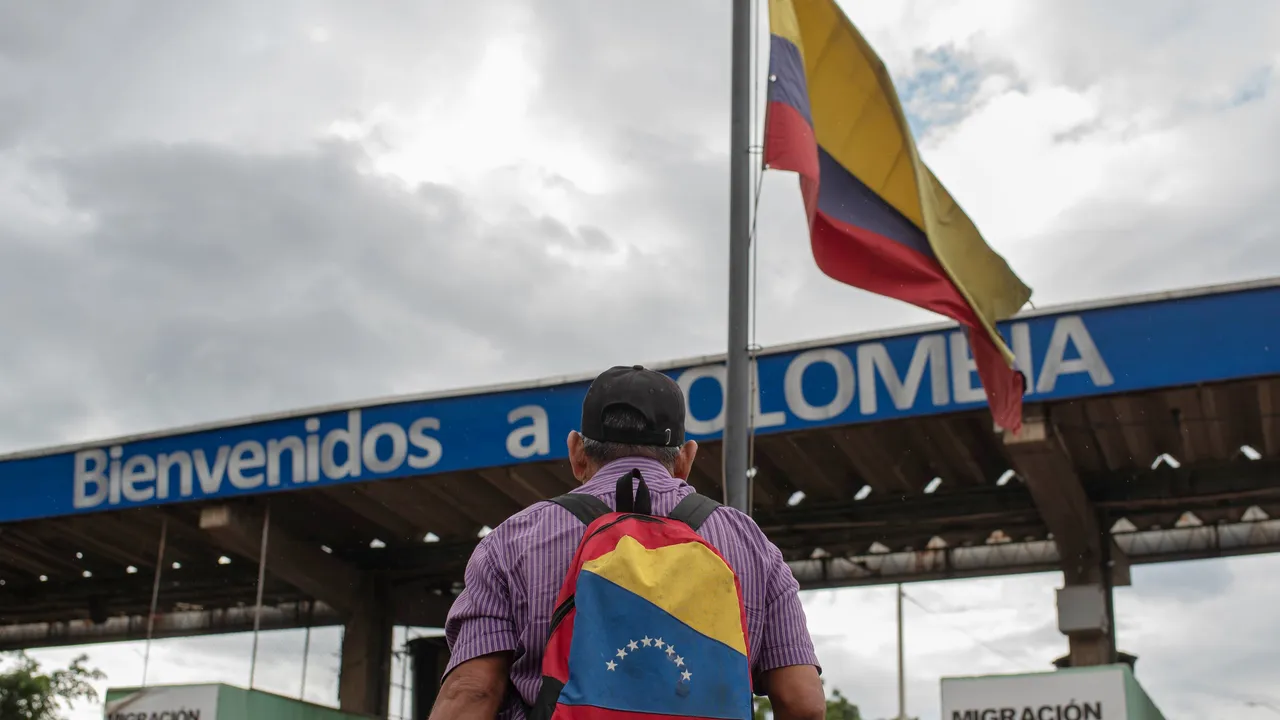
Still, no one was really prepared for 2017, when Venezuela’s hyperinflation made daily life unsustainable. That year, the official inflation rate rose to eight hundred and sixty-three per cent; the following year, it went even higher, to an astonishing annual rate of more than a hundred and thirty thousand per cent. Faced with this untenable situation, ordinary people from across the country simply picked up their belongings and began walking, eventually crossing the Simón Bolívar bridge into Cúcuta, and then heading farther, into Colombia, and beyond. What was initially a local concern for Cúcuta—which woke to find its streets and byways lined with refugees—soon became a national, and then regional, crisis. It was unprecedented, and if you talk to Cucuteños today, many still shudder as they recall those scenes. Mention los caminantes, the walkers, and everyone here knows what you’re talking about.
Keila Vilchez, a Venezuelan journalist writing for Cúcuta’s main paper, La Opinión, told me that those people weren’t migrating so much as fleeing. “That’s all you can call it,” she said. “Because anyone who decides to walk for twenty days, thirty days, forty days to leave their country is doing it because there is no hope.” The walkers whom Vilchez met in those days while reporting from Cúcuta, and along the roads of the Colombian state of Norte de Santander, were mostly headed to Bogotá, or to the coast, or to the coffee-growing region of Colombia, having heard rumors that there might be work there. They carried their entire lives with them, rolling their bulging suitcases along the sides of roads, children in their arms. They wore sandals or were barefoot. They were desperate: no papers, no money, perhaps a phone number of a relative or an address somewhere in Bogotá. Unprepared for the altitude or for the elements, many died along the way. In 2018 alone, more than 1.3 million Venezuelans left the country. “As a Venezuelan, I couldn’t help but think how lucky I’d been,” Vilchez said.
All told, more than seven million Venezuelans—around twenty per cent of the population—have left since 2015. It’s no exaggeration to say that this unprecedented exodus has affected every country in the region: straining diplomatic relations, testing social safety nets, sparking xenophobic backlash, polarizing public opinion, and transforming politics. The humanitarian emergency arguably transformed the political debate on immigration in the U.S., as well. How many Americans had heard of Tren de Aragua before it became a shorthand for the kinds of immigrants Trump was promising to deport en masse? I was living in New York when Republican governors began sending busloads of migrants to blue-state cities like mine. In the winter of 2022 to 2023, I volunteered to meet new arrivals at the Port Authority, most of whom were Venezuelans. They were young men and women, families; I remember them as dazed and bewildered and excited, scarcely able to believe that they were in midtown Manhattan. They needed winter coats and hats and underwear and shoelaces. And more—a place to rest, a job, a school for their kids. Many had crossed the Simón Bolívar bridge, and all one could do was offer a welcome, and stand in awe of how far they’d come, every journey a kind of miracle.
One morning in Cúcuta, I went to Las Delicias, a neighborhood of roughly four hundred families on the outskirts of town, where dirt roads snake up and down green hills, turning to mud in the rains, and more than half the residents are Venezuelan. There had been gunfire the previous afternoon, the victims a pair of young men on a motorcycle, one of whom had been shot in the back and died. The other remained hospitalized. Neither garnered much sympathy from the residents I spoke to; they were thieves, or so it was said, and life was too difficult to spend much time feeling sorry for criminals. Las Delicias officially became part of Cúcuta in 2015, a bureaucratic change that many hoped would bring much needed services and infrastructure improvements to the neighborhood, but not much has materialized yet.