- An agroforestry system of combining jhum cultivation with alder pollarding improves soil fertility, reduces erosion, provides firewood and timber, and lowers pressure on surrounding forests.
- The jhum–pollarding practices rely largely on farmers’ long-term knowledge of soil quality, tree regrowth cycles, and landscape health.
- Although pollarding temporarily reduces above-ground carbon, repeated regrowth of alder trees after pruning enhances long-term carbon sequestration.
Jhum farming plays an integral role in subsistence agriculture across the Northeastern region of India. Traditionally, jhum cultivation involved long fallow periods of 10–20 years. In recent times, however, these cycles have shortened and adapted to contemporary farming lifestyles due to increasing population pressures. As a result, the efficacy of jhum farming and shifting cultivation has become a point of concern among scientific and environmental groups, particularly in the context of climate change and deforestation.
Despite this debate, jhum farming offers several ecological benefits. It is considered carbon neutral, as carbon is sequestered during field preparation, while also helping to maintain the hydrological characteristics of the landscape, reduce soil erosion, and enhance soil organic carbon and nutrient levels. Farmers in Khonoma village in Nagaland have long recognised these advantages and have responded by integrating jhum farming with the pollarding of alder trees.
Pollarding — a method of planting and pruning trees — has historically been practised across Southeast Asia, Europe, and the Northeastern regions of India. Research has highlighted the benefits of alder-based jhum systems, particularly the tree’s ability to retain soil nutrients and fix nitrogen. Over time, this practice has become an integral part of land management strategies adopted by farmers in Nagaland.
A community for tree cover
The residents of Khonoma belong to the Angami tribe. When the village faced depleting tree cover in the mid-1990s, community leaders took charge, with several governing bodies, including the women’s union (Khonoma Thenoumiapfii Krotho), the youth group, the eco-tourism board, and the Khonoma Nature Conservation and Tragopan Sanctuary banding together to work towards forest conservation. Resident Niketu Iralu, often referred to as the “Gandhi” of Nagaland, informed Mongabay-India that the village built strong social structures to protect local forests, water sources, and the resident tragopan bird as a pathway to peaceful living. These sustained efforts have earned Khonoma the recognition of a “green village” over the years.
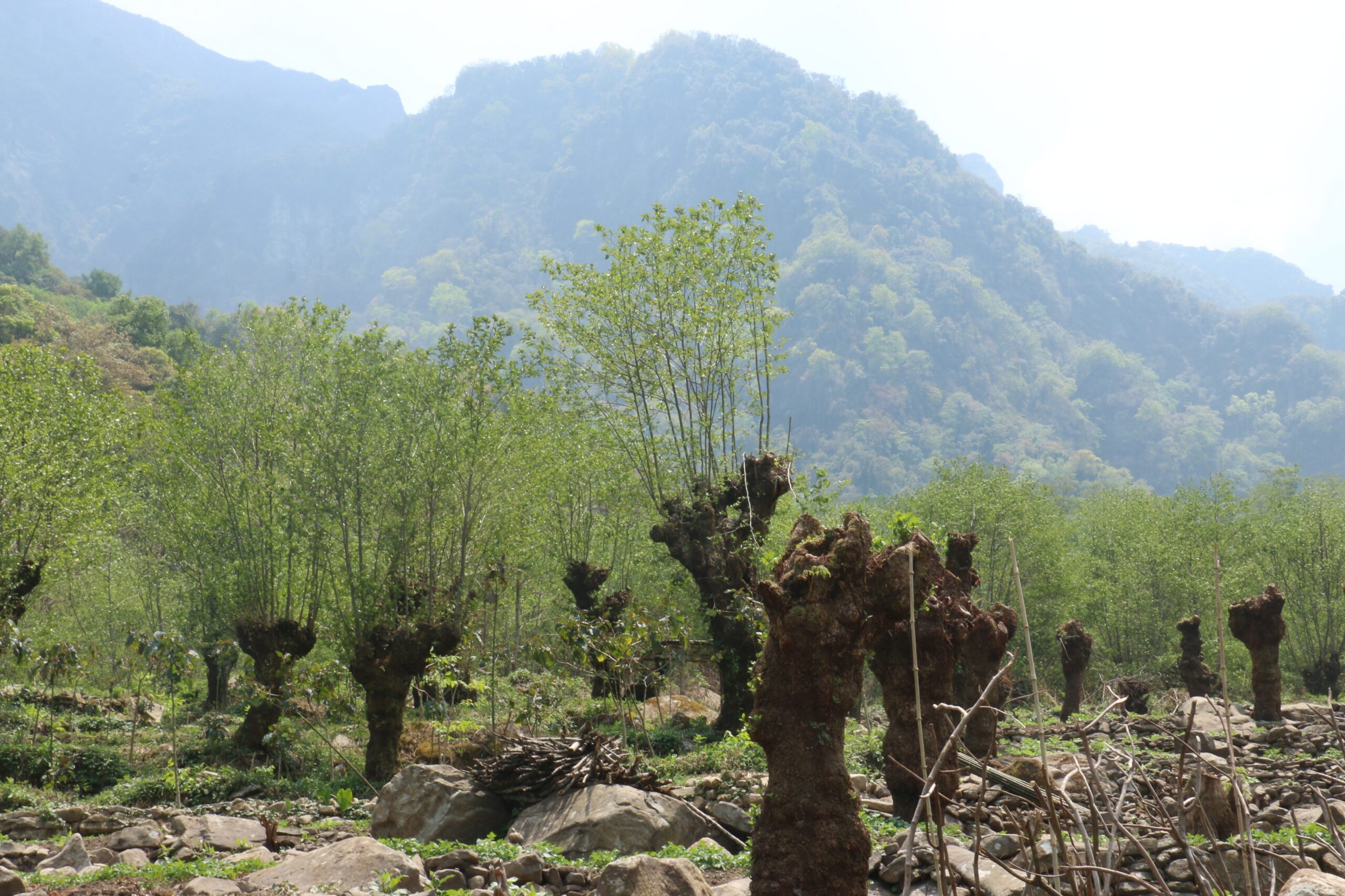
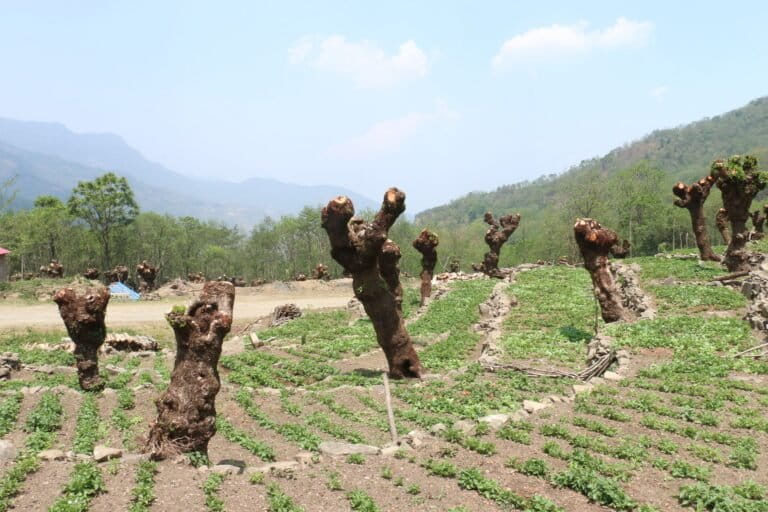
Practised mainly in the villages of Khonoma and Dzuleke, pollarding, when combined with jhum, functions as an agroforestry system. The tree is planted at regular intervals of approximately 3-4 m between plants and 5-6 m between rows. It is first pruned when it grows into an adult-sized tree in the first phase, after which some branches are left to grow on the tree, while others are carefully removed for timber. The branches that are chopped off are used as firewood, and the remaining stump is managed so that it grows new shoots in the next period. The land around the tree is left fallow for intervals of two, four, or eight years, while in other years it is used to grow vegetables. The tree’s roots supply nitrogen, allowing a range of food crops and vegetables to flourish under its shade. Crops such as turmeric, gourds, potato, amaranth, and chillies are known to thrive beneath alder trees, a fact affirmed by both local farmers and scientific studies.
According to Mhiesileto Lawrence (Leto), a resident, landowner, and farmer in Khonoma village, “The first pollarding of a newly planted tree can be done by the seventh or eighth year — sometimes even earlier, depending on its growth.”
Although the pruning technique involved in pollarding is not in itself indigenous and has been practised across the world, its integration with jhum cultivation creates a locally adapted agroforestry system. This combined approach improves soil quality while offering clear benefits to both farmers and the environment.
Drivers of shifting cultivation
Research examining the drivers of shifting cultivation shows that land allocation for jhum farming and pollarding is influenced by social and economic factors. In traditional Naga villages, land allocation systems were governed by specific social rules, such as Phesou among the Angami tribe, where land division was based on an individual’s role within the village. However, according to resident Leto, jhum and pollarding have been practised for generations, making land allocation today a more intuitive process rooted in assessments of soil quality rather than strictly defined social norms. Even so, these decisions are largely made by male landowners, with women participating mainly in rare cases such as widows or those who remain single.
Leto explains, “Jhum cultivation follows a rotational pattern, with the rotation period varying across different patches of alder trees depending on the time required for regrowth after pollarding. It’s usually between seven and 10 years.”
He adds that this practice has wider ecological benefits: “With this method, wasteland can be transformed into cultivable or agricultural land if the conditions are right, improving the ecosystem as a whole and the surrounding environment.”
Several farmers in Khonoma practise pollarding. Pollarding plays an important role in conserving forest land by providing a regular supply of firewood for village residents. This steady availability of fuel reduces the need to log surrounding forest areas.
Pollarding to mitigate climate change
Another climate-related benefit lies in the act of tree pruning itself. While removing branches initially reduces a tree’s carbon stock, the subsequent regrowth enables the tree to sequester carbon repeatedly, as it is encouraged to regenerate every few years. According to N. Manika, Member, IUCN CEM, carbon sequestration — measured over time — largely depends on a plant’s regrowth process.

Carbon sequestration refers to the capture of carbon in the soil or in different parts of a plant, a process that is closely linked to biomass. In trees, leaves are primarily responsible for photosynthesis. During pruning, branches and leaves are removed while the main stem remains intact. At this stage, the sequestration temporarily decreases, as plants store carbon in their biomass and leaf removal can result in the release or non-processing of captured carbon, adding to the carbon footprint. However, once leaves return and growth resumes, they function energetically and enhance sequestration during that period.
Manika cites the example of fig trees in Sikkim and the Himalayan region, where green biomass is pruned and, after winter, leaves return and resume photosynthesis, leading to increased carbon sequestration during the regrowth phase. “There is no fixed rule that pruning will always increase sequestration, as this depends on how heavily a tree is pruned,” she says.
Research suggests that if the tree crown is allowed to regrow, carbon stocks can increase by up to 65%. Carbon is stored in new leaves, branches, and buds, reducing its potency as a greenhouse gas. As alder forests age, they also reach peak sequestration capacity beyond 20 years, when regrowth may absorb more atmospheric carbon than younger trees.
While the precise balance between sequestration and local emissions from burning timber, pruned branches, and mulching remains uncertain, the sustainable way of life in Khonoma and its extensive protected forest cover suggest that such emissions are largely offset, contributing to its recognition as a “green village“.
Read more: Farmers demand separate minimum support price for natural farming products
Banner image: New shoots emerging from pruned alder trees. Image by Tarini Manchanda.