
Word in Hazelwood spread quickly. When Andrea Valderrama, who represents Outer East Portland in the Oregon State Legislature and lives in the neighborhood, saw her elementary-school-aged daughter an hour later, she was horrified to learn that her child was already aware of an incident. “It was not the standard, ‘How was your day at school?’ conversation,” Valderrama told me. “It was an indication, as a mom, of the impact these ICE enforcement actions are having on our kiddos.”
The district Valderrama represents is forty-eight per cent nonwhite, and seventeen per cent identify as Hispanic, including Valderrama, whose parents are Peruvian. “East Portland has a significant number of immigrants, refugees, and families of color,” she said, “more so than other parts of the city.” The community had been besieged by D.H.S. raids since Trump retook office. Valderrama described “ICE agents breaking down doors” and “causing property damage, drawing guns regularly.” This has affected the disposition of the neighborhood. “There has been increased fear and concern because there’s been an increased use of excessive force and violence and traumatic separation of families,” she told me.
Now, just a day after the fatal shooting of Good, in Minneapolis, two people had been shot down the street from Valderrama’s home. That night, she joined Mayor Wilson and other community leaders to address the public. “My family came to this country fleeing really the same type of violent tactics that we’re seeing in my neighborhood and in this city and across this country,” Valderrama said from the podium. The mayor, after questioning D.H.S’s version of events, had a message for the Feds. “We are calling on ICE to halt all operations in Portland,” he said, “until a full and independent investigation can take place.”
Nearly all the questions at the press conference were for Bob Day, Portland’s chief of police. A ginger-haired former aspiring pastor, Day seemed visibly troubled by the shooting. Did he expect the Feds to involve his department in the investigation? “I’m not exactly sure,” he said. “Frankly, there’s a lot of competing interests, as we know.” Just before the briefing, D.H.S. alleged the two shooting victims had ties to Tren de Aragua, a Venezuelan transnational organization accused of crimes including kidnapping, human trafficking, and contract killings. Is the gang active in Portland? “I don’t have any information that would link that at this time,” Day said. He didn’t even know the victims’ names yet.
Throughout the night and into the next morning, the story ran through the maw of cable news and social media, following the same patterns as the story of Good’s killing earlier in the week. Observers were either on the side of the shooting victims, who were recovering in the hospital, or on the side of the federal agents, who had reportedly been assaulted with a vehicle. Except in this case, with no video footage, the online and talk-show combatants had less to draw from.
On Friday, just before 8 A.M. local time, D.H.S. announced new details on X, writing that Nino-Moncada “is a criminal illegal alien from Venezuela and suspected Tren de Aragua gang member” and was “arrested for D.U.I. and unauthorized use of a vehicle.” The post also accused Zambrano-Contreras of playing “an active role in a Tren de Aragua prostitution ring” and being “involved with a prior shooting in Portland.”
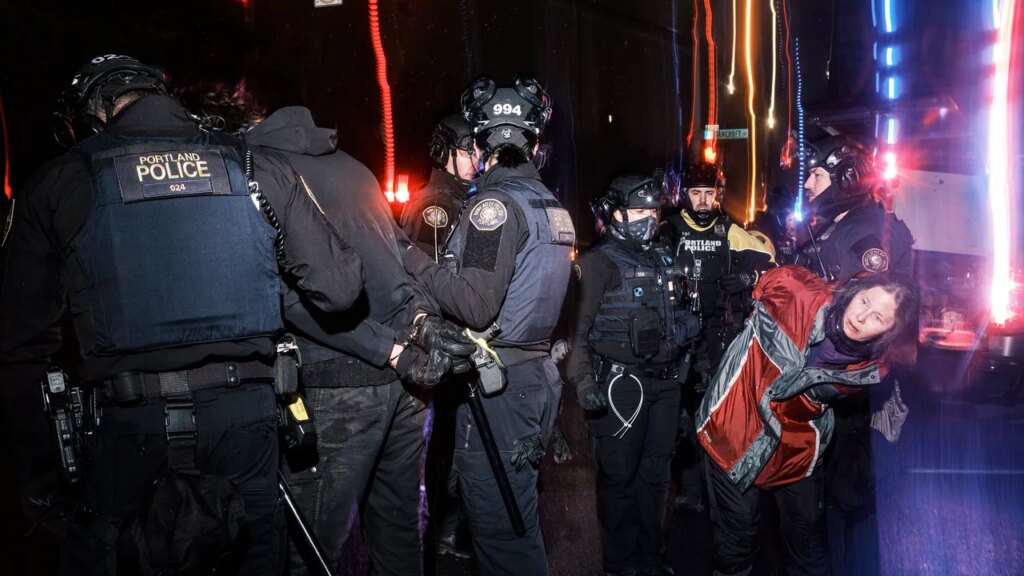
Hours later, Day held another press conference. Standing at the same podium, he was even more solemn than before. He recapped the events of the prior night, when hundreds of people outside City Hall and outside the ICE facility protested the shootings in Portland and Minneapolis. Six people had been arrested for disorderly conduct. And he announced that, after doing some digging into the department’s backlog of cases, there was “a nexus” between the shooting victims and Tren de Aragua. A shooting in the area, in July, 2025, had ties to one of the victims, he said. But he couldn’t say which victim, Nino-Moncada or Zambrano-Contreras, was connected to the prior shooting, or what exactly those ties were, although he noted that they were not identified as suspects. He could only say that, in the aftermath of the July shooting, a victim in that incident had told police that Tren de Aragua was involved. (An attorney for Nino-Moncada characterized accusations of his connection to Tren de Aragua as “without evidence,” while an attorney for Zambrano-Contreras said that the federal government “has a well-documented history of making false and inflammatory statements about immigrants, Venezuelans in particular.”) Day also said that Zambrano-Contreras had once been arrested for prostitution. (It was unclear if she was charged with a crime, or if Nino-Moncada was charged after his D.U.I. arrest. But earlier this week, Nino-Moncada was charged with aggravated assault of a federal officer, in connection with the Border Patrol shooting. He pleaded not guilty.)