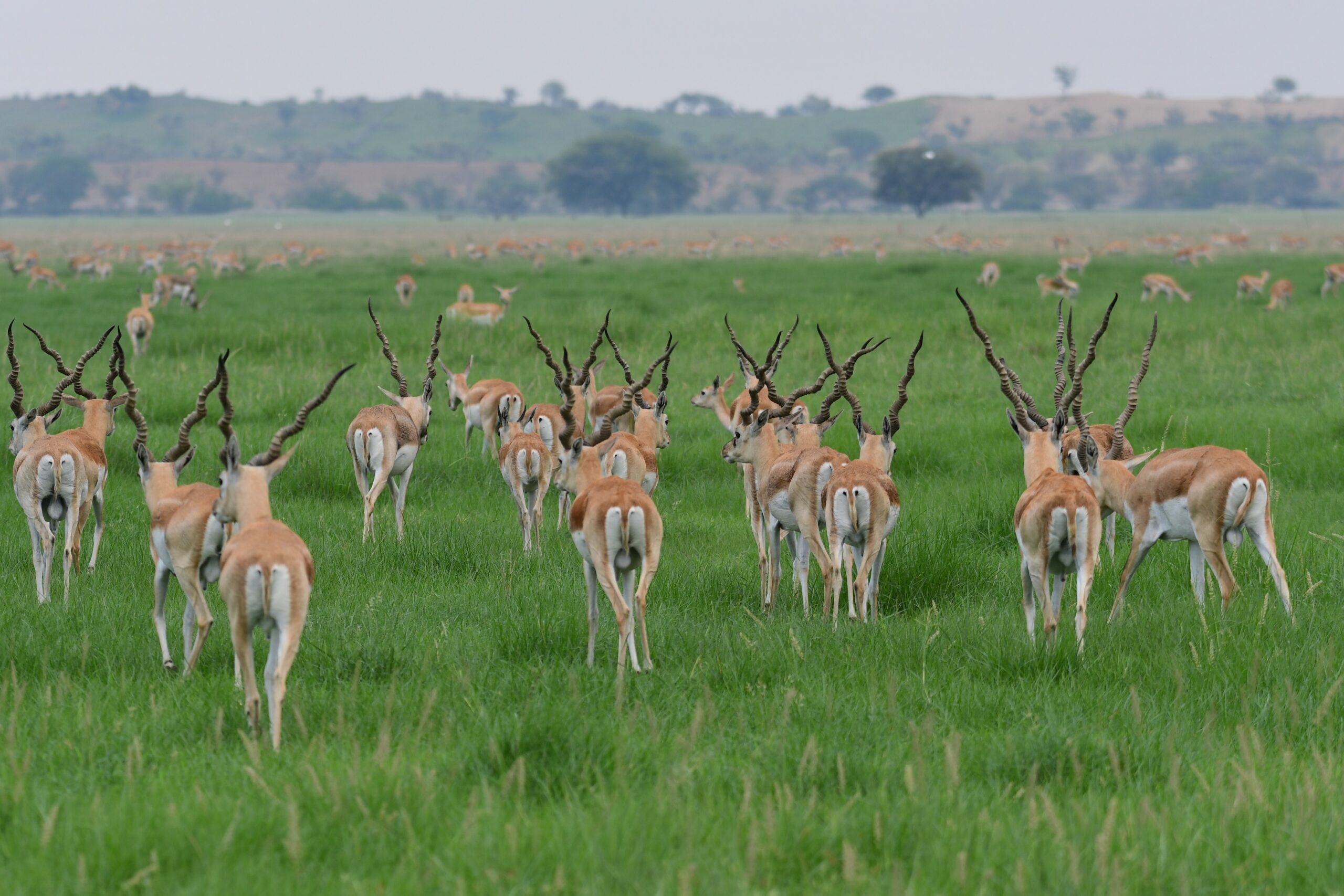
- Tal Chhapar Wildlife Sanctuary in Rajasthan was once a degraded grassland with its blackbuck population having to be fed food and water by the forest department.
- Restoration efforts in the grasslands, led by Surat Singh Poonia, now retired from the forest department, included the removal of invasive species and contour bunding for water management.
- In recent times, not only are the blackbuck and migratory bird populations increasing in Tal Chhapar, but restoration efforts have started in other parts of the state too, note experts.
It is difficult to imagine Tal Chhapar Wildlife Sanctuary in Rajasthan, which is a thriving grassland today, was once a mere skeleton of itself: brawny, dry and overrun by the invasive Prosopis juliflora plant. The condition was such that the forest department had to provide grass and water to the local blackbuck population during the harsh summer months. However, concerted efforts to restore the grassland, which included removal of the fast spreading P. juliflora plants and contour bunding for water management, bore results.
Now, Tal Chhapar, a seven-square kilometre wildlife sanctuary, has become a model of grassland restoration, paving the way for similar work in another degraded grassland, as well as development of grasslands in three other areas in Rajasthan. Whether this is seen microscopically, as revival of Tal Chhapar and its flora and fauna, or macroscopically, seen in the context of India’s massive loss of grassland, Tal Chhapar’s story is one of hope.
A struggling past
Tal Chhapar was declared a sanctuary in 1966, but invasive plants were taking over the landscape. “When I first came to Tal Chhapar as a range officer in 2007, I saw that it was overrun by P. juliflora and there were hardly any native species of grass left,” shared Surat Singh Poonia who retired from the Rajasthan State Forest Department as the Assistant Conservator of Forest (ACF) in 2018, and is credited to be one of the most important people behind Tal Chhapar’s restoration. ‘If there are no native species of grass, how will the animals survive?’ he wondered.
“The forest department had started feeding the blackbucks because of scarcity of fodder in the sanctuary. I would feel them myself. We would take water inside in bullock carts and the animals would follow us from behind. That made me think: if this continues, these animals would become dependent on us. What will happen to their wild instinct?” he reminisced.
Poonia noted that while the supplementary feeding of the blackbucks had been going on since before 2000, a major drought occurred in 2002, after which people started donating fodder for the animals. The forest department was also buying fodder at the time to feed the blackbucks. “After we started the restoration process of planting native species of grass, we bought fodder for one more year. In 2009 we stopped buying fodder,” he said. The contour bunding work, which was also done in 2007, started showing impacts such as an equal distribution of water and an increase in the ground moisture levels from the following monsoons, which also aided the growth of grass.
Tal Chhapar, in Rajasthan’s Churu district, was once the hunting ground of the erstwhile Maharaja of Bikaner. It was a well-maintained grassland; however, after India’s Independence, when it was handed over to the forest department, its slow degradation began. “There was lack of monitoring,” Poonia said, “People would uproot a local grass variety called mothia and sell its roots for consumption. The spread of Prosopis juliflora, the invasive species, was also a big contributing factor.”
These are some oft occurring reasons behind degradation of several other grasslands in India. In just a decade, between 2005 and 2025, India lost 31%, or 5.65 million hectares (mha), of grassland area, showed data the union government presented to the United Nations Convention to Combat Desertification (UNCCD). Grasslands are India’s most threatened ecosystems, a research article titled Grassland conservation and restoration in India: A government crisis, says. “…yet they have been neglected in conservation and restoration policy in India,” it adds. They play a critical role in livelihood and food security. The spread of invasive species is one of the main reasons behind grassland degradation.


Bringing in change
Tal Chhapar was no exception. Unlike the sight it presents today, “with 34 varieties of grasses, including mothia, dhaman, and ghoda ghaas (Sporobolus)”, according to the present Forest Range Officer of the sanctuary, Umesh Bagotia, who added that Tal Chhapar of that period wore a near barren look.
One of the first initiatives taken by Poonia then was therefore to remove P. Juliflora. It was an arduous task to uproot the plants. “Juliflora grows very fast. The locals then told us that applying lime after uprooting is effective in preventing its growth,” Poonia said. The P. juliflora clearing process was—and continues to be undertaken in the months of October and November, when the native varieties of grass turn yellow and it becomes easy to identify the green juliflora. “Birds and animals eat the pods of this plant, and seed dispersal therefore continues to happen. Hence, the removal of juliflora is a continuous process,” he added. Apart from removal of the invasive species, efforts were undertaken to replant native species of trees, including some of the slow-growing ones, such as acacia, salvadora and zizyphus.
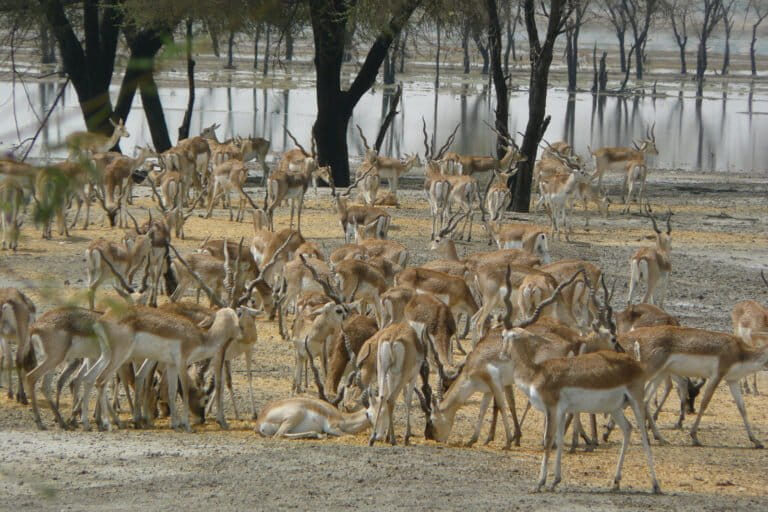
Rainwater management and contour bunding also played a crucial role in raising the depleted water table and restoring the grassland. “Contour bunding helps in the even distribution of the rainwater,” Poonia explained, “We also created small water leakages for the animals and birds.” The watering holes slowly came to life, providing water even through the harsh summer months.

The visible impact
As the restoration process slowly progressed, Poonia said that they started seeing more migratory birds in the sanctuary. At one time, he said, they had counted 104 migratory bird species. Latest estimates put the count at 333, he noted. In birding circles, Tal Chhapar is today known as a bird watcher’s paradise, well-known for sighting of raptors in particular. “Tal Chhapar also receives all the six species of harriers that visit India,” Bagotia added, “In the last two years we have started spotting a number of quails, and in 2022 we also spotted the long-eared owl.”
T. Ganesh of ATREE (Ashoka Trust for Research in Ecology and Environment) has been monitoring and tagging harriers in Tal Chhapar for over a decade now. “In 2008, a colleague from ATREE who was monitoring harriers, counted 20-25 of them. This year, in September, we counted more than 120 individuals,” he said. Grasslands are primary wintering areas of harriers.
Paving the way for similar restoration
The biggest jump in population however, has been of blackbucks. From 1,250 when Poonia had first come, the blackbuck population in Tal Chhapar is now over 5,000, he said, an overpopulation beyond its 1,000 capacity. The good news is that Tal Chhapar’s story of recovery is now being implemented in other degraded grasslands close by, and a blackbuck relocation plan to these areas has already begun.
About 15 kilometres away from Tal Chhapar is Jaswanthgarh Sanctuary in the Nagore district of the state. Since 2016, Poonia, who is now retired from the forest department but continues to work as a consultant, has been spearheading similar efforts on a portion of this sanctuary to restore the degraded grassland.
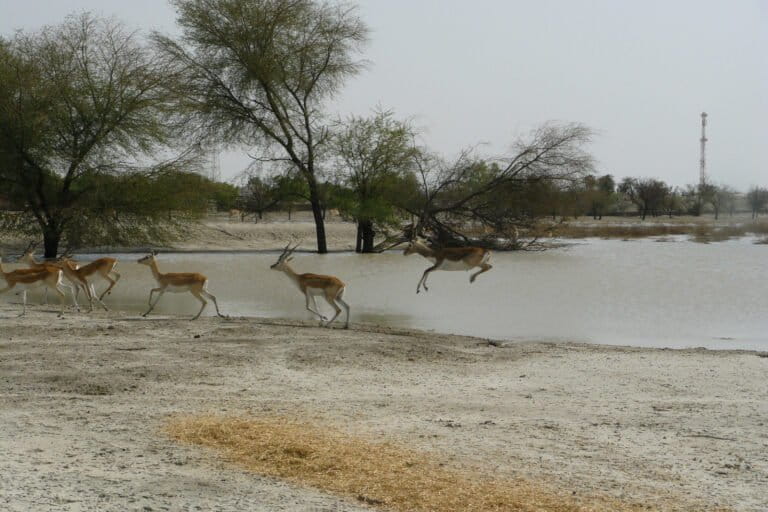
“Like Tal Chhapar, this area too was taken over by P. juliflora,” he said. As things began turning, 22 blackbucks from Tal Chhapar were translocated to Jaswantgarh which, Poonia said, was the first of its kind wild-to-wild translocation of blackbucks in India. Adding to this, Bagotia, the present forest ranger in Tal Chhapar noted that one of the translocated blackbuck recently gave birth in Jaswanthgarh, indicating that the animals are settling well.
Apart from restoration the forest department is now working on developing grassland on unclassified forest land in other areas in neighbouring areas and districts. “Work for this has already begun in Leelki Beed in Churu. Next, we will begin work in Fatehpur Beed and Jhunjhunu Beed,” Poonia told Mongabay-India. Blackbuck translocation will then take place in these areas, it is planned.
“Grasslands are not very glamorous but they are crucial,” Arijit Banerjee, Principle Chief Conservator of Forest (PCCF), Rajasthan, said, “They capture a lot of water and sequester a lot of carbon, almost as much as a dry deciduous forest. In a carbon-starved economy, we need this.” Studies say that restoring grassland biodiversity can accelerate carbon sequestration.
For Tal Chhapar, restoring its grassland has not just benefitted its native flora and fauna, but is also generating revenue for the local community through eco-tourism as it becomes a popular destination for birdwatchers and others. Banerjee, in a conversation with Mongabay-India, said that through such efforts the forest department wants to create a model that will inspire local people to protect the grasslands. “Intent is important. An arid, or semi-arid land, a desert, is not a wasteland. If locals can see how, by restoring or developing a grassland, they can also benefit, it will be worth our efforts,” he said.
Read more: A grassland gets a lifeline, offers a lesson
Banner image: Blackbuck population in Tal Chhapar has resurged over the years, with some even being translocated to Jaswanthgarh Wildlife Sanctuary, where the grassland has similarly been restored. Image by Umesh Bagotia.