- Lakshadweep’s smallest inhabited island, Bitra, is home to rich coral reefs and lagoons that host a wide variety of fish species. Generations of artisanal fishers depend on it for their livelihoods.
- The government plans to take over Bitra for defence use, owing to its strategic location.
- Conservationists and marine scientists fear that the development plans could keep the traditional fishers away, which could also threaten the island’s ecology.
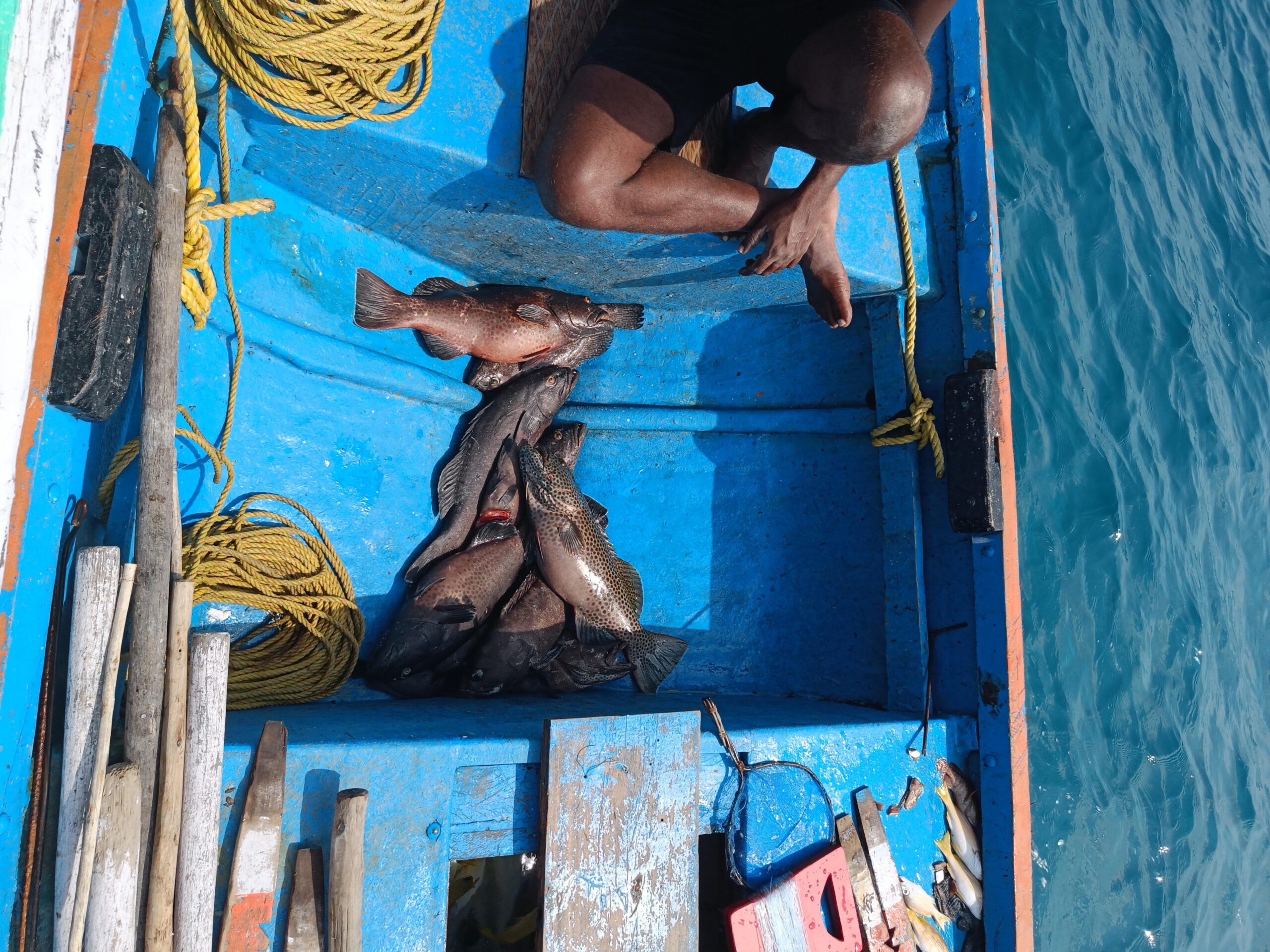
“A thousand leopards in a forest patch the size of a football field!” This is how marine conservation researchers Rucha Karkarey and Vardhan Patankar described unusually large shoals of squaretail groupers (Plectropomus areolatus) gliding along the coral reefs, off the shores of Bitra, an island in northern Lakshadweep. In 2010, Karkarey’s team recorded densities of over 3,600 fish in over four hectares — an area roughly the size of five football fields. “This was between two and six times higher than any density previously recorded across south-east Asia,” recalled Karkarey, who is now a senior research associate at Lancaster University, U.K.
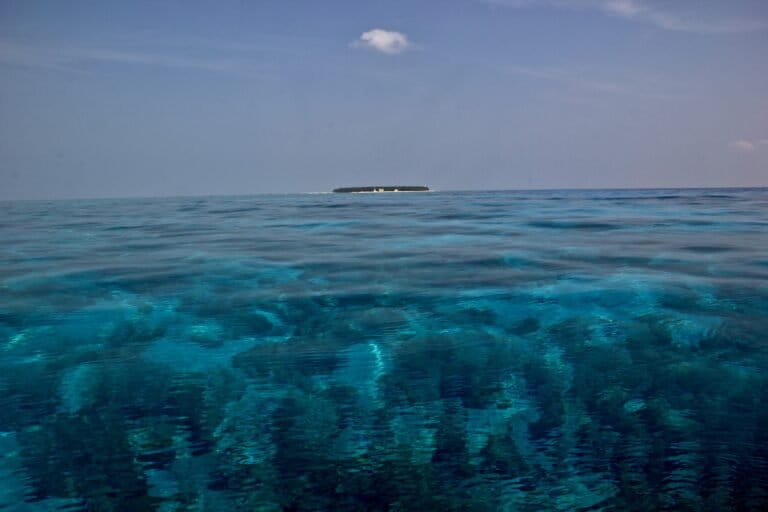
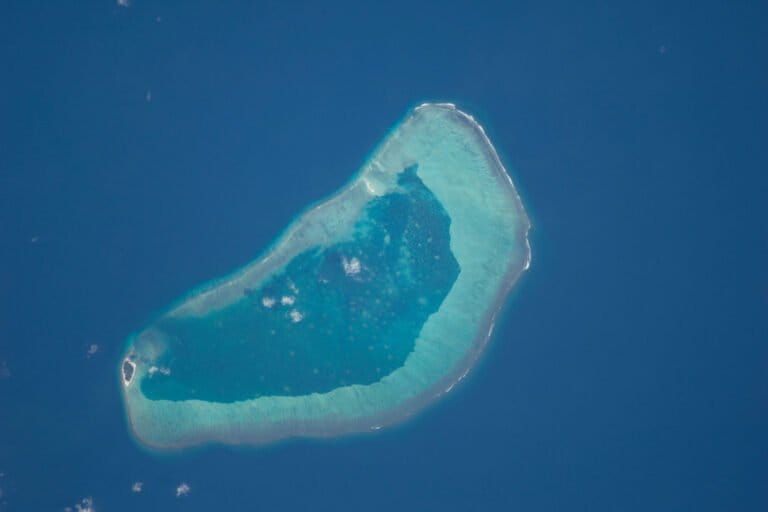
Geographically, the Union Territory of Lakshadweep comprises 12 atolls, three reefs, and five submerged banks. Out of a total of 36 islands in the Lakshadweep archipelago, with a total area of 32 sq km, only ten are inhabited. Among them Bitra is a tiny shark-fin-shaped strip of sand that is home to just about 271 people. The island is 570 metres in length and 280 m at its widest point, with an area of 0.105 sq km.
The smallest inhabited island of the archipelago with its ecologically-sensitive marine landscape, Bitra is now under spotlight. The Lakshadweep administration is planning to take over the island, because of its strategic location, its national security relevance, and the inherent logistical and administrative challenges associated with civilian habitation.
The islanders however, say this is “land-grabbing” for tourism, trade and development, especially in the post-COVID-19 tourism boom. “The islanders have been fishing here for generations,” said a resident who requested anonymity due to security concerns. “Our history dates centuries back. Of late, however, the local fishers fear they are losing their place,” they said.
Geostrategic imperatives
Bitra is located 483 km (261 nautical miles) from the port city of Kochi. “The move forms part of a larger national plan to boost defence presence on India’s critical island territories,” reported the CSR Journal. Along with recent upgrades to naval facilities in Minicoy and the Coast Guard presence at Androth, Bitra can strengthen surveillance of busy sea lanes, help counter illegal activities, and enable faster responses to maritime threats, the report noted, citing defence experts.
However, a move that could threaten the fishers’ livelihoods that depend on the lagoon may not be good for the local ecology, conservationists and marine scientists have cautioned in media reports.
“The island’s huge significance lies in its lagoon, the largest in the archipelago, a rich fishing ground,” said Ajith Raj, a doctoral scholar in the Transdisciplinary Sustainability programme at the Memorial University of Newfoundland, Canada. Islanders from elsewhere in the archipelago come here to fish, generation after generation, and they conserve these biodiversity-rich coral reefs, ‘rainforests of the sea’,” he noted.
Fishers as keepers
Much of Lakshadweep’s reefs are looked after by the traditional fishers. Conserving an archipelago with the highest rural population density in India — with over 64,000 people living in the ten inhabited islands of the archipelago, is very rare.
For instance, after an unusually severe El Niño in 1997-98 drove global heat records causing large-scale coral deaths, it was the local traditional fishing practices that helped Lakshadweep’s lagoon ecosystems recover, reported Rohan Arthur in his 2004 doctoral thesis. Arthur, who is currently a scientist with the Nature Conservation Foundation (NCF) specialising in oceans and coasts, explained that the pole and line tuna fishing — promoted by the government for economic development back in the 1960s — took away the pressure on reef fishing, allowing this speedy recovery. “Thus local regulations have played an important if inadvertent role in controlling marine resource in Lakshadweep,” he noted in his thesis.
Focusing on the fisheries dimension of this argument, Ishaan Khot from the University of Manitoba, Canada, and co-authors including Raj closely studied “live-bait pole and line tuna fishery” in Lakshadweep. Their 2024 study in Maritime Studies calls it a rare example of environmentally-sustainable, equitable livelihoods that ensures food security — an “outlier”. However, of late, traditional small-scale fishing that was once dominated by seven- to nine-metre-long artisanal boats, has been undermined by bigger operators. Boats that are bigger than 15 metres long entered the deeper parts of the lagoons, and the fishers increasingly used LED lights to attract fish at night, the study noted.
There were conflicts between commercial fishers and small-scale fishers. There was a shortage of smaller fish used as bait for tuna, Raj and colleagues found. Conservation groups such as Dakshin Foundation promoted co-management measures as a solution. However the COVID-19 pandemic disrupted such work, as “visions of maritime development that do not take local social-ecological contexts into consideration” took over, as the study noted.
Corals in warming oceans
The stewardship of the traditional fishers attains added significance in a global warming context that requires careful steps of local adaptation, as recent research shows. Gradual warming of the ocean and the cyclical El Niño Southern Oscillation (ENSO) events affect corals, explained researcher Wenzel Pinto, who works for NCF’s oceans and coasts programme. “They get bleached, and sometimes die en masse. Live corals decline,” Pinto told Mongabay-India. (ENSO) is a naturally occurring climate pattern involving periodic warming or cooling of the central–eastern Pacific Ocean and associated shifts in atmospheric pressure, which together drive major weather extremes worldwide.
There were global coral bleaching events in 1998, 2010 and 2014–2017. The fourth event, the biggest recorded, is happening now, the U.S. National Oceanographic and Atmospheric Administration (NOAA) confirms. “Bleaching-level heat stress” has impacted about 84.4% of the world’s coral reef area from January 2023 to September 2025, with 83 countries and territories reporting “mass coral bleaching”.
“Coral bleaching, especially on a widespread scale, impacts economies, livelihoods, food security and more,” scientists noted. However, when the stress driving the bleaching diminishes, corals can recover and reefs can continue to provide the ecosystem services, they added. If at all such recovery is possible, a more eco-friendly local resource use pattern is necessary for that, Raj told Mongabay-India.
“The ecological impact depends less on the mere presence of fishing and more on its intensity, methods, and the kinds of species people target.” Experiences in tropical coral reefs confirm this viewpoint.
Secrets of ecosystem recovery
In a new study of Lakshadweep published in Diversity and Distributions, led by NCF’s Mayukh Dey with Pinto, Arthur and Karkarey, noted, that over 24 years, coral cover declined from about 37% to 19%, reflecting a roughly 50% reduction from the 1998 baseline. “This decline was explained by reduced recovery rates after each bleaching event, despite coral mortality (both absolute and proportional) decreasing with successive events. Recovery rates dramatically increased after six years, suggesting a critical period of bleaching-free years needed for reefs to recover,” it stated.
Along the coral atolls and reefs of the Lakshadweep-Maldives region, traditional fishing also helped the plant-eating reef fish thrive. Such fish prevent excess growth of algae that could possibly smother corals, shows a new study published in the ICES Journal of Marine Science. It notes, “Over the past 1,000 years, the pelagic tuna fishery has kept reef fishing light in the Maldives, promoting the functional resilience of these reefs and buffering them from climate change-related disturbances, like mass coral bleaching events.”
While tuna fishing has traditionally been prioritised over near-shore reef fishing — possibly shaped by early Indian Ocean trade and a market for dried tuna — mass tourism and new forms of globalisation are now increasing demand for reef fish and disrupting these practices, the study said.
Lessons for Bitra
A “top-down push” for high-end tourism models with infrastructure development can harm the ecosystem, Khot’s study points out. Such a push keeps traditional fishers away from the lagoons and still opens up the water for more tourists and traders, Karkarey explained.
Traditional fishers who still follow their ancestors’ deep knowledge of the sea and the sky, and the modern reef anglers who catch tuna in the open ocean with pole and line to have conserved the reefs.
As Khot’s study notes, the “dominant developmental thinking manifests at local scales and trickles down to highly remote regions and induces vulnerability in small-scale fisheries.” That means conserving Bitra’s lagoon means recognising the rights and the key roles played by the artisanal fishers. “They are the stewards, the guardians of the sea,” Karkarey stated.
Read more: Tribal leaders allege pressure to surrender land for the Great Nicobar project
Banner image: A catch of squaretail groupers (Plectropomus areolatus). Image by Rucha Karkarey.