- Tigers migrating from reserves such as Bandhavgarh and Kanha are settling and contributing to Chhattisgarh’s growing tiger population.
- Chhattisgarh’s tiger numbers, which had fallen sharply in earlier assessments, have shown a notable recovery in recent years, with breeding populations increasing.
- Experts say protecting forests within the state is not enough; maintaining landscape corridors connecting reserves across central India is essential for continued tiger movement and long-term population stability.
In 2018, a young tigress stopped appearing on camera traps in Bandhavgarh Tiger Reserve in Madhya Pradesh. There was no official report of conflict as well as no records of carcass recovery or poaching incidents. This indicated that she had not died within the reserve.
However, for nearly three years, there was no photographic trace of her anywhere in the official monitoring grids of Madhya Pradesh.
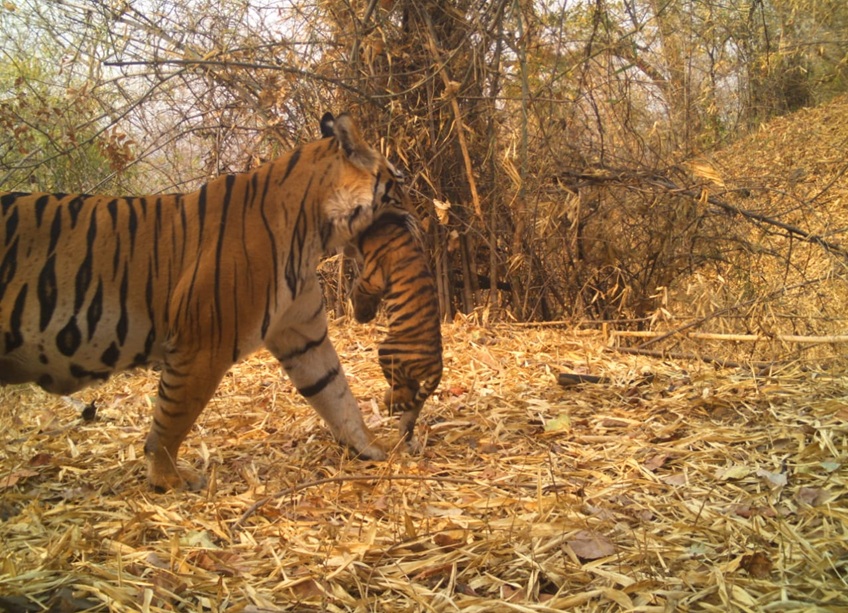
Then, in 2021, camera traps in Achanakmar Tiger Reserve (ATR) in the neighbouring state of Chhattisgarh captured a tigress moving through the sal forest with cubs trailing behind her. The stripe pattern verification confirmed what the field staff suspected. She was the same tigress. She had crossed over from Madhya Pradesh to Chhattisgarh – nearly 400 kilometres. Forest officials later named her Jhumri. In official monitoring records, she was catalogued as TK-8.
Experts say that when she disappeared from Bandhavgarh Tiger Reserve, she had reached dispersal age, a stage in a tiger’s life, usually between two and three years old, when remaining in the natal territory is no longer possible.
Bandhavgarh is one of India’s most densely populated tiger reserves. In such landscapes, ecological success creates pressure. When prey density is high and breeding females are established, cub survival increases. But territory is finite. Adult males hold defined ranges that overlap with resident females. Sub-adults, once independent, are gradually pushed outward, said Samir Kumar Sinha, head of conservation at the Wildlife Trust of India (WTI).
Jhumri is not an isolated example.
In early 2023, another movement reinforced this pattern. A young male tiger, identified as T-200, was recorded in Kanha Tiger Reserve. Later that year, he disappeared from Kanha’s monitoring grid. In December, camera traps in ATR recorded a new male. Stripe analysis confirmed it was T-200.
These movements are contributing to the increase in tiger numbers in ATR and in Chhattisgarh.
Sanket Bhale, Director of the Central India Landscape at the WWF-India, told Mongabay-India that tiger presence in ATR has gradually increased as observed over successive All India Tiger Estimation (AITE) surveys conducted every four years since 2010. One, three, and five tigers were recorded in 2010, 2014, and 2018, respectively, within ATR. The reserve now holds seven female and three male tigers, with regular dispersal from nearby reserves.
Recent monitoring suggests that around ten individuals currently use the reserve, including several breeding females.
Chhattisgarh’s overall tiger numbers, which had once declined, have begun to increase in recent years, doubling from 17 in 2022 to 35 in April, 2025. State authorities attribute this to strengthened anti-poaching enforcement, expanded camera-trap monitoring, habitat management, and renewed focus on maintaining forest corridors.
Chhattisgarh Chief Minister Vishnu Deo Sai stated that his government has made efforts over the past few years to create a favourable environment for tigers.
Speaking to Mongabay-India, he said, “The way the tiger population has increased in the forests of ATR indicates that the tigers are now thriving here. Tigers arriving from neighbouring states have also established their territories permanently. Our administration has worked closely with forest officials, local communities, and wildlife organisations to enhance habitat protection, strengthen anti-poaching measures, and maintain connectivity between forests. These coordinated efforts have made ATR an attractive home for tigers, encouraging both resident and migrant individuals to settle, reproduce, and expand the population steadily.”
Sinha said that three factors influence whether a dispersing tiger settles in a new landscape: prey base, safety, and the presence of a mate.
“If ATR is witnessing the breeding of tigers that have travelled from Bandhavgarh and Kanha, it indicates an improvement in forest conditions,” he said.

A forest-rich state with a fragile tiger population
Chhattisgarh was carved out of Madhya Pradesh in November 2000 as a new administrative state.
At the time of its formation, nearly 44% of Chhattisgarh’s geographical area was under forest cover, according to the Forest Survey of India. These forests form part of the Central Indian Highlands, one of the most important tiger conservation landscapes in the world.
The new state inherited potential tiger sites— Indravati Tiger Reserve in the south, ATR in the north, and Udanti-Sitanadi Wildlife Sanctuary. All three were later notified as tiger reserves. In 2021, Guru Ghasidas-Tamor Pingla Tiger Reserve was notified, spanning more than 2,800 square kilometres and strengthening ecological linkages toward Madhya Pradesh’s Sanjay-Dubri landscape.
However, when it comes to tiger numbers, Chhattisgarh’s story has not been as successful as that of Madhya Pradesh.
In 2006, Chhattisgarh recorded 26 tigers. By 2010, the number had stabilised. By 2014, the population stood at 46, showing fluctuation but limited long-term growth. In 2018, the All-India Tiger Estimation recorded 19 tigers in the state, indicating a decline from earlier years.
During the same period, Madhya Pradesh experienced sustained growth. From roughly 300 tigers in 2006, the number rose to 526 in 2018 and reached 785 in the 2022 national estimation, the highest in India.
Pran Chaddha, a conservationist and former member of the wildlife boards of undivided Madhya Pradesh and Chhattisgarh, told Mongabay-India that on paper, Chhattisgarh possessed many of the structural components required for tiger persistence — forest cover, prey base, river systems, terrain heterogeneity, and adjacency to strong source populations such as Kanha and Bandhavgarh. Yet the demographic trends told a different story.
The forests had not disappeared in Chhattisgarh. But their ability to retain stable breeding populations had weakened. Conservation scientists began describing parts of the state as functioning as a demographic “sink” — a region where mortality and instability prevent consistent reproduction and where persistence depends on immigration from neighbouring source landscapes, Sinha said.
Protected reserves remained intact islands of habitat. But the spaces between them — the corridors — began to narrow. Mining expansion in forested districts such as Korba, Raigarh, Sarguja, Koriya, and Surajpur increased pressure on habitats. Linear infrastructure, including roads, railway lines, and transmission corridors, intersected forested hill systems and fragmented landscape continuity. Agricultural expansion intensified edge effects around reserve boundaries. Hydrological changes altered riparian vegetation patterns, said one of the senior officials at WWF, who was not authorised to speak to the media.
Subhranjan Sen, Principal Chief Conservator of Forests (PCCF), Madhya Pradesh, told Mongabay India that prey availability in parts of Chhattisgarh remains limited, making it difficult for wildlife populations to sustain themselves.

A political boundary, an ecological continuum
When Chhattisgarh was carved out of Madhya Pradesh in November 2000, the ecological system did not reorganise itself along that line. For instance, the Maikal Hills along the northern boundary merged into the forest belt of Madhya Pradesh.
In large carnivore conservation, connectivity is not rhetorical. It is biological.
Chaddha explained that central India operates as a metapopulation system—a network of subpopulations connected by dispersal. In such systems, some reserves function as sources, producing surplus individuals because of high prey density and successful breeding. Others function as sinks, where local reproduction alone cannot offset mortality. “Without dispersal, isolated tiger populations face reduced genetic diversity. Inbreeding depression increases the risk of lowered reproductive success and higher cub mortality. Small populations become vulnerable to stochastic events, disease outbreaks, prey crashes, or poaching incidents,” he added.
The forest corridors linking Kanha, Bandhavgarh, Sanjay-Dubri, Guru Ghasidas, Achanakmar, Indravati, Udanti-Sitanadi, Nagzira, Tadoba, and Palamu form part of a wider Central Indian landscape spanning tens of thousands of square kilometres. Much of this land lies outside formally protected boundaries. Its future depends on land-use decisions that extend beyond wildlife policy.
Research across the Central Indian landscape shows that tigers often disperse along forested ridgelines and riparian strips. Even relatively narrow canopy corridors can function if disturbance remains below certain thresholds. What matters is permeability — the ability of a landscape to allow movement — rather than its legal classification, said Sinha from WTI.
A 2014 report by the National Tiger Conservation Authority (NTCA) has highlighted several bottlenecks affecting wildlife corridors in the region. It noted that the Kanha–Pench and Bandhavgarh–Sanjay-Dubri corridors pass through landscapes with historical poaching pressures and increasing infrastructure linked to coal mining. Corridors connecting Bandhavgarh to the sink habitats of Sanjay-Dubri and Guru Ghasidas also face risks from linear infrastructure associated with mining. In the Kanha–Achanakmar corridor, parts of the intervening forests are used for commercial forestry, and the report stresses that such activities must be carefully managed to avoid undermining the corridor’s function as a wildlife movement route.
Its 2022 report again raised concern, stating, “Although some habitat corridors exist that allow tiger movement between them, most of these habitats are not protected areas, and continue to deteriorate due to unsustainable human use and developmental projects, and thereby not conducive to animal movement.”
Fragmentation also brings new pressures. Livestock grazing, human activity, noise, artificial lights, and roads begin to appear along forest edges. Each break in the forest makes it harder and riskier for animals to move through the landscape, said Sen, the PCCF, Madhya Pradesh.

Jhumri’s movement suggested that at least one dispersal pathway between Bandhavgarh and Achanakmar remained functional.
Her arrival alone would not have signified recovery. Reproduction would. Her first litter in ATR experienced loss — one cub reportedly killed by a male tiger, forest officials informed.
But she bred again. In 2023, she successfully raised two cubs. Subsequently, she gave birth to four more.
Similarly, T-200 walked from Kanha Tiger Reserve to Achanakmar, an estimated 400–450 kilometres journey. The movement suggested that connectivity between Madhya Pradesh and Chhattisgarh had not collapsed. It had narrowed, but it remained biologically viable, Chaddha said.
Chhattisgarh’s tiger numbers, once declining, have shown signs of recovery in recent years. The state’s chief minister attributed this to strengthened anti-poaching enforcement, expanded camera-trap monitoring, habitat management, and renewed attention to corridor protection. Forest Survey of India reports have also indicated incremental increases in forest cover.
He credited his government’s conservation efforts for the improvement in tiger numbers. “Not only have tiger numbers increased, but Forest Survey of India data also shows a rise in Chhattisgarh’s forest cover,” he said.
However, Subhranjan Sen said corridor protection remains critical. “Corridors are natural, but in areas with heavy human presence, it becomes difficult for tigers to survive, and the challenge is even greater for breeding tigers. Chhattisgarh needs to work more on forest management,” he said.
Jhumri’s journey from Bandhavgarh to ATR highlights the importance of wildlife corridors. Her role in the growing tiger population in Chhattisgarh underscores a larger reality. Whether the state continues its demographic recovery will depend not only on protection within reserves, but on the permeability of the forests between them.
Read more: [Commentary] Connecting corridors for tigers in Central India
Banner image: Jhumri with her cub. Since arriving at Achanakmar Tiger Reserve in Chhattisgarh, she has had three litters. Image courtesy of Achanakmar Tiger Reserve.