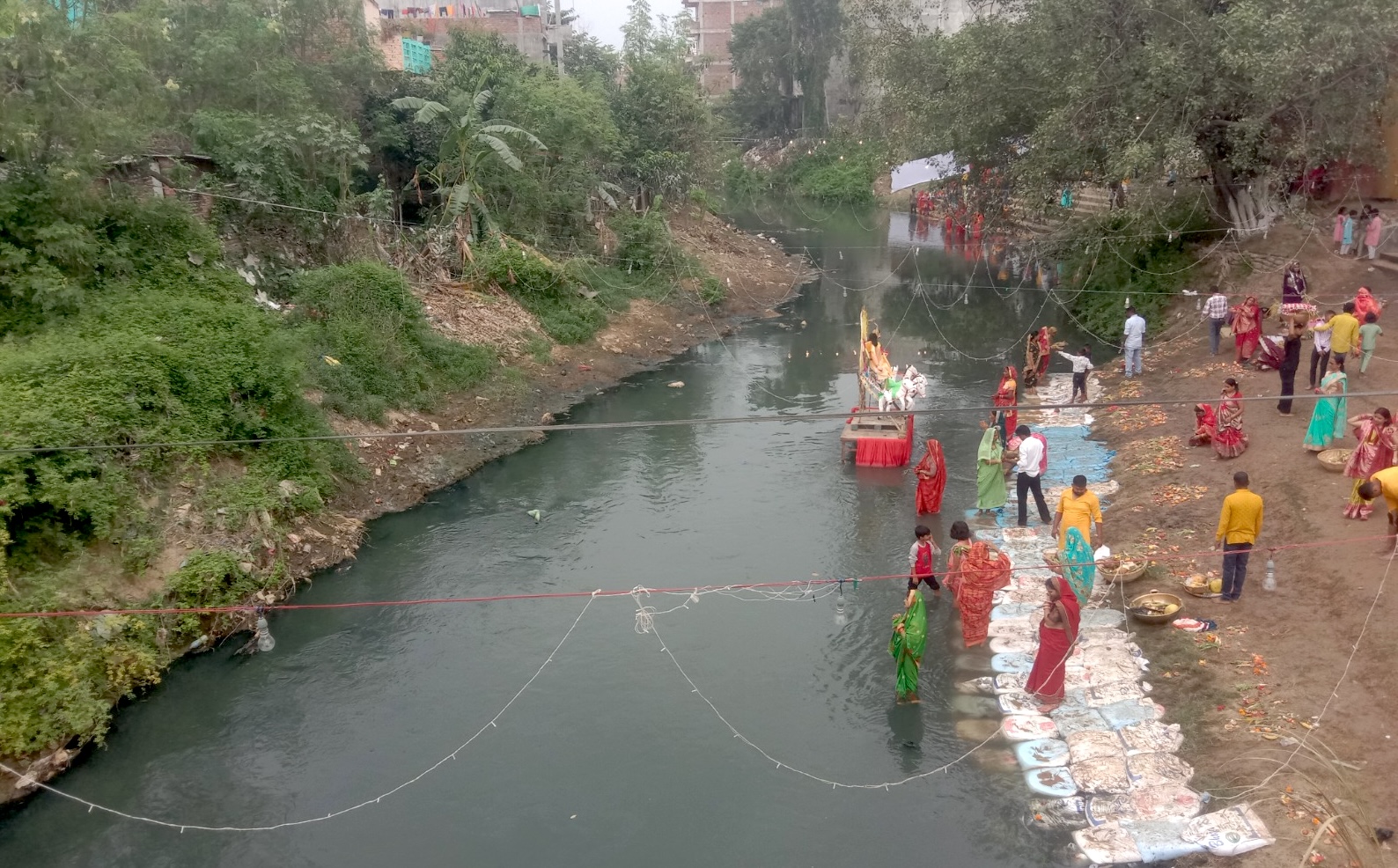
- The Sirsiya river, once central to daily life, agriculture and religious rituals in southern Nepal, is now heavily polluted with industrial waste and sewage, turning it into a public health hazard.
- Factories in Nepal’s industrial corridor discharge untreated effluents as weak enforcement, ineffective regulation and unimplemented wastewater plans allow pollution to persist.
- Pollution flows into Raxaul, India, contaminating water and harming crops, while residents on other side of the border say Indian efforts to treat local sewage can’t offset the influx from Nepal.
When 38-year-old Pradeep Kumar Bishwokarma was growing up in Ramgadhawa, a neighbourhood in southern Nepal’s industrial town of Birgunj, he would jump into the Sirsiya river to beat the summer heat as his mother washed clothes and residents drew drinking water from it.
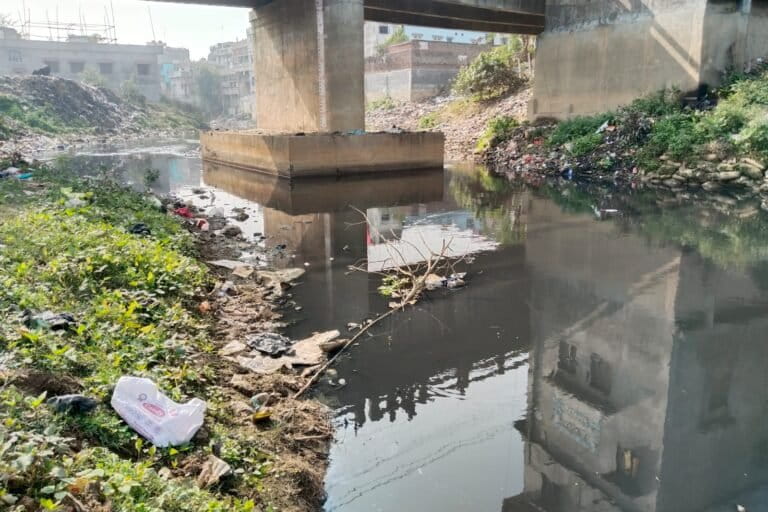
Today, Bishwokarma and his fellow residents of the border town cover their noses with a handkerchief whenever they pass by the river that was once their village’s lifeline. The flowing liquid no longer resembles a river. It is thick and black as if a truckload of oil had been dumped into it. The air around the river feels heavy with the stench of sulphur and rotting organic matter.
“This is no longer a river,” Bishwokarma said, pointing toward it. “It has become an open drain for factories, and we haven’t just lost a river, we’ve lost our self-respect,” he added.
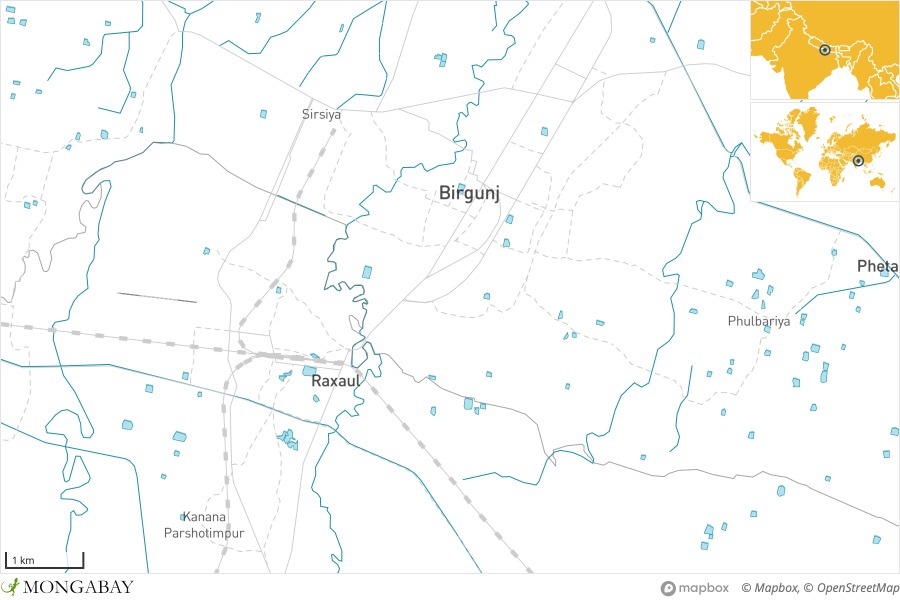
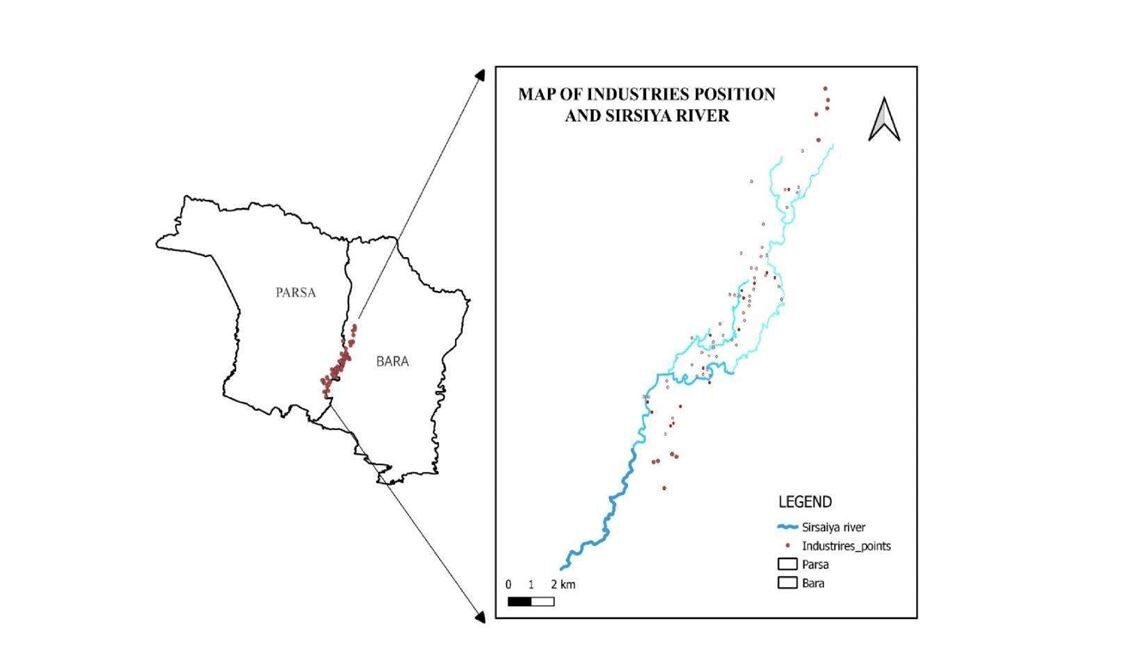
The river, which was once a crucial part of daily life, religion and agriculture in Bara and Parsa districts, is one of the 6,000-odd rivers and rivulets flowing into India from Nepal. It begins its journey from the Ramban Jhadi (forest) of Bara district farther north and passes through Nepal’s largest industrial zone, the Bara-Parsa corridor.
Today, ineffective environmental regulation and poor coordination among government agencies have allowed factories to dump untreated industrial waste and sewage into the river. Even after decades of protests, multiple court cases and government committees and unimplemented wastewater treatment plans, the river remains a public health hazard, damaging local culture and ecosystems not just in Nepal, but also across the border in Raxaul in India’s Bihar.
The Bara-Parsa industrial corridor is home to approximately 1,200 small and large factories. For decades, the area, touted as Nepal’s “industrial capital,” has served as an engine of the country’s economy, producing goods ranging from leather and textiles to steel, soap and ghee, providing employment to thousands of people. But this economic growth has come at a severe environmental cost.
According to a 2010 report by the Sirsiya River Monitoring Committee, at least 47 large factories discharge waste directly into the river. By 2026, environmentalists say, the number has risen to more than 60.
“The pollution profile of the Sirsiya is extremely complex,” said Binod Gupta, an environmental chemist based in Birgunj. “You find chromium from leather industries, sulphuric acid from chemical plants and toxins from paper mills. During the dry season, about 80% of the river’s volume consists of industrial wastewater,” he added. This means that ironically, during the dry season, most of the water flowing in the Sirsiya consists of industrial effluent. “If industrial discharge is stopped, the river would dry up,” a government official said.
The impact of the sewage on the river’s ecosystem has been severe. A study by researchers at B.R.A. Bihar University found that once industrial waste entered the river, zooplankton communities, considered the foundation of aquatic ecosystems, would be almost entirely annihilated, turning the river into a biological desert.
For Hindu communities living along the banks of the Sirsiya, the river’s decline is not only a health crisis but also a spiritual one. During the Chhath festival, one of the biggest in the Indo-Gangetic plains, devotees traditionally stand in the river to offer prayers to the sun. In recent years, the number of people performing Chhath rituals in the Sirsiya has dropped sharply. Those who still do enter the water often suffer from skin ailments, allergies and infections.
“We used to cook ritual offerings using this river’s water,” said 60-year-old Naina Pati Devi, who lives along the riverbank. “Now, we feel disgusted even putting our feet in it. During Chhath, which falls in October/November, the factories stop dumping waste for a few days.
“It is as if they are doing us a favour, and the water looks slightly cleaner. But from the third day, the same black sludge returns,” Devi said.
Article 30 of Nepal’s Constitution guarantees every citizen the right to live in a clean and healthy environment. Section 111 of Nepal’s Muluki Criminal Code contains provisions for prison sentences of up to three years for those found polluting drinking water sources. But all of that is on paper.
Lawyer Surendra Kurmi, who leads the Sarisawa River and Pollution-Free Birgunj Campaign (Sirsiya is also known by the name Sarisawa), has been fighting a legal battle to rejuvenate the river since 2018. He filed a public interest litigation case against Birgunj Metropolitan City and 10 large factories for polluting the river.
“The court initially dismissed the case, saying it should be initiated by the public prosecutor,” Kurmi said. “The police said it’s the chief district officer’s [CDO’s] responsibility, the CDO passed it on to the municipality, and the municipality argued it lacks the technical capacity to regulate the factories.”
In 2019, the Janakpur High Court finally issued a directive ordering Birgunj Metropolitan City to take effective measures to control pollution. Yet seven years later, little has changed.
Once the river crosses the border into India at Raxaul, pollution becomes a diplomatic issue between the two countries sharing an open border.
Subhash Kumar, a resident of Raxaul, said the river’s pollution has contaminated local groundwater. “Even in summer, we have to keep our windows closed because of the smell. We can’t irrigate our fields because the water kills crops. We are receiving industrial waste from Nepal, but there’s nowhere to lodge a complaint.”
The Indian government has approved a sewage management project costing ₹ 746.4 million ($8.21 million) to treat Raxaul’s own wastewater. According to Pramod Kumar Sinha, a Bharatiya Janata Party legislator from the Raxaul constituency, work is underway to treat water from major drains at three locations before releasing it into the Sirsiya river.
However, Indian officials acknowledge that unless waste flowing from Nepal is stopped, the river will never be clean. The Raxaul town has been identified as the only source of sewage generation within the Sirsiya river’s catchment area on the Indian side.
Ranjit Singh, president of Swachh Raxaul, said he received no response even after traveling to Nepal to stage a protest against river pollution. He holds industries in the Bara-Parsa corridor responsible for destroying the river and warns that if pollution is not stopped, residents of Raxaul are prepared to block raw materials going to Nepal’s industries and halt the export of finished goods.
Back in Nepal, industrialists in the Bara-Parsa corridor say a large-scale effluent treatment plant is needed in Nepal, as most factories in the area are small and medium-sized and can’t afford to build and operate individual treatment facilities.
“A common treatment plant is the only sustainable solution,” said Hari Gautam, Chair of the Birgunj Chamber of Commerce and Industries. “The government should build the infrastructure; industries are ready to pay service fees.”

Nepal’s Ministry of Industry, Commerce and Supplies, through its Industrial Infrastructure and Environment Division, has conducted a feasibility study for an effluent treatment plant for discharges from industries in the Birgunj-Pathlaiya section. The study identified 18 types of pollutants from 16 categories of industries and found that 122 industries are directly discharging wastewater into the river. The study recommended three treatment units with a combined capacity of 13.4 million litres (3.5 million gallons) per day, at an estimated cost of about 2.5 billion Nepali rupees ($17 million). “We have prepared a proposal worth 2.5 billion Nepali rupees,” a government official said, “But it requires allocation from the federal budget.”
Meanwhile, patience among the younger generation is wearing thin. A group of youths running the Save Sirsiya Movement since late 2025 have begun delivering bottles of polluted water from the river to the gates of government offices and also hanging them on the doors of the Birgunj Chamber of Commerce and Industries.
Caught between protests, court orders, committees and promises, the Sirsiya river continues to carry black water, flowing past homes, temples, fields and across an international border.
For Pradeep Kumar Bishwokarma, assurances and committees no longer carry any weight. “Every year a new committee is formed, and every year new promises are made,” he said, looking at the black water. “But the river only gets darker. We grew up with this rive. Now we are forced to live with poison.”
Citation:
Siddique, S. (2018). Effect of sewage pollution on zooplankton community of Sirsiya river at Raxaul, India (JETIR1802264). Journal of Emerging Technologies and Innovative Research (JETIR), 5(2). Retrieved from https://www.jetir.org/papers/JETIR1802264.pdf
This story was reported by Mongabay’s global team and first published here on our Mongabay Global site on January 21, 2026.
Banner image: Pilgrims observe the Chhath festival on the banks of the Sirsiya. Image by Suresh Bidari.