
- Rann of Kutch in Gujarat changes its appearance every year, as tidal currents from the Gulf of Kutch flow onto this white desert during monsoons.
- An earthquake in 1819 changed the fluvial systems and affected the human settlements and supporting infrastructure.
- Today, the land of Agariyas who practice salt farming, faces threats from industrial development, poaching, climate change and renewable energy projects.
- The views in the commentary are that of the author.
Have you ever heard of a desert that disappears every year, only to return? Rann of Kutch is a landscape where a shallow sea floods the land for a few months each monsoon. During the monsoons, tidal currents from the Gulf of Kutch flow onto this white desert, transforming it into an inland sea. As the monsoon retreats, the waters recede, leaving behind an endless stretch of snowy flats.
Migratory birds like flamingos descend upon the newly formed lake, where they feed on fish and hatch their young on the fringes of the marshes, which then turn green. But this doesn’t last forever. Come summer, the water recedes, the earth dries, and you see a land that stretches to the horizon — snow white, with shiny crystals of salt. This is the Rann of Kutch in the western Indian state of Gujarat, where a desert changes its appearance with the seasons, year after year. The features are not permanent; they come and go.
Derived from Hindi, rann means salt marsh, and Kutch refers to an alternately wet and dry place. This large area of salt marshes, called the Rann of Kutch (also spelt Kachchh), stretches across the border between India and Pakistan. Much of it lies in the Kutch district of Gujarat and extends into Sindh in Pakistan.
Occupying around 26,000 square kilometres and extending east to west, the Rann of Kutch is divided into the Great Rann and the Little Rann. This “marsh of alluvium” is home to India’s most extensive salt plains. The spectacular landscape, which shimmers under a blazing sun and sparkles under a moonlit sky, remains less explored, even by tourists. To its north lies the Thar Desert, to its south lie the hills of Kutch, and to its west lies the Indus River Delta.
The transformations from desert to expansive salt pans are just a brief reminder of what the present landscape was, only a few hundred years ago: located by the sea and crisscrossed by rivers and sea inlets that provided an ideal transportation network for traders from across the globe, including the ancient settlers who lived there about 4,500 years ago.
An earthquake-sculpted landscape
Seasons bring unique ecosystems; a salt-based economy; the landscape attracts tourism and much more. The salt pans of Kutch, the largest salt-production areas in India, hold a history dating back to their geological origins. This land was the site of a large earthquake on 16 June 1819. Shaped by such tectonic events — including at least three large earthquakes over the last 1,000 years — the Rann presents one of the most dynamic landscapes on Earth.
The evening of June 16, 1819, was like any other day in the Great Rann of Kutch and the southern parts of Sind. At around 6:50 p.m., the sunset was as spectacular as ever — and that is when the ground shifted. Captain MacMurdo, a British Political Resident stationed in Bhuj, the district headquarters, described the pre-earthquake dawn as “a day that had been cool and showery; Fahrenheit’s thermometer ranging from 81° to 85°. The monsoon had set in mildly… The wind, which had been blowing pleasantly towards evening…” Then came the earthquake, described as: “The first and greatest shock took place on the 16th of June 1819, a few minutes before seven in the evening…” This is an excerpt from an article presented at the Literary Society of Bombay on April 28, 1820.
The day after the earthquake, the local people woke up to an unbelievable sight. Along the northern fringes of the Rann, they saw a mound that had sprung up during the earthquake. Rising three to five metres off the ground and stretching in an east-west direction, the mound was a sight to behold — an 80-km-long scarp that local residents call the “Allah Bund” (the Mound of God), extending into Pakistan. It stood silhouetted against the low hills of the distant Nagar Parker ridge.
The earthquake did something unusual to the ground: it uplifted the northern fringes of the Rann, forming a mound that blocked the Nara (Puran) river, a distributary of the Indus that was flowing through the Rann to the Gulf of Kutch. The river was a trade route for coastal and inland merchants in Sindh Province. The immediate vicinity of the earthquake was not highly populated at the time. A brick fort at Vigakot, located on the banks of the Puran River and used as a tax collection centre at that time, collapsed. A site of the 1965 India-Pakistan war, the remnants are still visible there, with the red bricks of the ruined fort protruding from the sand over a large area.
The earthquake originated in the northern part of the Great Rann, but severe damage was reported in distant cities in Pakistan and India. The maximum impact was felt within a 70-kilometre radius of the epicentre. About 7,000 houses were destroyed, and more than 1,500 people died in the towns of Bhuj and Anjar.
The earthquake also caused significant changes to the fluvial systems. It is reported that areas south of Hyderabad in Pakistan, experienced changes in river channel flows. Approximately 300 km from the epicentre, at Ahmedabad, the ground shook severely, and the spire of a distant 450-year-old mosque toppled. It was the first large, historically documented earthquake to affect the region’s human settlements and supporting infrastructure, including waterways and revenue outposts.
The Allah Bund transformed both the landscape and our textbook knowledge of earthquake-sculpted landforms into an awe-inspiring, real-time experience.


Long-term geological changes
The 1819 earthquake is a classic case of a natural agency that demonstrated the duality of destruction and construction, functioning as a primary mechanism for both sudden devastation and long-term geological reshaping. While they are immediately recognised as natural disasters, causing extensive damage to infrastructure and loss of life, they simultaneously act as nature’s architects of the Earth’s surface by elevating landscapes and forming new geographical features.
Charles Lyell, the author of The Principles of Geology, published in 1830-1833, believed the event marked a watershed moment in the history of seismology and used it as a classic example to describe surface deformation. Simon Winchester in his 2003 book Krakatoa: The Day the World Exploded), wrote that it “presented a distant prospect of where the forces of the world were at work, a place of elemental significance, and a disastrous place once — these days quiet again, serenely biding its time.”
The earthquake also produced many secondary features, such as liquefaction — a quicksand condition generated by high pore pressure induced by earthquake ground shaking. The sand blows formed by liquefaction are still preserved in various parts of the Rann. All these phenomena were new to 19th-century geologists. The Allah Bund earthquake was one of the earliest documented examples of surface faulting, in which rocks on either side of a fault plane are displaced due to tectonic forcing. During this earthquake, as one side of the Rann rose by four–five metres, the other side subsided to a lesser degree. The quicksand condition developed on the downfaulted part of the tidal channel connected to the Puran River caused the famous Sindhri Fort, located there and which controlled river traffic, to settle and sink.
The Rann of Kutch was still under the sea when Alexander the Macedonian king reached the western part of the Indian subcontinent. The history of this region has been well documented for over 2,000 years. For example, some ancient scholars have noted the disastrous sea-level variations in the Indus Delta and its consequences for the Macedonian fleet during Alexander’s military campaign in 326/327 BCE. The proto-historical Harappan settlers in Dholavira, at the eastern extremity of the Rann, may have used the shallower sea at the time for trade—that is, about 4,500 years ago. The evidence suggests that eventually the land was forced to rise above sea level to form the Rann of Kutch, due to tectonic movements.
The geographical notes by Robert Sivewright, written in 1907, apprise how the Rann of Kutch was transformed from a shallow sea inlet into a tidal flat. Sind was invaded by the Arabs in 712 CE, and the Arab chroniclers of the conquest furnish information on the delta’s growth. After the Arab conquest of Sind, the sea remained navigable for hundreds of years, though it was much shallower than it was during Alexander’s time. The Rann had been gradually getting shallower and was cumulatively raised by the vertical forces that precipitated occasional large earthquakes, such as the one in 1819, to facilitate a niche for species to flourish and humans to live.
Rann of Kutch today
This is the land of the Agariyas, who have lived here for centuries, knowing just one means of livelihood—salt farming. Large chemical and salt companies often extract brine more intensively, lowering the water table and concentrating toxic byproducts. Agariyas, working on small family plots, cannot compete with them. Working day in and day out under a fierce sun from October to June, they grow salt in square-shaped salt pans. Gujarat produces 76% of India’s salt and Little Rann of Kutch contributes almost one-third of it. The square salt pans the Agariyas tend are not alien structures; they are integrated into the Rann’s saline desert hydrology.
Families often live in makeshift huts on the salt flats, with limited access to clean water, electricity, or healthcare. While focusing on charismatic species (wild ass, flamingos) or industrial GDP, the indigenous, landless or semi-landless salt farmers — with no formal title to the land they work — are rarely at the negotiating table. Climate change has made monsoon rains more erratic and intense. Unseasonal rain in March or April can dissolve months of salt crystals in hours, wiping out a family’s entire annual income. The “delicate balance” that humans negotiate also includes the right salinity, water depth, and drying time.

Conservation efforts, such as the Indian Wild Ass Sanctuary and Chhari Dhand Wetland Reserve, aim to protect this unique biome and its inhabitants amid increasing environmental pressures.
The Rann faces numerous threats from industrial development, poaching, and climate change, which jeopardise its delicate balance and the livelihoods of local indigenous communities. The region is currently being transformed into a hybrid renewable energy park with significant portions dedicated to solar panels and wind turbines by major industrial houses. The development of large-scale solar projects in the Rann presents a conflict between global climate goals and local ecological protection. One of the major concerns is that the harsh saline environment causes rapid corrosion, leading to potential structural failure of solar panels. Such corroded panels could fall to the ground and mix with the soil. Experts and activists argue that the industrialisation of this landscape poses significant threats to its fragile biodiversity-rich ecosystem.
After the devastating 1819 earthquake, residents of Kutch developed the innovative circular design of the bhunga (a traditional mud hut) to minimise damage to life and property. This revised bhunga design, now nearly 200 years old, remained standing during the 2001 Bhuj earthquake, despite being very close to its epicentre. This traditional home-building innovation shows that the Rann is not just an abstract “unique biome”; it is a living, working landscape.
Its future — and that of the Agariyas, the wild ass, the flamingos, camels, and the salt pans — depends on whether conservation and development plans can move beyond exclusion toward community-led, ecologically sensitive coexistence. The story of the Rann of Kutch reminds us that in the wake of destruction, whispers of hope and new life can also emerge from the shadows of forgotten or ruined places.
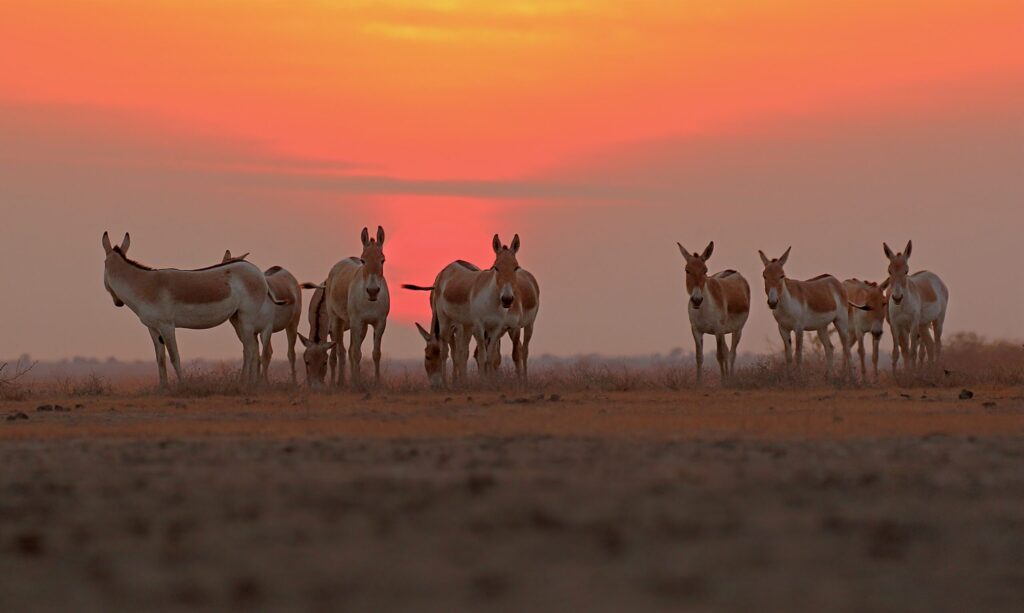
Banner image: A herd of wild asses photographed against the setting sun in Little Rann of Kutch. Image by Shaunak Chitgopkar via Wikimedia Commons (CC BY-SA 4.0).
CP Rajendran is a geoscientist and an adjunct professor at the National Institute of Advanced Studies, Bengaluru.
Read more: Traditional salt workers contribute to wild ass conservation and regain access to Little Rann of Kutch
Citation:
- Rajendran, C.P. and Rajendran, K. 2024. The Rumbling Earth: The Story of Indian Earthquakes, Penguin Random House, 256p.
- Rajendran, C. P. and Rajendran, K. (2001), Characteristics of deformation and past seismicity with the 1819 Kutch earthquake, northwestern India. Bulletin of the Seismological Society of America, Volume 91, pages 407-426.

