
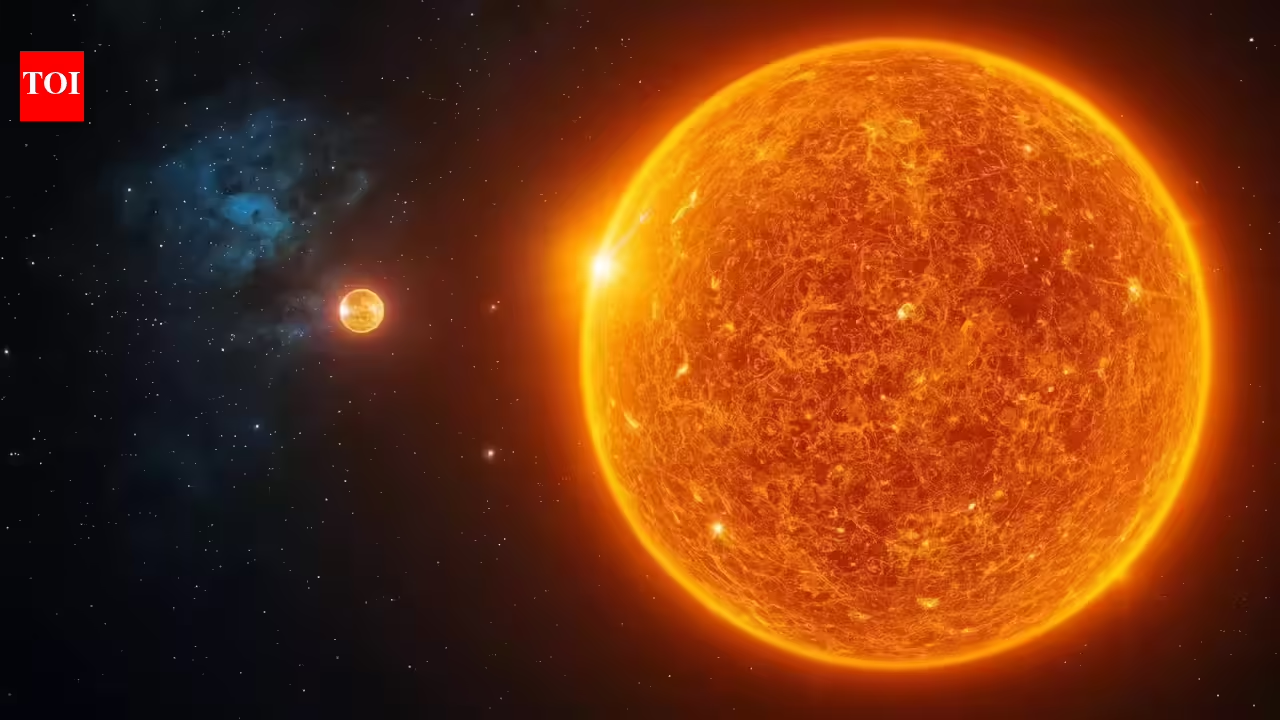
Far beyond the Milky Way, in a nearby satellite galaxy, a giant star has been shifting in a way astronomers did not expect. The star, known as WOH G64, sits inside the Large Magellanic Cloud, roughly 163,000 light-years from Earth. It is enormous, about 1,540 times wider than the Sun and close to 30 times more massive. For years, it was classed as a red supergiant, a late stage in the life of massive stars. Those stars are usually expected to end in a supernova explosion. But recent observations suggest WOH G64 is no longer behaving like a typical red supergiant.
One of the universe’s biggest stars is changing faster than expected
Since the 1970s, scientists have described WOH G64 as one of the most extreme red supergiants known. It appeared cool, very luminous and heavily surrounded by dust. Red supergiants are ageing massive stars that have expanded and cooled after burning through much of their core fuel. These stars are unstable, but they tend to change slowly over thousands of years. That is why what happened next drew attention.Around 2014, the light from WOH G64 began to change. It grew bluer and hotter. Its spectrum, which shows the chemical fingerprints of a star, shifted dramatically. Features typical of a cool red supergiant faded. Warmer signatures appeared instead.Astronomers concluded that the star had likely transitioned into a yellow hypergiant. This is a rare and short-lived phase in the evolution of very massive stars. Yellow hypergiants are hotter than red supergiants and highly unstable. They can lose huge amounts of material into space. The change was unusually fast by stellar standards. In human terms, it was gradual. In cosmic terms, it was abrupt.
Mass loss and binary interaction may explain the change
Researchers have suggested two different major explanations. The first is that WOH G64 might have thrown out its outer layers in a gigantic eruption, by which the inner hotter areas would be exposed, resulting in the increased surface temperature. The second theory is related to the companion star. There is some evidence that WOH G64 is a massive symbiotic binary system. If that is the case, then the interaction between the two stars through which one star causes loss of material from the other or shakes the outer atmosphere, resulting in the transformation, can be seen. Both hypotheses implicate heavy mass loss. That is one of the main processes influencing the fate of massive stars.
The future remains uncertain
Whether WOH G64 will soon explode as a supernova is not clear. It could remain unstable for a long period before collapsing. Some massive stars may even collapse directly into black holes without a bright explosion.For now, astronomers are watching. The star offers a rare chance to observe stellar evolution unfolding in near real time. It does not provide answers yet. It does show that even well studied stars can still shift in unexpected ways.