The sun rises early at this time of year, hitting the south of the beach first before chasing the shadows north, the gradual retreat of the darkness to the light.
Hanukah, the Jewish festival of lights, was being celebrated here on Sunday evening, when the darkness came brutally roaring back.
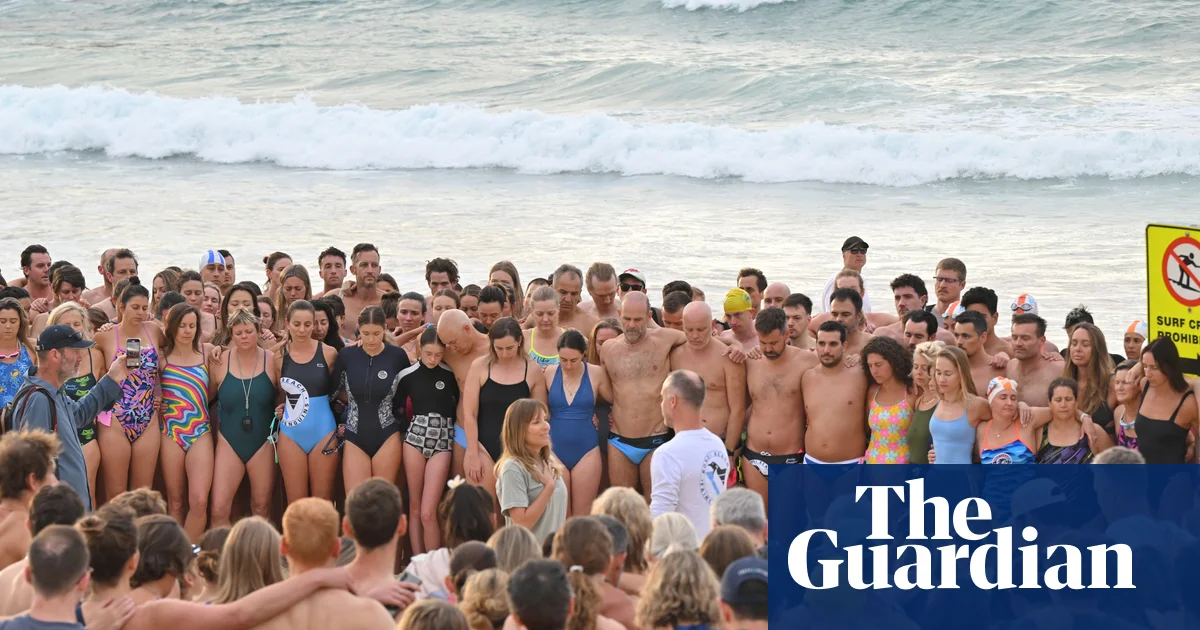
At dawn on Friday, people came in their thousands, in their many colours and their many tribes, to be back in the sea.
“In this time of darkness, let’s spread light, love and compassion,” the crowd was urged, before thousands took surfboards and rescue boards, or simply swam out to join together in a mammoth circle in the sea, facing the middle of the beach.
That solidarity is holding, for now. In the water, it feels strong and loving.
But back on land, across Sydney and the rest of Australia, that unity is taut and fragile. Undercurrents of political division, of a politicisation of a community’s grief, of a fraying social cohesion, are breaking through the surface.
The water helps to forget. But some things cannot be undone.
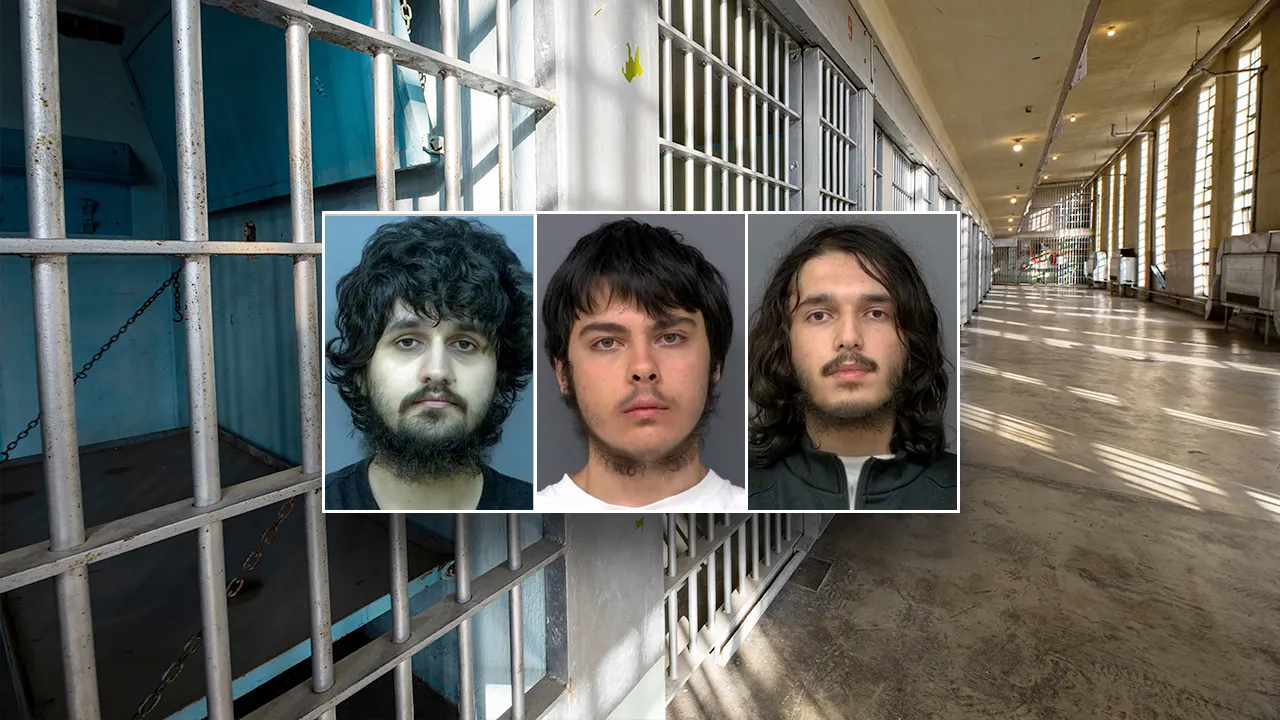
Fifteen innocents were shot dead here in minutes by high-powered rifles allegedly carried by the father and son, Sajid and Naveed Akram. Sajid was shot dead. Naveed was shot too, but survived. From hospital, he has been charged with dozens of offences, including terrorism and 15 counts of murder.
The footbridge from where the gunmen fired has been reopened. On the wall, someone has sketched a menorah in chalk. There is a bee drawn too, in remembrance of the youngest victim, 10-year-old Matilda.
But the bridge that was once the passage of thousands of innocent visits to the beach each day will be forever marked now. A stain that cannot be erased, a memory that cannot be forgotten.
The park too: the site of Hanukah events for years, the place of kids’ birthday parties and work barbecues and scratch games of cricket, where exhausted City to Surf runners sprawl on the grass after the finish of Sydney’s classic 14km run and van-life nomads hang their washing.
A city on high alert
The attack was recorded on dozens of phone and dashboard cameras. The calm cruelty of the shooters, firing round after pitiless round into a defenceless crowd of men, women and children lighting candles in celebration of their faith.
At one point one can be seen to halt firing at the Hanukah celebration, turning back towards the road.
He appears to gesture at people off-camera to wave them away but he does not raise his weapon. He does not fire.
He turns around, and starts firing again.
Dozens of Jewish voices have said an attack of this sort, aimed specifically at Jews, in the heart of a Jewish community, was entirely predictable, if not inevitable.
Australia has seen a surge in antisemitic attacks since 2023 – including an arson attack on a Melbourne synagogue – some domestic in origin, some allegedly orchestrated by organised crime, others allegedly engineered from Iran.
For many outside Australia’s Jewish community, these were seen as isolated events, the vile work of a deranged fringe, of outliers and the alienated.
But for those within the community, this was very different: this was a coordinated series of assaults on their very being, overlaid with dark historical memories.
There was a shrinking space to be Jewish in this country.
As those attacks roiled the country, Eli Schlanger, assistant rabbi of the Bondi Chabad, urged his congregation: “In the fight against antisemitism the way forward is to be more Jewish, act more Jewish, and appear more Jewish.”
Schlanger organised the Hanukah by the Sea event on Sunday night.
His was the first body to be identified.
His youngest child is three months old.
Mass killings are exceedingly rare in Australia. The Bondi attacks have drawn immediate comparison with the Port Arthur massacre in Tasmania in 1996, in which 35 people were killed.
But this attack is different, and it has taken place in a different Australia, a place more divided, more politically tribalised, less able to find consensus and common ground.
In the aftermath of Port Arthur, the conservative prime minister, John Howard, had broad political support for sweeping gun control reforms, including bans on semi-automatic and automatic weapons, and a government-funded compulsory buyback that took 650,000 firearms off the streets.
Australia’s current prime minister, Anthony Albanese, has announced a similar measure, but faces a different political climate. Even before the first funeral, he was being directly, personally blamed for the attack.
“Your government did nothing to stop the spread of antisemitism in Australia,” the Israeli prime minister, Benjamin Netanyahu, said.
“You let the disease spread and the result is the horrific attacks on Jews we saw today.”
The conservative former treasurer Josh Frydenberg – currently out of parliament but considered a future prime ministerial candidate – said: “Our prime minister … has allowed Australia to be radicalised on his watch.
“It is time for him to accept personal responsibility for the death of 15 innocent people, including a 10-year-old child.”
Sydney remains on high alert. In the south-west of the city on Thursday night, seven men were dramatically arrested – cable-tied on the side of the road – on suspicion they were driving to Bondi with an intent to commit a “violent act”. They were later released pending further investigations.
On Friday, police were called to the funeral of two Bondi victims – Boris and Sofia Gurman – over reports, ultimately false, that a man was carrying a weapon.
And on the same day the NSW premier proposed sweeping anti-protest laws, including a power to effectively ban all protests where the government believes they could “add to community disharmony … a combustible situation”.
Before the gun reform announcement Albanese’s plans has been criticised as an “attempted diversion” by none other than Howard himself, defying overwhelming expert opinion that, once a global gold standard, Australia’s gun laws have loosened and fractured.
Sajid Akram held a licence for six high-powered rifles. His son had come to the attention of the Australian Security Intelligence Organisation as long as six years ago, according to police, because of “associations” with known preachers of Islamist extremism.
On Sunday, Sajid Akram packed four of his six rifles in a car and drove with them to Bondi. Until he opened fire on innocents he had not broken any laws.
‘An Aussie hero’
Amid the fierce debate around antisemitism, social cohesion and political unity, it appeared symbolic that the principal resistor of an attack on a Jewish festival was an Arabic-speaking, Syrian-born Muslim.
As the gunmen fired into the crowd, Ahmed al-Ahmed, unarmed but unhesitating, risked his life to save the lives of others unknown to him.
Phone camera footage shows him lunging at the elder Akram and wrestling his rifle from him. Ahmed menaces the disarmed Akram with his own weapon, forcing the shooter backwards. But he does not shoot, instead, he lays the firearm gently against a tree.
Ahmed’s actions represent an image Australia has clung to, has celebrated, of the diverse, multicultural country it aspires to be.
“Ahmed al-Ahmed represents the best of our country,” the prime minister said of the father of two, newly a citizen of his adopted homeland.
At Ahmed’s modest tobacconists by a suburban train station, friends have laid flowers bearing messages: “thank you”, “we love you”.
One reads “you are an Aussie hero”. A sign taped to his door says, “we are so very proud of you”.
The footage of Ahmed’s intervention made a stark contrast set against the savage violence.
As he walked towards the gunfire, he turned to his cousin. “I’m going to die,” he said. “Please see my family and tell them that I went down to save people’s lives.”
Ahmed did not die. But he was shot five times. He faces rounds of surgery and months of recovery.
As the sun rose over the sand at Bondi on Friday morning, Rabbi Yosef Eichenblatt urged defiance in the face of terror.
“They want us to be afraid,” he said. “We need to be more joyful, more brave.”
Hanukah, he told those gathered on the beach, celebrates the victory of light over darkness.
“We need to bring more light into the world … even in the darkest of times, we can always light a candle.”