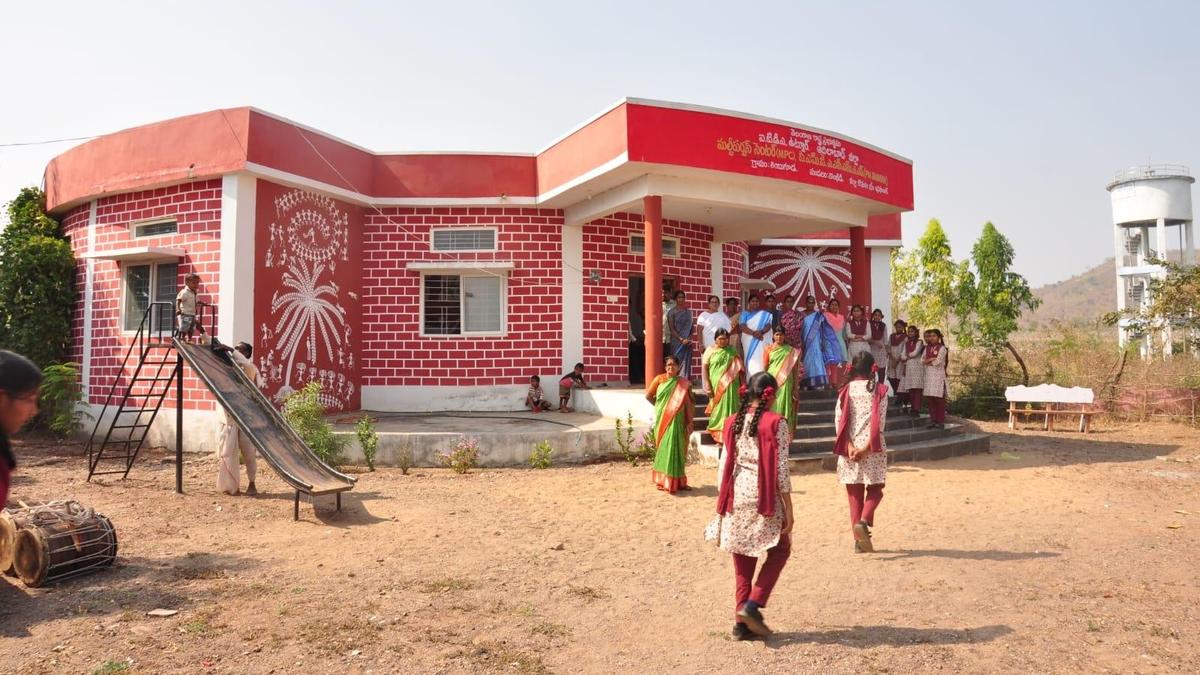
Tucked away in the north-eastern corner of Telangana, about 320 kilometres from the State capital Hyderabad, Limbuguda — a tiny Particularly Vulnerable Tribal Group (PVTG) hamlet in Kumram Bheem Asifabad district — is charting a new course for transformative change through the potential of Artificial Intelligence (AI).
But how did this tiny hamlet, surrounded by hilly terrain in the tribal heartland of Wankidi mandal bordering Maharashtra, shoot into prominence? Limbuguda earned wide recognition for its prized possession — the Multipurpose Centre (MPC), equipped with AI-assisted learning tools.
In July last year, the MPC was set up in Limbuguda under the Pradhan Mantri Janjati Adivasi Nyaya Maha Abhiyan (PM-JANMAN) scheme at an estimated cost of ₹60 lakh. AI-aided tools were introduced at the MPC to enhance learning outcomes among PVTG children.
Incidentally, the school dropout rate is high among PVTGs, whose population is estimated to be around 16,092 in Kumram Bheem Asifabad district.
Billed as the first-of-its-kind state-of-the-art centre in PVTG habitations, it houses an ANM centre (a maternity centre specialising in maternal and neonatal care), an Anganwadi, a conference hall with a projector, and a computer lab, among other facilities.
The centre aims to provide education, healthcare, nutrition, and livelihood support — all under one roof — while promoting the holistic development of PVTGs, with a thrust on tribal empowerment and cultural revival.
Tribal students attending the Assisted Mathematics Learning (AML) session at the Multipurpose Centre in Limbuguda, a tribal hamlet, in Telangana’s Kumram Bheem Asifabad district.
| Photo Credit:
P. Sridhar
Limbuguda is one among the 149 PVTG habitations in the predominantly tribal-populated district. Kolams constitute an overwhelming majority of the PVTGs in the combined Adilabad district. They are among the most marginalised and socio-economically backward tribal communities. Limbuguda was selected for the targeted welfare initiative under PM-JANMAN because of its geographical remoteness and other parameters.
A Cement Concrete (CC) road laid to connect the MPC, running along an irrigation canal, leads to Limbuguda, home to less than 40 families of the aboriginal Kolam tribe. Standing in the middle of the obscure hamlet, surrounded by hills, the centre serves as a beacon of hope for the local tribal population and plans are afoot to extend this tech-driven initiative to other PVTG hamlets across the district under the aegis of the Integrated Tribal Development Agency (ITDA), Utnoor.
Kolam farmers in Limbuguda and surrounding tribal habitations rely on rain-fed agriculture and mostly cultivate cotton in black soil. During the off-season, they work in agricultural fields or take up daily wage labour.

“Around 29 MPCs have been sanctioned for the district under the PM-JANMAN scheme. Several infrastructure and welfare measures — including roads, mobile medical units, housing, electricity connections and mobile networks — have also been approved based on needs identified during a survey conducted last year.”Rama DeviDeputy Director (Tribal Welfare), Kumram Bheem Asifabad
Sitting before a row of mud-and-tiled houses abutting the lane beside the MPC, Athram Jaithu proudly said that he donated a portion of his small ancestral land for the centre, rooted in his belief that education alone can empower PVTGs.
“I donated a piece of land for the Multipurpose Centre with the hope that it will spread the light of education and improve the living conditions of our people,” Jaithu said with contentment. He is among several small Adivasi farmers who depend on agriculture for sustenance.
Affectionately called ‘Devara’ by his villagers, Jaithu regretted not being able to ensure higher education to his two children, who took up agriculture after completing their SSC.
Echoing similar concerns, another Kolam farmer attributed poor literacy among Kolams to poverty, lack of connectivity, and limited opportunities.
The MPC’s establishment also paved the way for a CC road to Limbuguda. “Not a single person from Limbuguda and Bheemguda Kolam habitations has secured a government job so far,” he said, noting that one Athram Anand Rao returned to farming after completing his under graduation in B.Sc.
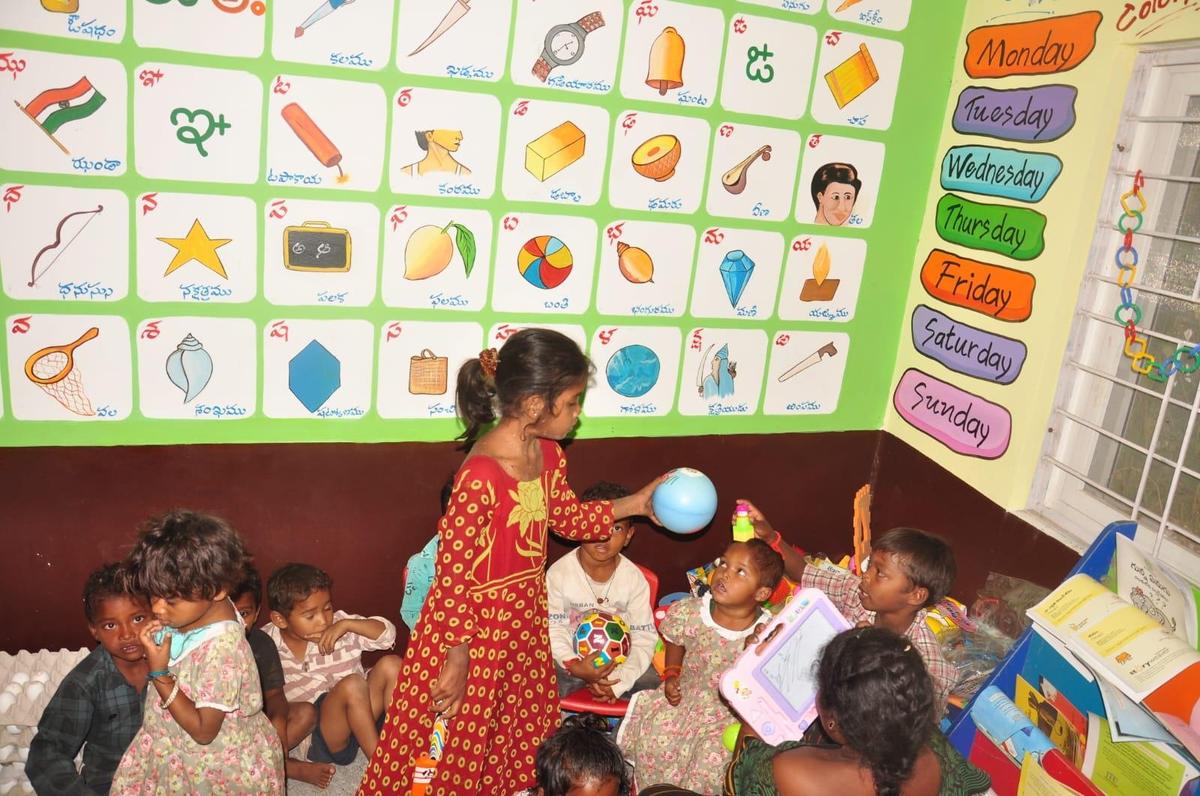
Children of Kolam tribe, a Particularly Vulnerable Tribal Group (PVTG), at the Anganwadi centre in the Multipurpose Centre in Limbuguda, a small tribal hamlet, in Telangana’s Kumram Bheem Asifabad district.
| Photo Credit:
P. Sridhar
Two youths from Limbuguda — Athram Bheem Rao and Sidam Bheem Rao — are currently pursuing M.Pharm and B.Sc courses, respectively. “I am determined to secure a government job, preferably in a uniformed service, after graduation,” said Sidam Bheem Rao.
Integrated approach
Elaborating on the functioning of the centre, an official of the Integrated Tribal Development Agency (ITDA), Utnoor, said that the MPC is employing an integrated approach aimed at tackling malnutrition and anemia among children and women of PVTGs while bridging the digital divide between urban and rural (tribal) areas through AI-assisted learning tools.
Meanwhile, Aniga, a local villager, was all praise for the aesthetics at the centre and said that the impressive murals on the walls of the centre highlight tribal heritage and valour of Adivasi warriors – Kumram Bheem and his follower Kumram Suru.
On the change being ushered in by the centre in the hamlet, one Sidam Maru said that he never touched a computer in his life but added with pride that his daughter, a student at the Tribal Welfare Primary School in Limbuguda, handles a computer at the MPC right in their habitation.
“The MPC initiative under the PM-JANMAN scheme is well-intended. Its success ultimately depends on effective and transparent implementation. Real empowerment of PVTGs lies not merely in infrastructure creation but in sustained investments in education and skill development that enable tribal communities to access welfare schemes and achieve financial self-reliance.”Athram BheemraoPresident of Telangana PVTGs Association
Speaking about the use of AI tools in teaching, instructor Shivaraj said that they are using tools like Assisted Language Learning (ALL) and Assisted Mathematics Learning (AML) to enhance the language and mathematical skills of tribal students of classes III, IV and V. For students of classes VI, VII, VIII, and IX, concepts of maths and physics are being explained by deploying the Khan Academy’s tech-enabled learning resources, he noted.
Meanwhile, describing the MPC initiative under the PM-JANMAN scheme as well-intended, Athram Bheemrao, president of the State PVTGs Association, emphasised that its success ultimately depends on effective and transparent implementation. He said that real empowerment of PVTGs lies not merely in infrastructure creation but in sustained investments in education and skill development that enable tribal communities to access welfare schemes and achieve financial self-reliance.
He also called for complementary measures such as vocational training for Adivasi artisans to revive traditional livelihoods and the introduction of off-grid solar power projects in remote PVTG habitations located on forest fringes.
Local voices echoed similar aspirations while pointing to persistent gaps. Jalapathi of Khirdi gram panchayat observed that most Kolams are multilingual, conversant in Telugu, Marathi and Gondi besides their mother tongue Kolami. In his view, the MPC concept is well-designed to provide students from PVTG communities with a nurturing environment that opens new windows to the outside world.
The centre’s visibility has drawn attention from policymakers as well. Union Minister of State for Road Transport & Highways and Corporate Affairs Harsh Malhotra, who visited Limbuguda last year, reportedly appreciated the efforts of the ITDA, Utnoor, and described the facility as a “Lighthouse MPC” — a potential role model for tribal regions across the country.
Despite this recognition, connectivity remains a pressing concern. Residents of Limbuguda, Bheemguda and Khirdi underline the absence of a regular bus service linking their habitations to the Wankidi mandal headquarters. Improved transport access, they said, would allow tribal children to utilise the MPC’s educational and digital learning facilities without hardship.
Digital infrastructure is another area requiring attention. Villagers stressed the need for reliable high-speed internet at the MPC to ensure seamless operation of AI-assisted learning tools and online educational resources. They also hoped that the centre could host seminars and awareness programmes to familiarise tribal students with emerging technologies while promoting tribal arts and culture.
A youngster noted the social challenges that persist in remote regions. Superstitious practices, inadequate housing, and limited livelihood opportunities continue to affect sections of PVTG populations, highlighting the need for broader socio-economic interventions alongside technological initiatives, he added.
Cultural preservation
At the same time, cultural preservation remains central to local discourse. Gangu, an Adivasi artist from Tiryani, underscored the importance of safeguarding traditional knowledge systems, particularly indigenous understanding of medicinal plants and nutritional practices. He recalled that the tribal resistance against the Nizam regime is replete with stories of valour, including the role of Kolam warrior Kumram Suru, a close associate of the legendary Kumram Bheem.
Providing an administrative perspective, Rama Devi, Deputy Director (Tribal Welfare), Kumram Bheem Asifabad, said: “29 MPCs have been sanctioned for the district under the PM-JANMAN scheme. Several infrastructure and welfare measures — including roads, mobile medical units, housing, electricity connections and mobile networks — have also been approved based on needs identified during a survey conducted last year.”
Officials said that the Limbuguda MPC forms part of a broader multipronged strategy aimed at delivering healthcare, nutrition and digital learning services under one roof. However, community leaders and youth representatives stressed that such initiatives must be supplemented by targeted skill development programmes to promote sustainable livelihoods and financial self-reliance among PVTG youth and women.