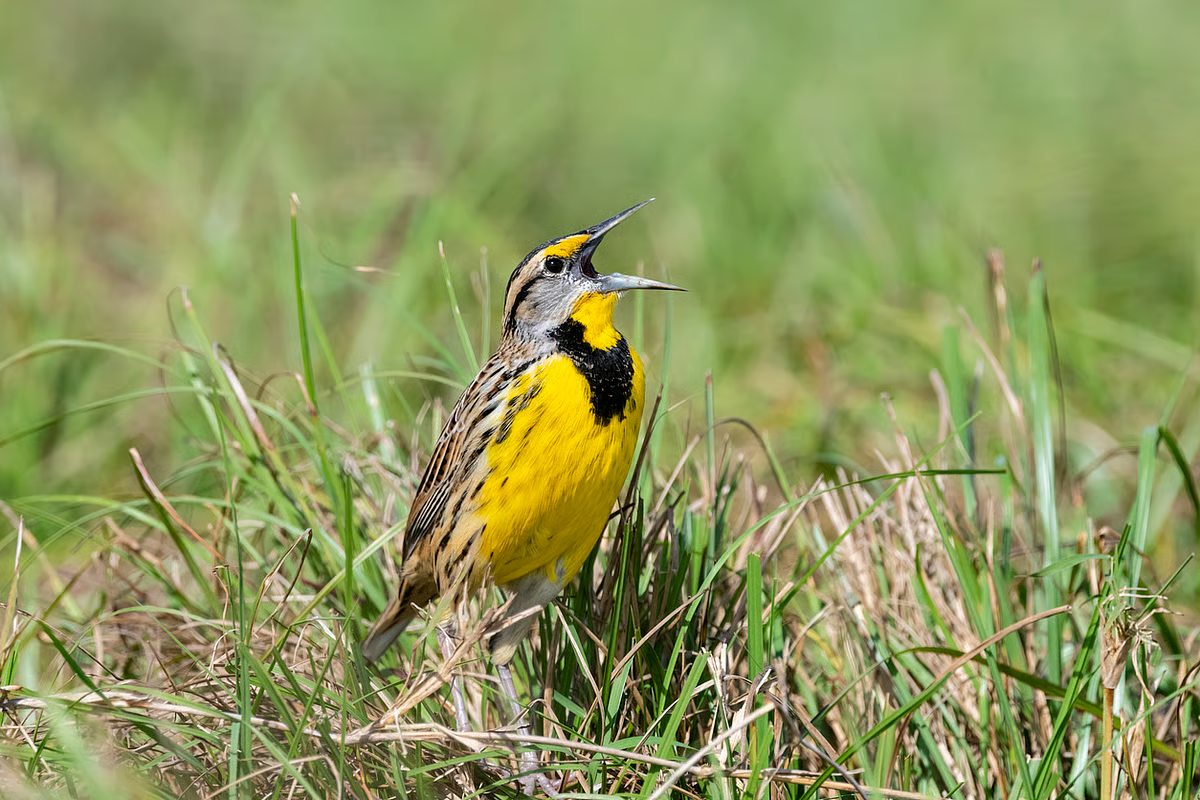
Since the 1970s, the US has . We now know that those losses aren’t just growing — they are accelerating in places with intensive human activity, particularly where agriculture and expanding communities are changing the landscape.
Bird have been .
But human pressures on nature are not just continuing; they are increasing at an accelerating rate. Indicators of human activity, such as population growth, economic growth and transportation use, rose more rapidly after the 1950s, as did measures of environmental change, from atmospheric carbon dioxide levels to tropical forest loss.
In a new study published in the journal Science, my colleagues and that bird populations are responding in the same way: Their , particularly in regions dominated by intensive agriculture.
It’s not just that there are fewer birds each year. In some places, each year brings larger losses than the one before.
Where bird populations are shrinking faster
Using data from the , we analysed bird population changes for 261 species across the contiguous US between 1987 and 2021.
We found that, on average, bird numbers declined by about 15 per cent — for every six birds in 1987, there were only five three decades later. Nearly half of the species we examined showed significant population declines, with the strongest declines observed for the , the and the .
The is one of the longest-running wildlife monitoring programs in the world. Since 1969, trained volunteers have counted birds along thousands of fixed routes across the US and Canada during the breeding season, when birds are reproducing, nesting, laying eggs or raising young.
Because the survey spans decades, a continent and hundreds of species, it provides an unparalleled window into how bird populations are changing over time.
Most studies using this data focus on whether populations are increasing or decreasing. In , we asked a different question: Are those trends themselves speeding up or slowing down?
When we examined how the decline of birds evolved over time, a .
The losses were strongest in southern parts of the United States — a pattern consistent with previous research that linked bird declines to warm and warming regions. Many species have been found to struggle in hotter temperatures, or .
The Midwest, California and parts of the Mid-Atlantic region stood out as areas where bird declines are accelerating. Populations that were already shrinking in the late 1980s are now losing birds more rapidly than they did three decades ago.
These regions share a common feature: intensive agriculture. We measured agricultural intensity using indicators such as cropland area, fertilizer application and pesticide use around survey locations. Areas with were more likely to have accelerating bird declines.
Why agriculture intensity can amplify decline
Modern agriculture transforms landscapes. Large cropland areas replace diverse habitats. Herbicides and pesticides used on farms reduce weeds and insects that many bird species depend on for food. Heavy machinery and reduced habitat diversity can limit nesting opportunities.
We cannot disentangle which agricultural practices are most responsible for the accelerating declines. Fertiliser use, pesticide application and land-use change often occur together. It is likely that multiple pressures interact to affect birds. However, higher in , both directly through toxicity and indirectly through declines in insect prey. These findings suggest that chemicals may play an important role in amplifying population declines in agricultural regions.
We also found that agricultural intensity and temperature change may reinforce each other. Agricultural landscapes , potentially compounding climate-related stress on bird populations.
Why acceleration matters
Accelerating population declines are an early warning sign about birds’ well-being. A steady decline is concerning, but when losses grow larger year after year, it means the situation is getting worse faster.
Monitoring acceleration can help identify emerging hot spots before populations reach low levels, providing an early warning for conservation action.
Birds are more than just familiar backyard species. They help . Because they are well monitored and sensitive to environmental change, they often provide an .
Nearly is used for agriculture. How these landscapes are managed will shape the future for many birds, and farmers are thus at the forefront to address the biodiversity crisis. It’s also important to remember that agricultural workers themselves are the most exposed to the same chemicals that affect ecosystems, and a growing body of research has examined the of . Balancing food production, environmental sustainability and human health is a shared challenge.
Biodiversity responses to land management changes can occur quickly. So when habitats are restored or chemical pressures are reduced, birds and insects can return within years.
That potential for relatively rapid ecological recovery makes agricultural landscapes especially important. Our findings suggest that looking not only at how much biodiversity is changing, but also at how much those changes are speeding up, may offer a clearer picture of the pressures facing wildlife today.