
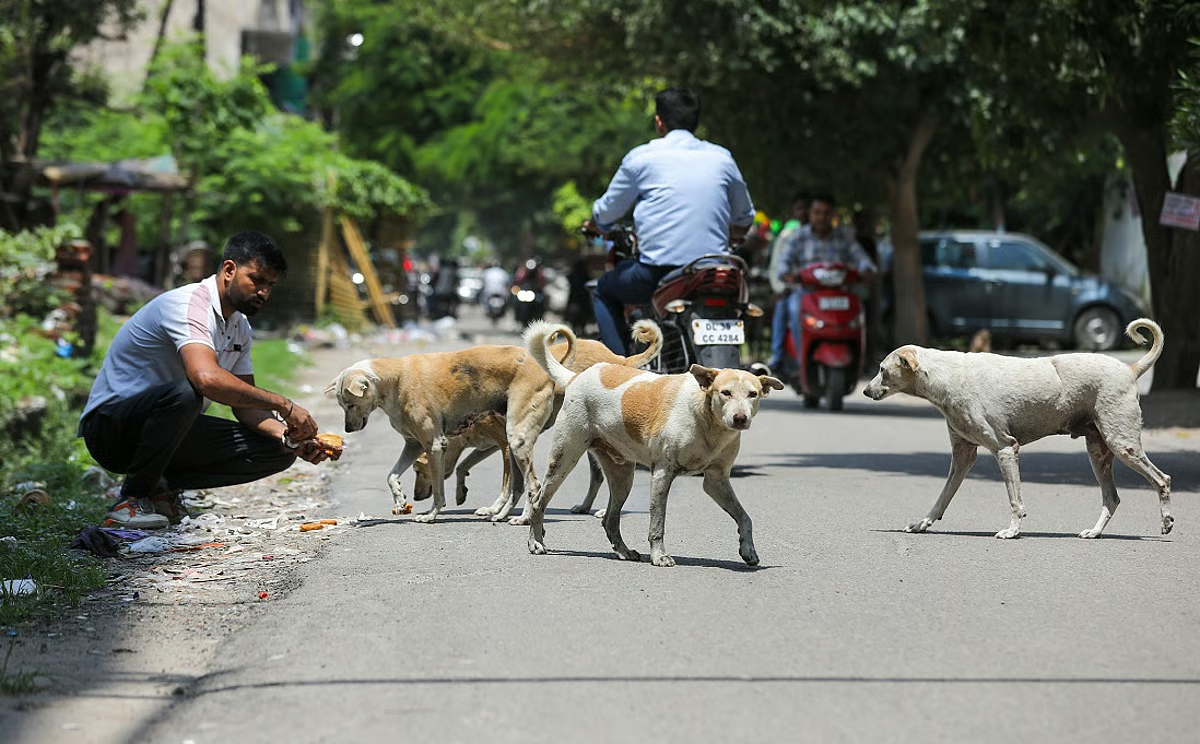
Those who have grown up on Bollywood movies have frequently viewed the courts as the messiah of the unheard and often, overlooked. Fighting for them, the hero, usually also the counsel secures evidence against all odds and with an impassioned speech, convinces the judge (not to mention, the audience) that justice must prevail. The story ends, with the judge passing an order in favour of the innocent, effectively letting us all know justice is truly impartial. For an exalted moment, in the life of the common man, otherwise plagued with injustice, there appears a light at the end of the tunnel!
While we await the pronouncement of order in the street dog matter before the Supreme Court, we wonder — Life is not a movie, and art may imitate life, will the converse hold true?
On August 11, 2025, our Apex Court took suo motu conginizance based on an unverified and inaccurate report of a dog bite incident, and since then, the light at the end of the tunnel seems to be diminishing for the country’s street dogs. Back-to-back court orders have followed, one seemingly in contradiction of the other. Packed courthouses have been the scene of pleas, and speeches from counsels representing compassionate individuals and organisations, including counsels who may not particularly be moved by the plight of animals but are invested in arriving at workable solutions.
In course of the hearings, hope was reignited on August 22, 2025, when the sweeping order of a two-judge bench dated August 11, 2025, to remove all dogs from Delhi NCR was set aside by a special bench and the states were asked to disclose their compliance. Decades since the ABC Rules were notified, their implementation, the court noted, was abysmal. After all, states and the municipalities/panchayats all had 25 years to implement vaccination and sterilisation to ensure the street dog population was reduced or at the very least maintained with no rabies incidents. What did they have to show for it?
The spark of hope was quickly dampened, when the woefully inadequate compliance reports (as summarised by the Amicus Curiae) filed by the state governments were simply asked to be revisited, and orders were issued to remove all community dogs living in ‘institutional premises’. Essentially, the states, were let off the hook for the last 25 years of failures, are now expected to catch, sterilise and perpetually confine lakhs of dogs in non-existent shelters. The street dogs continue to face persecution, while those who work towards welfare and safety struggle to deal with the after-effects: indiscriminate relocation, culling and cruelty. But the million-dollar question is: who really is accountable for the issues of dog bites, rabies and the state of the poor in India?
The background
The Prevention of Cruelty to Animals Act, passed by the legislature in 1960, sought to prevent the infliction of unnecessary pain & suffering on animals. Despite gruesome cruelties inflicted on animals being sporadically reported in the media, with countless instances being ignored and unreported, and despite repeated public demand to amend the law, the last acknowledgement to this necessity by the Union of India was in 2022. Several parliamentarians, NGOs and countless citizens have urged the government to table the bill in the parliament. As of 3rd February, 2026, in response to a Parliamentary Question [Unstarred Question 504, Answered on 3rd February, 2026] posed by Members of Parliament Dr. Byreddy Shabari & Shri Appalnaidu Kalisetti, to the Minister, Fisheries, Animal Husbandry & Dairying, the Government of India had this to say:
“The draft Prevention of Cruelty to Animal (Amendment) Bill 2022 was placed for public viewing during 21.11.2022 to 07.12.2022. Thereafter, the Department received suggestions / objections from more than 7000 individuals and organizations.
In the meantime, the Indian Penal Code (IPC) has been replaced with Bharatiya Nyaya Sanhita (BNS), 2023 which also made provision for dealing with the animal cruelty. Considering all the suggestions, advice and present policy, the proposed bill is under examination.”
Since 2022, the Bill remained gathering dust somewhere among the files in its Nodal Ministry; while the Bharatiya Nyaya Sanhita (BNS) simply retained its provision for mischief with relation to animals (Section 325 BNS replaced Sections 428 & 429, IPC) and neglected to retain the provision that made bestiality a criminal offence (Section 377, IPC).
Though long neglected, this Act has nonetheless brought forth several relevant & progressive Rules to further its objectives through its provision for delegated legislation (see section 38 & 38A). Among these Rules, was the Animal Birth Control (Dogs) Rules 2001. Prior to the notification in 2001, street dogs were drowned, electrocuted, beaten to death, injected with toxins (commonly strychnine), burnt alive and killed in other horrific ways that would send a shiver down your spine. VIP instructions to ‘remove’ dogs were dealt with by the police/security by way of ‘shoot at sight’.
Turn the calendar back a century or two, and we can see the reports of how the British Raj introduced policies that sanctioned killing of dogs considered ‘nuisance’ and even incentivised killing animals through bounty systems. Afterwards, the ‘removal’ of dogs by local authorities involved relocation and/or poisoning. Yet, more than 200 years later, India is not rabies-free, nor have we seen a notable reduction in dog population. So, what was the point?
The World Health Organization has consistently advocated for mass vaccinations for preventing dog to human rabies transmission and a 70 per cent sterilisation and vaccination coverage for achieving herd immunity and maintaining street dog populations. On paper, we are ahead of the curve, having brought into force the Animal Birth Control (Dogs) Rules 2001, which set in place a scientific process for safeguarding public health and managing rapidly developing urban landscapes, without completely disregarding animal welfare.
In this system, local authorities were tasked with carrying out ABC-ARV (animal birth control and anti-rabies vaccination) programs to manage street dog population & eradicate rabies. However, with the exception of select cities and towns where consistent efforts were made over a period of time, dog sterilisation and vaccination proved a failure in India, perhaps owing to gaps in legislation and the challenge of administrative complacency.
In 2009, several conflicting orders issued across High Courts regarding the ABC Rules 2001 fell to the Hon’ble Supreme Court. Writ Petition No 691 of 2009 (later amalgamated into Civil Appeal 5988/2019) was heard for close to 15 years. In the course of its adjudication the gaps were identified— roles and responsibilities were not spelled out clearly enough, no monitoring mechanism was in place to ensure the diligent execution of the overall process, and no specific complaint redressal mechanism was integrated. The Apex Court, through its orders, filled these gaps, directing strict implementation and the formation of monitoring committees at three levels of governance. The wisdom of the Court was incorporated into the Animal Birth Control Rules, 2023, an amendment to the 2001 notification.
The 2023 rules make it amply clear that the onus is on local authorities to conduct ABC programs. Animal welfare organizations could only be engaged for executing such programs through a tendering process. The implementing agency (whether the local authority through its veterinarians, or an Animal Welfare Organisation) would have to apply for a project recognition certificate from the Animal Welfare Board of India for the premises where the project was to be carried out. This was intended to ensure that the agency was adequately equipped to carry out ABC-ARV in a lawful and scientific manner.