- The commercial growth of Karjat threatens the land and food security for the Adivasi communities in the region.
- Small groups of Adivasi women respond by protecting, restoring, and managing their private forests, which support their livelihoods and preserve the ecological integrity of the region.
- Adivasi women’s ecological knowledge and acute market awareness position them as important drivers of community-led land and resource governance.
- The views in this commentary are that of the author.
Jija Darwada leads us through a dense patch of forest behind Mograj village in Raigad district of Maharashtra. She taps on the fissured bark of a tall tree. “This is the Ain tree (Terminalia elliptica),” she tells us, “We use it to build parts of our houses, or even stables for our cattle. We usually let it grow for 25-30 years.” She points to a plant with long leaves and a thick stem, “This is Pevga (Cheilocostus speciosus). In the midrib of its leaves, it contains its own water. When we are thirsty in the forest, we can break the stem and bite into it.”
“Ah, look here,” she continues as we walk through the narrow trail covered with a thick layer of wet leaves, “This is Moha (Madhuca indica).” We gasp at the sight of the magnificent tree. “Every part of this plant is useful. We make oil from its seeds. Its wood can be used to build the floors of our houses, the fruits (moh doda) are delicious — cooked and eaten as a side dish with rice or bhakri (flatbread) — and even its flowers are consumed. And of course, one can also make local liquor with it.”
About 20 kilometres away from this forest lies a growing town called Karjat, welcoming thousands of tourists a year. Poised to become a part of the “Third Mumbai” developed by the Maharashtra government (the second being Navi Mumbai), both the real estate prices and the population of Karjat are expected to soar in the coming years.
The Adivasi women here are highly dependent on small patches of forests — owned publicly, privately, or collectively — for their livelihood as well as household and cultural use. Market shifts and land use change in the region, however, are compelling Adivasi women to move towards actively protecting and restoring their private forests.
History shapes Adivasi-owned forests
A majority of the Thakur Adivasi people have traditionally owned small plots of agricultural and forest land, used for farming and the collection of non-timber forest produce, respectively. These forests have been affected by a complex history of land governance in Raigad district; unique land ownership systems were designed to sedentarise Adivasi communities during colonial rule, and the Maharashtra Private Forest (Acquisition) Act, which enabled the state government to acquire private forests to turn them into public forest land, caused anxiety among private landowners since it was enacted in 1975.
Rajeev Khedkar, a land tenure and governance researcher based in Maharashtra, explains the impact of such legislation on these forests: “In Raigad district, as with several other districts in Maharashtra, more forest area was under private forests than the Forest Department. After the Acquisition Act was passed in 1975, the government began acquiring land from people, even when they owned small areas.” This led to changes in people’s usage of their private forest land. Khedkar adds: “People started fearing that if there were trees on their land, it would be acquired. Many people cut the trees on their land. With this legislation, the time period for leaving the trees to grow back after felling was reduced—from 20-25 years to around five years. They are always apprehensive that if they let the forest be, the Forest Department would acquire it.”
This also impacted the livelihoods of many smallholder farmers. In the past, when left to grow for 20–30 years, the trees matured well and could be sold as timber. However, with a smaller cycle, the trees only grow enough to be sold as firewood, resulting in a much lower income.
Now, with compounding pressures from tourism and real estate industries, as well as seasonal disturbances and crop failures caused by climate change, dependence on forest land has become more challenging for Adivasi communities here. Traders have historically taken advantage of the lack of market awareness among the Adivasi, extracting all the resources they owned but giving them little in return. “Many Adivasi smallholder farmers started selling their land to companies leading big infrastructure and tourism projects in this high-demand area,” says Anil Harpude, a social worker who has been working in this landscape for over 35 years. He explains that many lost their land due to complications caused by different forest laws, or because contractors, moneylenders, and land agents seized land in exchange for small loans.
To combat the resulting land insecurity among Adivasi communities in Raigad, local organisations, individuals, and researchers have been supporting community restoration and livelihood generation for several years. The aim is to simultaneously create livelihood opportunities for people, maintain forest cover, and improve land productivity. “We are encouraging people to grow trees that generate income without needing to be felled,” Khedkar explains.


Sustaining a forest-dependent livelihood
Jija Darwada, who resides in Jambhulwadi village in Karjat, is one of the leaders of the Adivasi Mahila Upajeevika Suraksha Samiti (Society for the Protection of Adivasi Women’s Livelihoods), a local community-based organisation (CBO) that supports Adivasi women from a few villages in Karjat. They focus on issues related to food security, land, and livelihoods. Jija is one of the many Adivasi women in Karjat (belonging to the Thakur community) who own or jointly own private forest land. Owning between one and 20 acres of private forest each, collectively, these private landowners grow and protect more than 60 species of trees and plants.
In 2024, with support from Nilgiris-based non-profit Keystone Foundation, women-led CBOs around Karjat planted more than 15,000 seeds and saplings of 45 different native species in their private forest. They also attended training and awareness sessions on seed collection, nursery maintenance, and restoration, so that they could start small nurseries on their own and continue this effort. In addition to planting, the women also installed bio-fences around their plots, with pirkut (a cactus species), nirgudi (Vitex negundo), adulsa (Justicia adhatoda), limbu (Citrus limon), and karvanda (Carissa sp.) cuttings. Cloth bags were distributed to women who travelled to Mumbai and other major markets to sell leaves and vegetables, to support easier transportation.
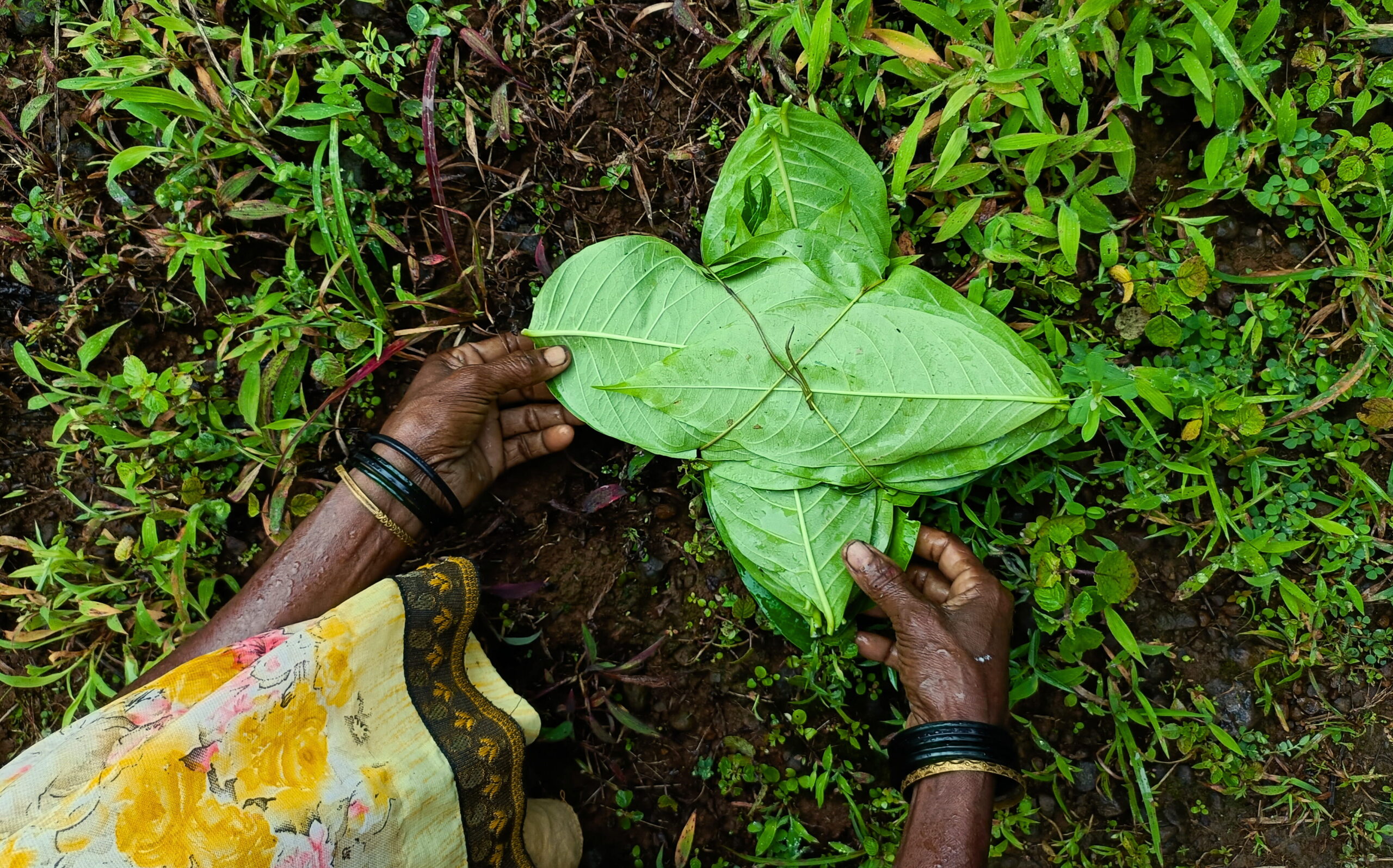
“We collect the leaves of many of these trees or plants and sell them in the Dadar market in Mumbai,” says Jija, “During the festival season, we earn a lot from selling these leaves, many of which are used to make plates on which temple food is served, or to make garlands and as offerings.”
A survey led by the co-author Yamini Khedkar found that the women earn about ₹45,000 (or more) selling kuda leaves (Holarrhena pubescens) in the 2-2.5 month-long demand period. The same amount can be obtained from selling palash (Butea monosperma) leaves. These leaves are used to wrap flowers, garlands, or paan (betel leaf), and as plates in homes and places of worship.

Adivasi women’s struggles with forest land
Women’s dependence on forest is more; they forage for leaves and vegetables for an income that makes them financially independent. Men often engage in wage labour and farming. Having better traditional ecological knowledge and market awareness, these women are more equipped to being stewards of these private forests.
Local organisations and CBOs working for Adivasi empowerment have also been supporting indigenous women in strengthening their leadership skills, understanding local governance systems — such as the Panchayat — and accessing government schemes related to electricity, food, roads, and sanitation. In villages such as Mograj, Tadwadi, and Jambhulwadi, women have established their own “banks” to support one another.
Making a livelihood out of leaf collection and foraging comes with its own challenges. There are regular encounters with snakes and wild animals and they also get bitten by mosquitoes and other insects. Injuries from falls are common, too. “Collecting jambhul fruits (Syzygium cumini) is the most difficult; it causes the greatest number of accidents,” explains Jija, during a discussion with Thakur women from Jambhulwadi and nearby villages. “The amba tree (Magnifera indica) is rough and easier to climb, but the jambhul trunk is very slippery. So, we try to tie a (safety) net when climbing jambhul. A similar issue arises with the karvanda shrub (Carissa sp.).” Women also report that they are constantly questioned for “trespassing” on disputed areas or land that has been sold to non-tribals in recent years.
Due to changing land use, declining forest cover, and increased pressure and use, traditional healers must venture deeper into the forest to look for medicinal plants. Many older women have noticed a decline in some plant species in their forests. Some attribute this to increasing pressure from a growing rural population, while others think this could be linked to changing weather patterns. “Many mango and jambhul trees are falling because of storms and cyclones,” says Anil Harpude. “When the trunk breaks or bends, letting the rain enter the core of the trunk or the soil beneath it, the tree rots.”
This year, the women reported, the mahua fruit harvest was poor because the monsoon came early. Harpude explains: “Phul, bhaji, tel (flower, fruit, then oil) — that is the sequence of extracting mahua. But that cycle was disturbed because it rained during the flowering stage. Mahua oil quantity has also been reduced this year.” Such events and changes adversely impact their income, and many women are compelled to return to wage labour to make ends meet.

The future of Adivasi-owned private forests
In the absence of cultural and emotional connection with the forest and the community, the younger generation may sell their private forests due to the ever-rising demand for land in the region. However, Adivasi women in Raigad are leading the effort to facilitate intergenerational knowledge transfer about private forests, foraging practices, and wild food recipes. Like Jija, Indu Agiwale, a farmer from Mograj, leads a small group of younger women from the village in growing and protecting their forest land. She has distributed seeds of wild trees for other women to plant in their private forests.
Several kilometres away, in the village of Gawandwadi, Savita Gawanda leads another group of women who forage and sell their forest produce together. She frequently speaks with others about the importance of their private forest lands. “We need to encourage people to keep their land,” she says, “These buyers may offer us money, but that money will be spent in no time. And our land will be lost forever.” Savita also realises that since children spend most of their time in school, away from the village, they may lose the opportunities to understand the value of their forests. They occasionally take children to the forest when they are engaged in planting activities, like showing them how deep to dig into the soil for planting different seeds and saplings.
Karjat and other towns in Raigad district are popular destinations for the wealthy to build second homes and resorts, and to cater to visitors. The cost of this urbanisation and development, however, is invisible to most visitors. The complex political and ecological history of the Raigad landscape points to a need for Adivasi women from the region, who are now being treated as outsiders in their own land, to be at the forefront in designing place-based and socially relevant solutions for climate-related impacts. As Adivasi women like Jija, Indu, and Savita work to sustain their forests, strengthen leadership, and access markets, timely support for local institutions is vital to build lasting resilience against climate change, urbanisation, and social injustice.
Nayantara Siruguri is a practitioner in conservation and development, interested in political ecology, human-nature relations, and place-based education. Yamini Khedkar is an independent practitioner working with Adivasi communities in Raigad district, Maharashtra, coordinating field initiatives on agroecology and land tenure in collaboration with Keystone Foundation. The commentary draws from Keystone Foundation’s work in the Raigad region.
Banner image: An Adivasi woman collects and ties kuda (Holarrhena pubescens) leaves from her friend’s private forest in Jambhulwadi. Image by Nayantara Siruguri.