Gujarat welcomed its first great Indian bustard chick after a decade of experimentation, the Union Environment Ministry announced on March 28. Programmes to revive the dwindling population of the great Indian bustard (GIB) have raced against time, particularly in Gujarat where three lone female birds were left in the wild.
Birthing the chick in Kachchh was made possible through what the government has called a “jumpstart approach” to conservation: a captive, incubated egg from Rajasthan’s GIB conservation breeding centre was transported over 770 kilometres to Gujarat, where it was nested by a female GIB in the wild.
The female had laid an infertile egg in August 2025, in the absence of a male counterpart. The infertile egg which was replaced by the incubated egg on March 22, and hatched on March 26.
The attempt was successful after several years of negotiations between both states. Transporting the egg made way for a halt-free corridor between Sam in Rajasthan and Naliya in Gujarat. In a press release, the government said the effort was a year in the making, and included guidance from the Wildlife Institute of India, apart from coordination between the state wildlife authorities and the Ministry of Environment, Forests and Climate Change.
Minister Bhupendra Yadav congratulated all the scientists involved in the conservation experiment. “We are keeping our fingers crossed for the survival of the chick. At the same time we remain committed to leaving no stone unturned to make the endeavour successful,” he wrote in a post on X.
There are fewer than 150 GIBs left in the wild, the vast majority of which are located in the Thar desert in Rajasthan. The Bustard Recovery Programme, launched in 2016 employs a range of activities to boost the GIB population, including artificial insemination of eggs, conservation breeding, and planned release into the wild.
There are now 73 birds in conservation breeding centres, with five new chicks born this season. However, threats to the GIB’s wild populations abound, particularly overhead power lines, collisions with which are responsible for killing an estimated 18 birds per year.
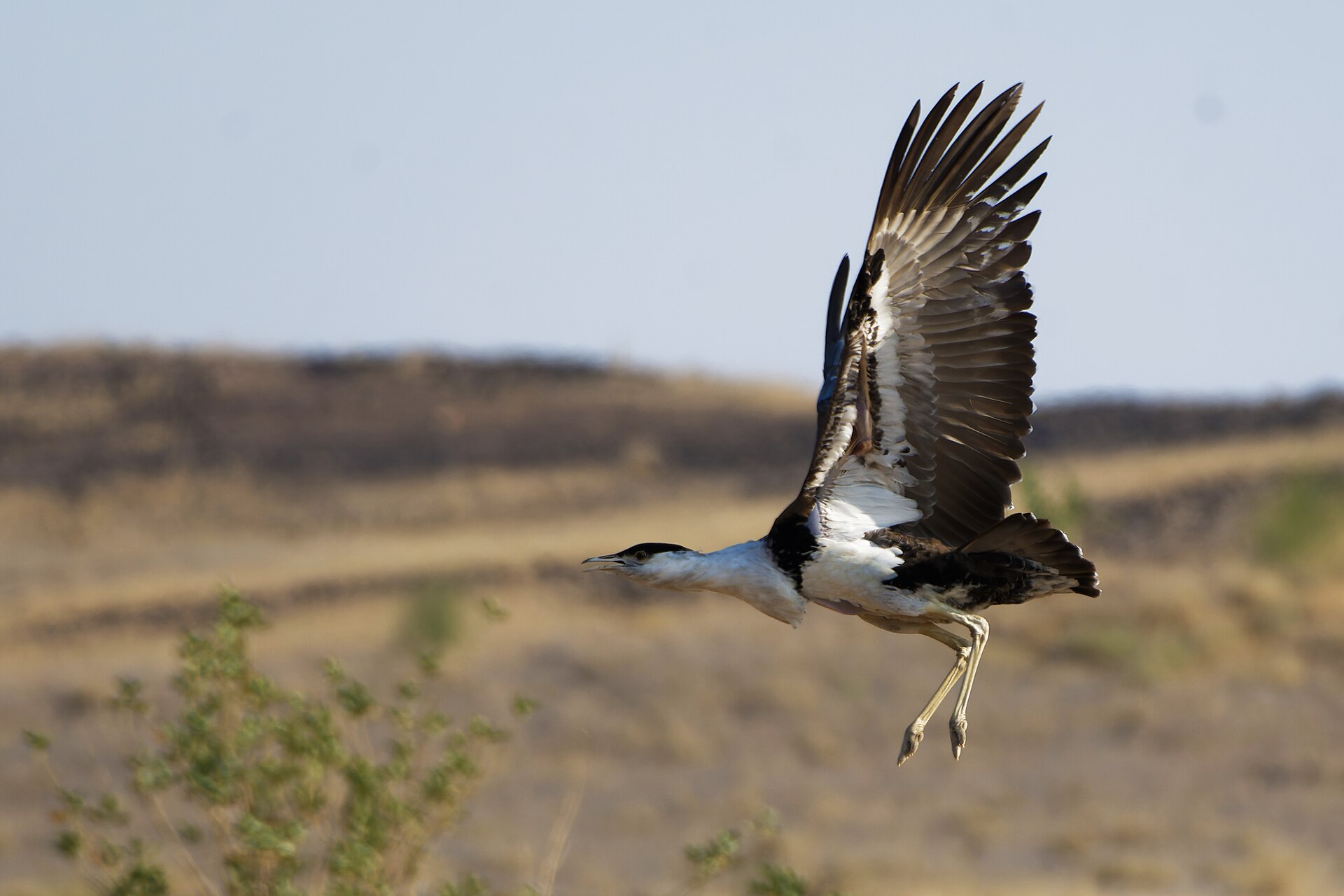
Banner image: Representative image of a great Indian bustard. Image by Shiv’s fotografia via Wikimedia Commons (CC BY-SA 4.0).