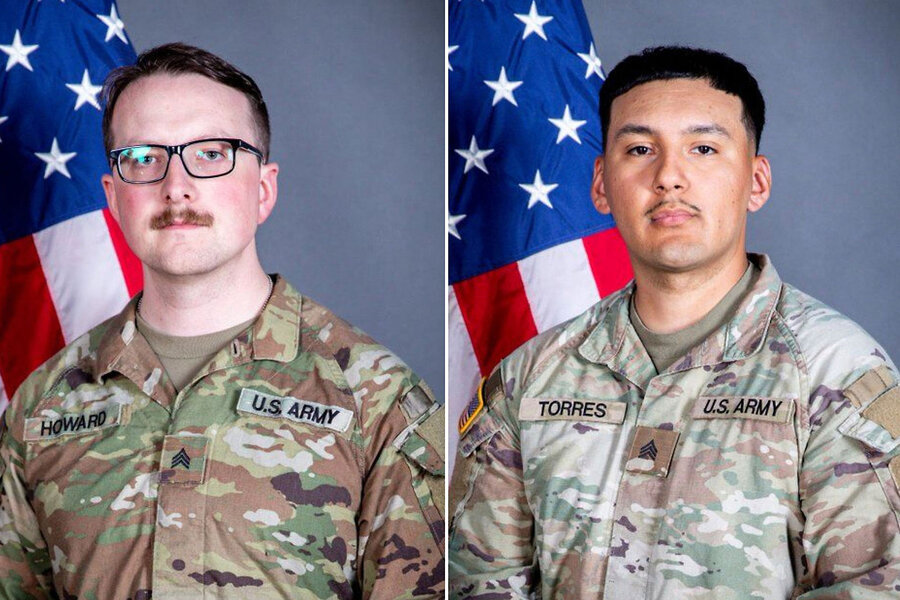
The United States military lost two Iowa National Guard soldiers and a civilian interpreter in Syria, and saw three more of its troops injured, in a shooting last week by an Islamic State supporter there. The violence threw a spotlight on the U.S. military’s mission in a country newly emerging from civil war.
Syrian officials had reportedly warned their American counterparts that an ISIS attack on U.S. forces could be in the offing. (Those officials said the warning went unheeded.) Though recently flagged for possible ISIS sympathies, the shooter was a member of the Syrian security forces, now a U.S. ally.
The U.S. has had soldiers on the ground in Syria for more than a decade now, with roughly 1,000 U.S. troops there today, according to the Pentagon.
Why We Wrote This
Following a recent Islamic State attack on its soldiers, the U.S. must weigh whether a return strike creates more problems for itself and a war-torn country than it solves.
Last month, Syrian President Ahmed al-Sharaa, who had ties to Al Qaeda and a $10 million bounty on his head 10 years ago, became the first Syrian head of state to visit the White House. The rebel forces he once led – which, though Islamist, routinely clashed with ISIS – overthrew Bashar al-Assad last December.
After their November meeting, President Donald Trump called Mr. al-Sharaa “a tough guy – I like him” and hailed a “new era” of cooperation. Since then, and in the wake of the shooting, there has been talk of expanding the U.S. mission in the country.
What are U.S. troops doing in Syria?
U.S. forces first launched operations in Syria with airstrikes in September 2014 as the Islamic State terrorist group was rapidly expanding. By the following year, U.S. special operations forces were conducting raids on the ground there against ISIS leaders.
With some fluctuations, American forces in the country generally increased until March 2019, when President Trump declared that the U.S. had liberated all ISIS-controlled territory, including “100% of the caliphate.”
But some U.S. forces stayed on, as officials explained then, to prevent the resurgence of ISIS. The 1,000 U.S. soldiers who remain are there “solely to finish the job of defeating ISIS once and for all, preventing its resurgence, and protecting the American homeland from terrorist attacks,” Tom Barrack, U.S. ambassador to Turkey and special envoy to Syria, wrote on social media this month.
The Trump administration also cut the number of U.S. bases in the country from eight to three earlier this year. The eventual goal, according to the Pentagon, is to bring that figure down to one.
That will leave what U.S. officials describe as a small but strategic U.S. outpost at Al-Tanf, in the country’s southeast near the border with Jordan and Iraq. This is designed to give the U.S. security reach that extends beyond the anti-ISIS campaign, the officials say, including the ability to monitor Iran and a jumping-off point for surveillance and rapid-reaction forces.
Will the U.S. military force posture change as a result of the fatal attack on American soldiers, and should it?
There has been no talk lately from the Trump administration of reducing U.S. forces in Syria beyond the current 1,000-troop footprint. There were, however, reports last month, around the time of Mr. al-Sharaa’s stateside visit, of an expanded U.S. presence at an airbase in Damascus to support a security agreement that the U.S. hopes to broker between Syria and Israel. Such cooperation could also help prevent an ISIS resurgence.
But some defense analysts question why the U.S. continues to put U.S. forces in harm’s way when the original foreign policy objective of the U.S. – to defeat ISIS – was declared to have been achieved six years ago. “We have defeated ISIS in Syria, my only reason for being there during the Trump presidency,” Mr. Trump tweeted in December 2018, three months before officially declaring victory.
This is similar to the question that arose in January 2024, when three U.S. military reservists were killed by a drone launched by an Iranian-backed militia close to the Syrian border in what became known as the Tower 22 attack.
“If we didn’t have troops in Syria, there wouldn’t be any U.S. targets,” says Rosemary Kelanic, director of the Middle East Program at Defense Priorities think tank.
As it stands now, she adds, the current Syria mission lacks a clearly-defined endpoint. “Talking about preventing the resurgence of ISIS is a way of saying that ISIS doesn’t exist. How do you know that you’re done preventing the resurgence of ISIS? There’s no criteria for us to judge when this mission is complete.”
There has been some movement, if not a groundswell, among lawmakers toward withdrawing U.S. forces. “I’m heartbroken that we lost soldiers,” Rep. Thomas Massie, a Kentucky Republican, wrote on social media after the attack. “Now is the time to ask: Why are we in Syria?”
What more can the U.S. do to help prevent terrorism, and does it involve retaliation for the recent troop attack?
As the new, relatively weak Syrian government works to get its footing, ISIS may be looking for ways to reassert itself, officials say.
For this reason, some analysts see merit in the Trump administration keeping troops on the ground, particularly since the fall of the Assad regime last year.
But others question whether it is too dangerous for troops to routinely leave their relatively secure bases, especially in violence-prone areas.
“The U.S. should do whatever it can to give Syria a fighting chance at stability,” says Adam Weinstein, deputy director of the Middle East program at the Quincy Institute for Responsible Statecraft think tank. “But I don’t think they should be doing these kinds of routine joint patrols and meetings that expose U.S. troops” to harm.
Adm. Brad Cooper, head of U.S. Central Command, which runs Pentagon operations in the Middle East, has warned that one of the big risks in the country is the large population of detainees – some 9,000 former ISIS fighters – who are still in Syrian camps.
The U.S. military lends intelligence support to thwart prison breaks, but Admiral Cooper has stressed the need to repatriate the ISIS fighters to their home countries. Humanitarian groups agree, citing alleged abuses including torture and poor conditions in the detention system, run mainly by Kurdish authorities under U.S. influence.
And there is near-universal concern about the risk of radicalization in the camps, particularly those that house the 38,000 families of ISIS fighters, roughly 60% of whom are children. Of those, nearly one-third are under age 5.
“There is no doubt that ISIS still maintains significant influence in these sites,” Admiral Cooper said. “Let us all double our work to protect the vulnerable and deny ISIS the opportunity to reemerge.”
To this end, the Pentagon in September announced that it was establishing “a special joint cell” tasked with coordinating the repatriation of ISIS fighters and their families.
As for Mr. Trump’s promised retaliation for the U.S. troop deaths, senior administration officials have said that a major U.S. bombing campaign is unlikely. Such a move could upend Mr. al-Sharaa’s tenuous political standing.
Syrian government officials have been quick to show that they are mounting an ostensibly muscular response to the recent violence, with nearly a dozen security personnel arrested and questioned about links to the attacker.
A more likely response from the U.S. could be raids against high-value targets, much like the U.S. carried out against a senior ISIS leader in July, Mr. Weinstein says.
Another possibility is drone strikes on “some targets somewhere out in the desert that are maybe loosely connected” to the attacker, Dr. Kelanic says. “They’ll call that retaliation and move on.”
But that, too, comes with risks.
“Every time you conduct an operation like that, you risk killing innocent civilians.” And, she adds, it perpetuates the cycle that leads people to terrorism in the first place.