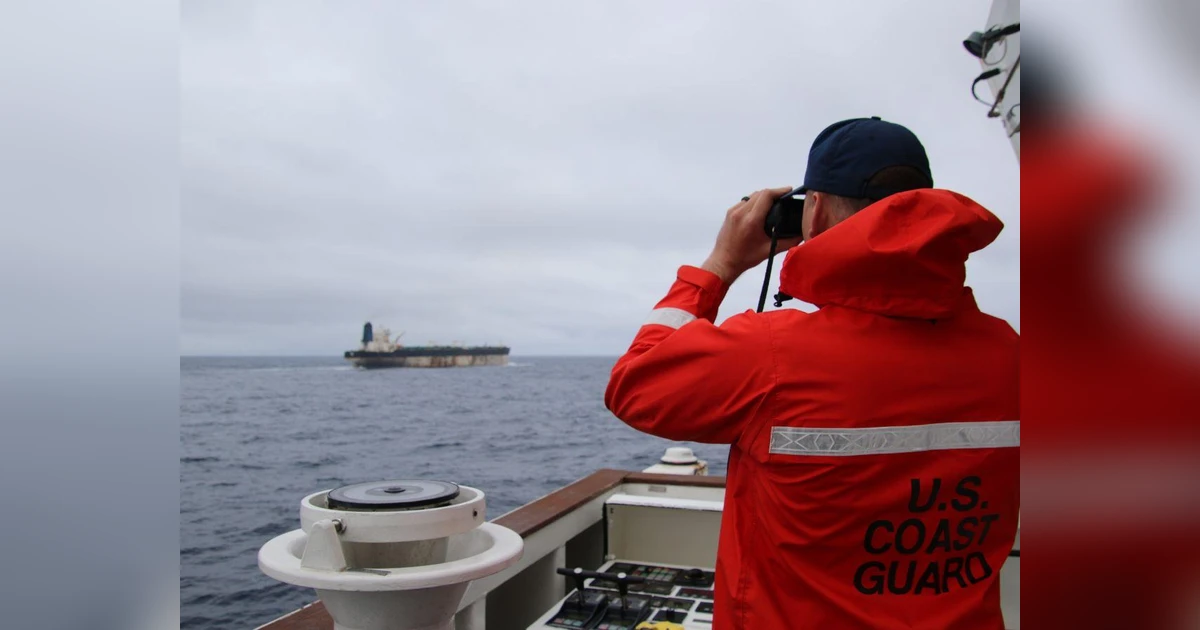
The United States (US) on Wednesday seized the Russian-flagged oil tanker Marinera in the North Sea after pursuing the vessel for more than two weeks, amid reports that Moscow had attempted to shield the ship through naval escort.
The operation was confirmed by the US military’s European Command in a series of posts on X, which said the seizure formed part of Washington’s broader action against sanctioned vessels.
“The @TheJusticeDept & @DHSgov, in coordination with the @DeptofWar today announced the seizure of the M/V Bella 1 for violations of U.S. sanctions. The vessel was seized in the North Atlantic pursuant to a warrant issued by a U.S. federal court after being tracked by USCGC Munro,” the statement said.
In another post, it said, “This seizure supports @POTUS Proclamation targeting sanctioned vessels that threaten the security and stability of the Western Hemisphere. The operation was executed by DHS components with support from @DeptofWar, showcasing a whole-of-government approach to protect the homeland.”
Boarding without Russian presence
According to a report by The New York Times, citing officials, no Russian naval vessels were present near the tanker when the US Coast Guard boarded it, averting the risk of a direct confrontation between American and Russian forces.
Russian state broadcaster RT released grainy images showing a helicopter approaching the ship and said an operation was underway. Separately, Reuters, citing two US officials, reported that American forces had moved to board the vessel.
Russia yet to respond
Moscow has not commented directly on the seizure. However, in a statement issued earlier to state news agency Tass, Russia’s Foreign Ministry said the tanker was operating in full compliance with international maritime law and described US and NATO scrutiny as “disproportionate to its peaceful status”.
From Bella 1 to Marinera
The tanker was originally named Bella 1 and was sanctioned by the US in 2024. It was later renamed Marinera. The vessel had been travelling from Iran to Venezuela but reportedly altered course and headed back into the Atlantic after attempting to evade a US effort to seize sanctioned oil tankers near Venezuelan waters.
Surveillance and earlier attempts
In the days leading up to the seizure, the tanker remained under close watch. Multiple surveillance flights were reported over the vessel, which included aircraft operating from US bases in Iceland, with British assets also involved.
It is to be noted that this was not the first attempt by US forces to stop the ship. In December, the crew reportedly thwarted a boarding attempt near Venezuelan waters. Following that incident, a Russian flag was painted on the hull and the vessel was added to Russia’s official shipping registry. Moscow subsequently lodged a diplomatic protest, demanding that Washington halt its pursuit.