
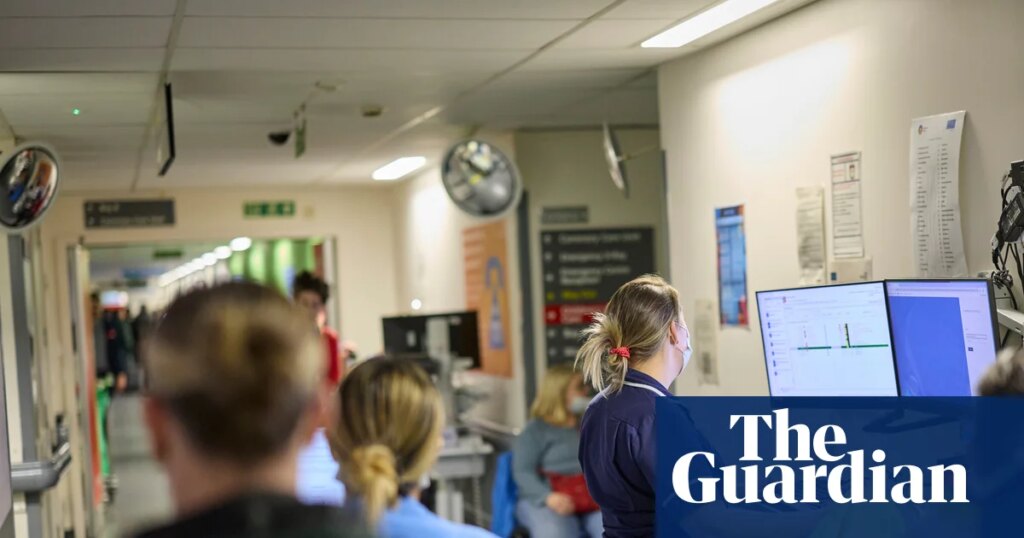
Hospitals in England are using articificial intelligence to help cut waiting times in emergency departments this winter.
The A&E forecasting tool predicts when demand will be highest, allowing trusts to better plan staffing and bed space. The prediction algorithm is trained on historical data including weather trends, school holidays, and rates of flu and Covidto determine how many people are likely to visit A&E.
The government said the technology allowed healthcare staff “to do the things that they’re trained to do, rather than having to be bound down by bureaucratic processes”.
Ian Murray, the minister for digital government and data, said: “The front door of the NHS is the A&E department. You’ve no idea how many people will come through the door, although you can have some analytical evidence that Saturday nights might be busier than a Tuesday night, for example, and the winter might be busier than the summer, unless you have a heatwave, of course.
“It [the forecasting tool] helps us to [predict] how busy their A&E departments are going to be. If you put that into context and see seasonal trends, along with how busy days are going to be, you can then put your resources in the right place.”
Hospitals could deploy more consultants in particular specialities or more nursing staff in the departments predicted to be busiest, Murray added.
“You can maybe then see about freeing up beds further down the pipeline, maybe see how you might need to get more people out of the hospital quicker, and free up those beds,” he said.
The A&E forecasting tool is available to all NHS trusts in England. About 50 NHS organisations are already using it, and, according to Murray, they are “seeing great results”.
“It’s about modernising the NHS, using the tools to allow clinicians and professionals to do the things that they’re trained to do, rather than having to be bound down by bureaucratic processes, allowing resources to be targeted where they need to be targeted,” he said.
The tool forms part of Keir Starmer’s AI Exemplars programme. In January, the prime minister said artificial intelligence would “drive incredible change in our country”.
Prof Julian Redhead, the national clinical director for urgent and emergency care at NHS England, said: “Early and efficient planning is key to managing busy periods like winter, and new tech like the AI tool has the potential to make a real difference to the way we manage care for patients.”