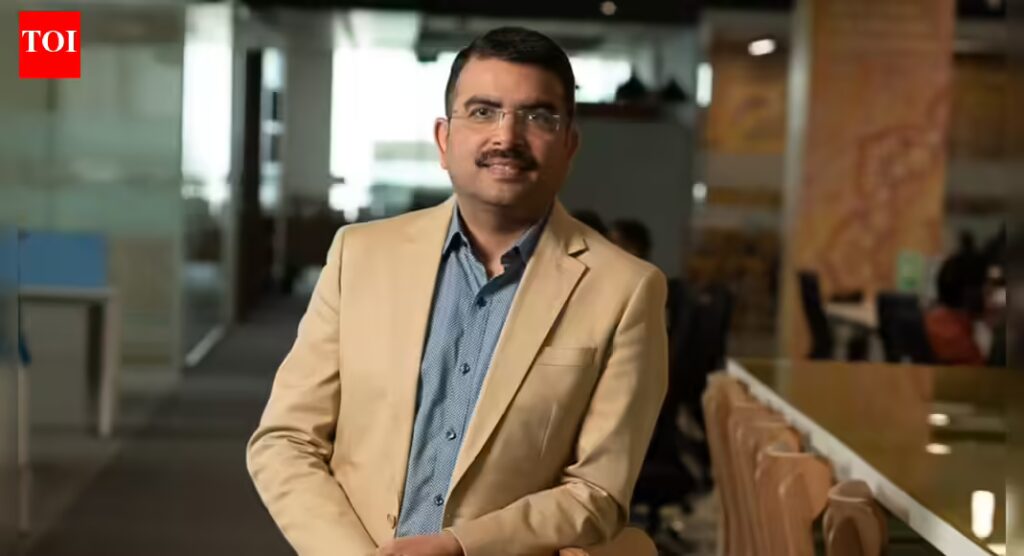
MUMBAI: Fino Payments Bank, promoted by Fino PayTech, received in-principle approval from the Reserve Bank of India (RBI) in early December 2025 to transition into a small finance bank, enabling lending operations after restructuring. Fino PayTech’s major shareholders are Bharat Petroleum, ICICI Bank group, Blackstone and Intel Capital. In an interview with TOI, Rishi Gupta, MD & CEO, Fino PB speaks about the roadmap for the transition.What kind of advantage do you get in forming a small finance bank because of your legacy as a payments bank?Unlike most SFBs, which emerged a decade ago from microfinance and carry that structure, our model starts digital-first and transaction-led, with liabilities at its core. Scale is the initial advantage: over 20 lakh merchants and 1.6 crore customers form a ready base, with 60 lakh customers active on UPI, allowing deposits and loans to be layered onto existing payment relationships.Deposits exceed Rs 3,000 crore, parked in-house and with partner banks at under 2% cost. Raising Rs 600–800 crore annually at low cost supports a stable CASA and cheaper funding. Distribution provides the edge. A nationwide merchant network doubles as both lead generator and borrower pool, turning payments rails into credit channels.Timing strengthens the case. With AI at the threshold of banking, it can improve onboarding, call-centre operations, fraud control, and process efficiency. The next pivot is secured lending, run on a low-fixed-cost, low-paper model. Payments remain the engine, with over Rs 1,700 crore flowing through transactions and set to continue under the SFB.Where will you invest to facilitate this transformation into an SFB?Spending will largely be on technology. In Jan, we are migrating our core banking system from FIS to Finacle, while hollowing out the core. Heavy digital investment over the past two–three years continues. The build stays light. Plans call for 100+ branches and 100+ asset centres over three years under a hub-and-spoke model.The aim is to keep fixed costs low, avoiding a branch-heavy reset. Asset centres will manage merchants and loans, while branches gather liabilities. The model remains merchant-first, targeting the middle of the pyramid through a tech-led merchant network rather than a universal-bank sprawl. Nationwide last-mile reach allows customers to move from small-value accounts to higher balances, alongside small-ticket credit such as micro loans, two-wheelers, and affordable housing. CapEx remains disciplined, with IT spending of about Rs 100–150 crore over the next two–three years.What products will you offer on the lending side?The focus will be on secured credit, where technology sharpens risk filters but touch-and-feel remains the cornerstone. We will start with affordable housing for the core customer, add micro loans against property, small-ticket merchant/MSME loans, and gold loans. Personal loans will be offered selectively, using customer and merchant data to price risk.Roughly 35–40% of merchants already borrow elsewhere; the effort is to migrate them onto our platform. Merchants are incentivised to provide better leads.We will eventually introduce secured credit cards, with limits linked to deposits, likely a year or two from now. Co-branded cards are not part of the current plan, though not ruled out. Insurance and mutual fund distribution will also be added.What kind of hiring do you plan?We will hire selectively, adding 500–600 staff over two–three years across corporate and field roles to open branches, asset centres, and strengthen headquarters. We start from scale: Rs 1,700 crore in revenue, 3,000 employees, and offices across states and districts. Much of the infrastructure already exists, reducing build-out time and cost. The real edge is liabilities. In banking, deposits decide winners.What kind of culture do you want to establish in the bank?We have evolved from a business correspondent to a payments bank to an SFB, led by a team with five–seven years of tenure that built the payments platform. Our DNA is merchant-led, anchored in personal connect, local trust, and last-mile reach. That focus remains.Equally important is digital connect. Customers are moving online; so are we, expanding UPI and allied lines. The DTP model—digital, distribution, partnerships—continues to drive growth, backed by 250+ partnerships. What worked for the payments bank carries into the SFB.Do you see becoming a universal bank at some point?Yes, that is an ambition. We became a payments bank in 2015 and received the SFB licence in 2025. If operations go well and execution is strong, there is no reason not to aim for a universal bank licence by around 2035. The rules allow an application after five years of operations. The transition framework is already set out in policy. If the conditions are met, there is no reason not to apply.What will be the impact of transformation spending on the bottom line? Do you plan to raise capital?We will remain profitable. Costs will rise in the first year or two as systems are built and staff hired, but revenues will follow. This is a two–three year play, not a quarter-by-quarter exercise. There is no likelihood of a loss. We made Rs 108 crore in profit last year and expect to remain profitable, even if incremental costs trim margins in the short term.Capital is not a constraint. We are above regulatory thresholds, and our initial two–three year plan does not require fresh capital. We are not looking to raise funds in the next financial year. That could change only if a clear growth opportunity or prudential need emerges. For now, capital is adequate.What will happen to the business correspondent division now that you will be competing with banks you provide BC services to?The business correspondent (BC) business has multiple options. It could be hived off into a group company or sold, either now or later. No decision is imminent, and all options remain open. The BC business contributes about Rs 140–150 crore, or roughly 8% of revenue, so any change would not materially affect the overall business.Under regulations, an SFB cannot house a BC arm or act as a corporate BC for another bank. That structure works for a payments bank but not within an SFB. If the BC business is carved out as a separate company, it can be appointed as the bank’s corporate BC. Merchants are independent entrepreneurs, often running kirana or other local shops, operating on fixed and commission-based arrangements. About 2,000 people manage the merchant network.
Aim to apply for universal bank licence in a decade: Fino Bank