
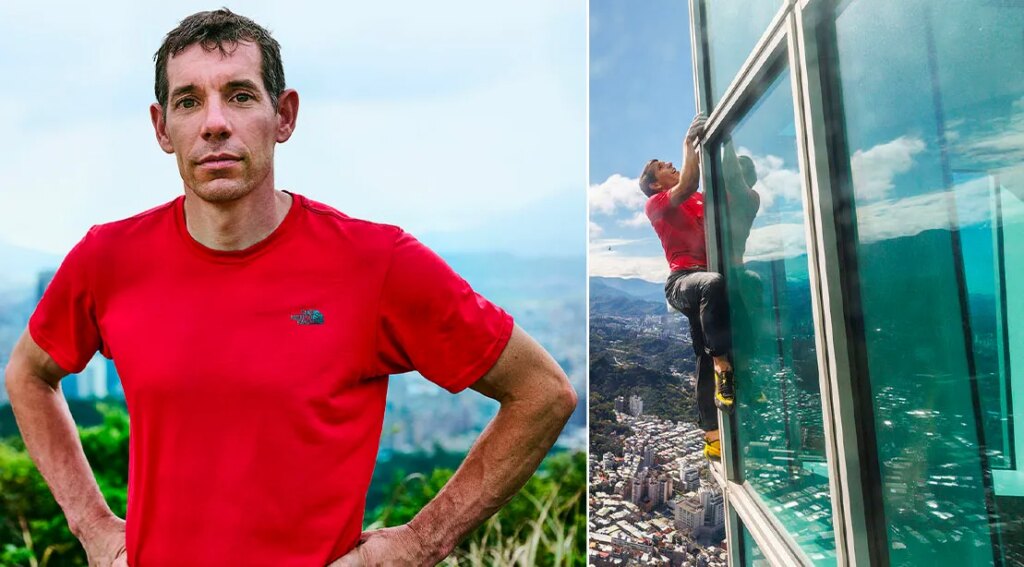
History was made in nail biting fashion on January 25, 2026, when Alex Honnold, free-soloed one of the world’s most iconic skyscrapers, becoming the first person to climb Taipei 101 without the aid of a rope or harness. It was such an extraordinary feat that many of those who watched the high-stakes challenge wondered the same thing: does Honnold experience fear? Interestingly, scientists aimed to answer this question almost a decade ago, with surprising results.
When the inspirational climber from Sacramento, California became the first person to free solo an ascent with a 5.13a grade during a 2,900-feet journey in 2017, Honnold’s epic endeavor was hailed as “one of the greatest athletic feats of any kind, ever,” by The New York Times. As an intelligent athlete and author, the 40-year-old has won awards in the Alpines and completed many major milestones, but his recent solo scaling of Taipei 101 in Thailand, broadcast live via Netflix, has once again caught the public’s imagination. During his most recent feat, Honnold finished the highest free solo climb of an urban structure in history, and it took just 91 minutes and 30 seconds to do it. But if those watching the event were nervous and on the edge of their seats, why did Honnold look so composed for the majority of his climb? It could all be explained by his amygdala, according to science.
What Is the Amygdala and Why Does It Matter?
The amygdala appears as two almond shaped nodules on either side of the brain. It is a network that processes our memories, decision making capabilities, and emotional responses such as fear, anxiety, and aggression. Back in 2016, Honnold agreed to be observed by neuroscientist, Jane Joseph, to find out whether or not his amygdala responded like the rest of us when faced with extreme situations. Using functional magnetic resistance imaging (fMRI), Joseph’s team were able to scan Honnold’s brain, and what they found surprised them greatly.
What Did Brain Scans Reveal About Alex Honnold?
When faced with a dangerous situation, the amygdala sends signals to the rest of the body, helping us to get out of harm’s way without a moment’s thought, leading to other responses such as sweaty palms or a rapid heartbeat.
Firstly, the scientists confirmed that Honnold’s amygdala was present in the brain and that it looked to be healthy. Then, to test its functionality, the climber was shown hundreds of images in a quick-fire fashion, the types of images that were designed to draw disgust, such as filthy toilets, or the horrors associated with dead bodies, for example.
Does Alex Honnold experience fear like the rest of us? As reported by Nautilus, Honnold showed no difference in brain activity when faced with the extreme imagery, despite the fact that the experiment did show a response in another climber, who was participating in the trials as a control candidate.
“Maybe his amygdala is not firing—he’s having no internal reactions to these stimuli,” said Joseph at the time. “But it could be the case that he has such a well-honed regulatory system that he can say, ‘OK, I’m feeling all this stuff, my amygdala is going off,’ but his frontal cortex is just so powerful that it can calm him down.”
Joseph has a theory that Honnold does have the capability to feel fear, but his years of experience, working his way through perilous situations, has given him a different perspective on what situations should require a fear response. “He really does have an extraordinary brain,” she said.
Skyscraper Live is streaming now on Netflix
To follow Alex Honnold on Instagram, click here.