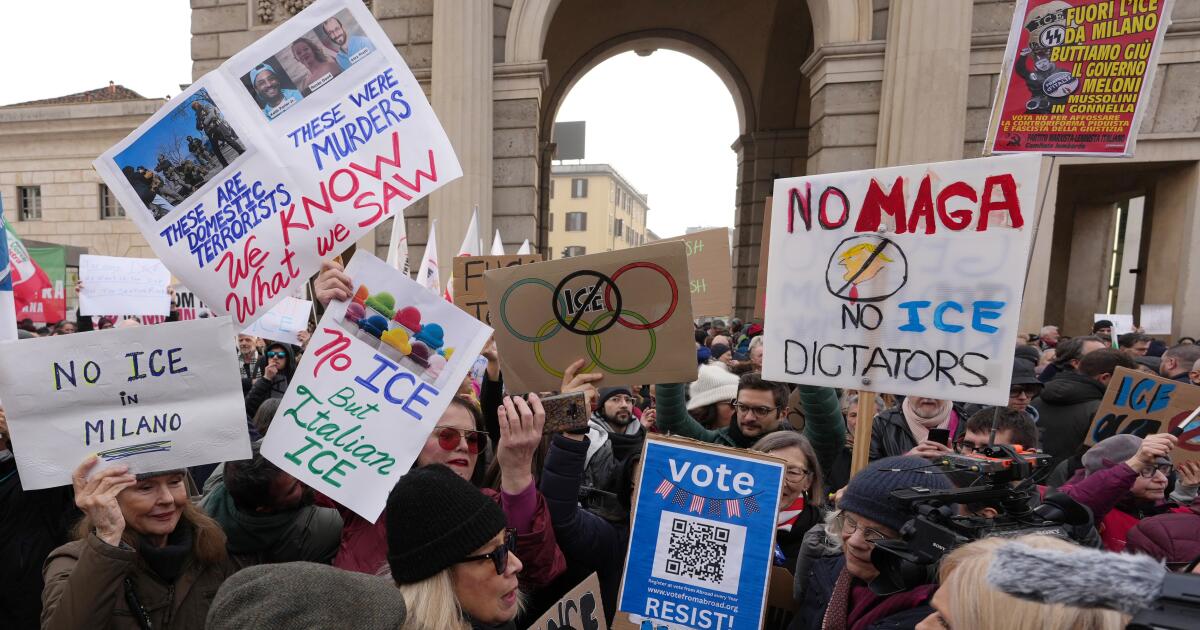
MILAN — Many of the officials supporting the nearly 250 U.S. athletes competing in this month’s Winter Olympics arrived in Italy last weekend to a greeting they may not have expected: Hundreds of demonstrators packed a square in central Milan to protest the reported plan to deploy U.S. Immigration and Customs Enforcement agents during the Games.
The first events in the 18-day competition, which will be shared by Milan and Cortina d’Ampezzo in the Italian Alps, begin Thursday and the opening ceremony is scheduled for Friday. Against that background, International Olympic Committee President Kirsty Coventry called the agents’ involvement “distracting” and “sad.”
“This is a militia that kills. They are not welcome in Milan,” Mayor Giuseppe Sala said on local radio ahead of the protests, which took place beneath the neoclassical Porta Garibaldi arch in the Piazza XXV Aprile, named for the date of Italy’s liberation from Nazi fascism in World War II.
Many demonstrators blew whistles and carried signs of the five Olympic rings rendered as handcuffs above the words “No ICE in Milan.” One woman held a handmade poster featuring photos of Renee Good and Alex Pretti, the two Minnesotans killed by federal agents last month, alongside Liam Conejo Ramos, the 5-year-old boy in the blue bunny hat who was taken from his home in Minneapolis to a detention facility in Texas.
Anti-ICE protests take place in Piazza XXV Aprile ahead of the Olympics in Milan.
(Lucia Buricelli / Associated Press)
“All the videos are public and everyone can see what’s happening,” Bruna Scanziani, an 18-year-old demonstrator told reporters. “The perception of America has changed.”
Tricia McLaughlin, an assistant secretary for the Department of Homeland Security, confirmed the presence of ICE agents in Italy to the Athletic, leaving her department, the U.S. Consulate and the U.S. Olympic and Paralympic Committee to try to cool the controversy.
DHS said the agents dispatched to Milan are not immigration agents but come from a unit known as Homeland Security Investigations, which specializes in cross-border crime. They commonly provide intelligence and security at large sporting events, both in the U.S. and overseas, but in Milan their role will be strictly advisory and intelligence-based, Ambassador Tilman J. Fertitta said.
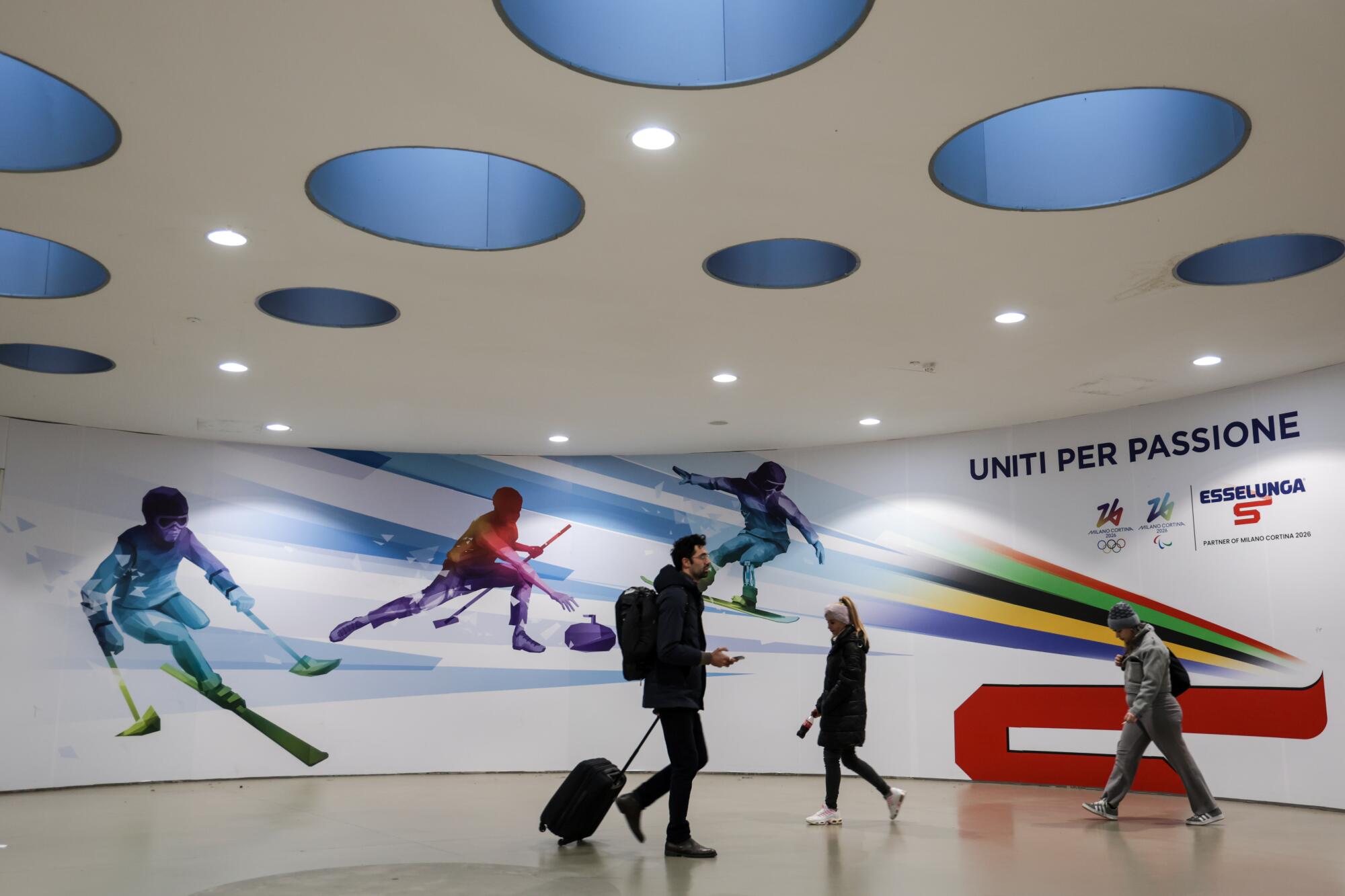
Travelers pass through the lobby of Milan Linate Airport M4 Metroline train station Tuesday.
(Robert Gauthier/Los Angeles Times)
The U.S. Olympic and Paralympic Committee, meanwhile, said it is working with the Diplomatic Security Service, which is under the umbrella of the State Department, unlike ICE, which is part of Homeland Security. The Diplomatic Security Service has been providing security for U.S. delegations at every Olympics since 1992.
“The USOPC does not work with U.S. domestic law enforcement or immigration agencies in the planning or execution of the Games, including agencies within the Department of Homeland Security often referred to as ICE,” the committee said in a statement. “Italian authorities are solely responsible for all security operations at the Games.”
Despite the tensions, in the days before the Games there were few signs of the kind of heavy security presence that marked the Paris Olympics 17 months ago. At Linate Airport, the closest of Milan’s three airports to the city center, two camouflage-clad Italian soldiers with long guns milled outside the arrival gates Monday evening. They were gone by Tuesday afternoon.
Five miles away at the Piazza del Duomo, the cultural and social heart of Milan, two pairs of soldiers stood on either side of the massive square, huddling under white awnings on either side of a pop-up Olympic souvenir tent and ignoring the hundreds of international tourists raising their phones to take photos of the ancient Gothic cathedral that gives the square its name.

A building located in the heart of Piazza del Doumo is lit up with animated Olympic competitors Tuesday.
(Robert Gauthier/Los Angeles Times)
Up the street, where the trolley tracks curve before the trendy shops and restaurants that line the busy Via Orefici, groups of city police and Carabinieri, the national police known by their black Giorgio Armani-designed uniforms, joked among themselves. They were far less menacing than the roving patrols of soldiers and police officers that were ubiquitous in France.
A local woman shrugged at the officers’ presence.
“Being the iconic and most touristy place of Milan,” she said “there are always lots of police and soldiers.”
It’s unclear how American athletes will be received during Friday’s opening ceremony, which Vice President JD Vance and Secretary of State Marco Rubio are expected to attend.
“When they have the flag and when they have the tracksuit and they’re announced as the U.S., that’s obviously an opportunity for the spectators to make known their feelings about the U.S.,” said Kristian Coates Ulrichsen, a fellow for Middle East studies at Rice University’s Baker Institute and an expert on sports and international relations.
Europeans have strong feelings about the U.S. right now, feelings spurred by more than the images of ICE agents that have led TV newscasts and have filled social media feeds for months in Italy and beyond. In the last few months, President Trump has sent forces into Venezuela to removes its president, threatened military action against Iran, fired on alleged drug boats in the Caribbean and Pacific, and disparaged Europe as “decaying” and its leaders as “weak.”

Demonstrators in Milan hold signs protesting ICE in solidarity with the people of Minneapolis on Saturday.
(Alessandro Bremec / Associated Press)
“Without us,” he said in a combative speech before the World Economic Forum in Davos, Switzerland, “you’d all be speaking German.”
What has upset the continent most amid the chaos, however, is Trump’s insistence that the U.S. take control of Greenland from Denmark, a loyal North Atlantic Treaty Organization ally, warning the Danes and seven other countries that they would be hit with 25% tariffs if they didn’t relent. Many in Europe’s far-right parties, whose members are often supportive of Trump, now consider the U.S. president an “enemy of Europe,” according to a poll published by the Paris-based platform Le Grand Continent.
As a result of the blowback, Trump has backed away from the tariff threat and said he wouldn’t take control of Greenland by force, but the fallout from tensions remains.
“Greenland, especially, has really touched a nerve. That’s unfortunate coming right in the run-up to the Olympics,” said Coates Ulrichsen, who was born in Greece to English and Norwegian parents.
And that makes the U.S. team and its 232 athletes, the largest contingent at the Milan-Cortina Olympics, a convenient foil for European wrath.
“The national team is symbolic of the nation. That just makes it such a target for any potential political frustration,” Coates Ulrichsen said. “It wouldn’t be the first time.”
During the 2004 Summer Games in Athens, for example, which opened 17 months after the American-led invasion of Iraq, the U.S. team was roundly booed.
“The Olympics have been no stranger to politics,” Coates Ulrichsen said. “And obviously the key element [of athletes] walking out behind a flag is a very easy target in a way.”
Some Italians aren’t so sure.
“My personal view is that U.S. athletes will not be targeted by the protests,” said one woman who asked that her name not be used because she works with many international clients, including some in the United States. “It is more of a political subject.”
She also said the attitude of Italian Prime Minister Giorgia Meloni, among the European leaders most supportive of President Trump, has blunted public opposition to the U.S.

The Olympic Rings ahead of the Milano Cortina 2026 Winter Olympics on Tuesday.
(Mattia Ozbot / Getty Images)
Because this month’s Games, the first Winter Olympics to officially have co-host cities, will be spread across four clusters covering about 8,500 square miles in northern Italy, there will be four opening ceremonies Friday, with the main one at San Siro Olympic Stadium in Milan beginning at 11 a.m. Pacific time. Smaller events will take place simultaneously in the mountain venues of Cortina d’Ampezzo, Valtellina and Val di Fiemme.
Bobsledder Azaria Hill, a first-time Olympian whose mother, father and aunt all competed in the Summer Games, said marching in the opening ceremony has long been a dream of hers. And she doesn’t think politics will spoil that Friday.
“Olympics brings all the nations together,” she said. “That’s one of the special things about the Olympics, and you really see that in the unity. I think everything will be fine.”
In an effort to separate athletes from politicians, the U.S. governing bodies for three winter sports — figure skating, speedskating and hockey — changed the name of their Milan hospitality space to the Winter House.
They had planned to call it the Ice House.