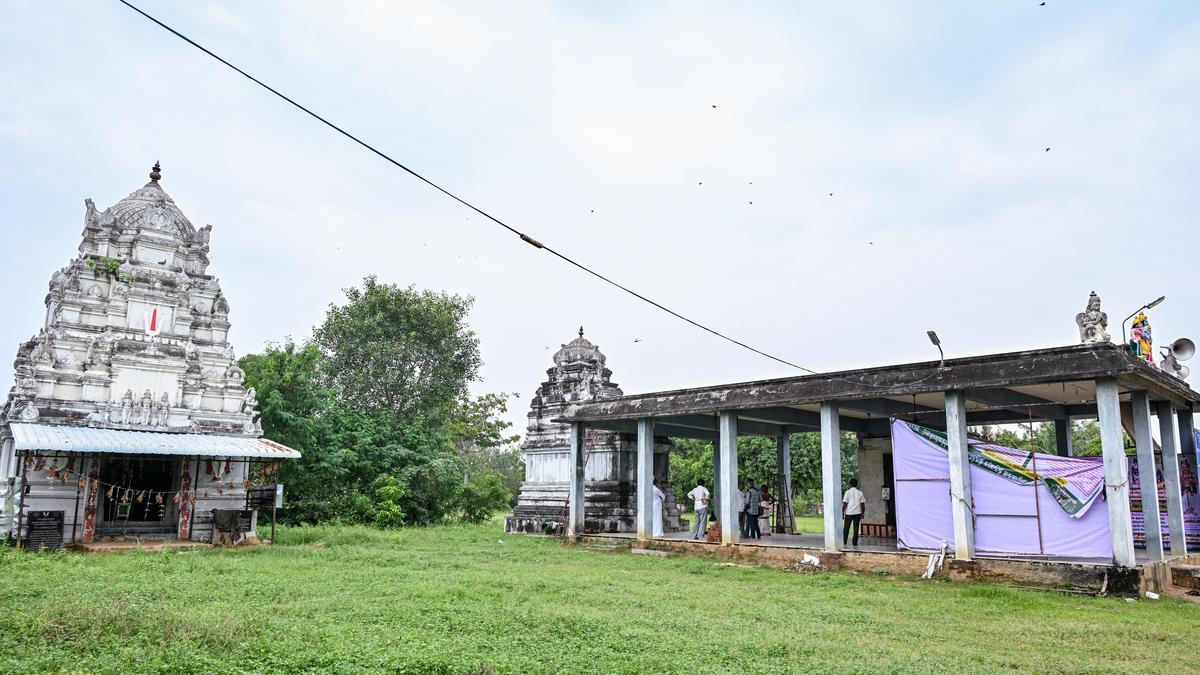
Rooted in history: The two temples, built recently at Sorgapallam or Sembodai in Ariyalur district, house the idols of Srinivasa Perumal, with his consorts Sridevi and Bhoodevi, and that of Nathamunigal.
| Photo Credit: R. VENGADESH
On a narrow, unpaved lane about a kilometre away from the Gangaikonda Cholapuram-Kumbakonam Road stands a compound housing two historically significant temples, though both are of relatively recent construction. The original name of the place is Ulagalantha Cholagam, but it is locally known as Sorgapallam or Sembodai. The entire area is overgrown with Prosopis juliflora, locally called ‘Velikathan’. One of the temples in the compound occupies a pre-eminent position in the Vaishnavite tradition. It is the ‘Thiruvarasu’, the memorial of Nathamunigal, the first Acharya of Vaishnavism, who recovered all 4,000 hymns collectively known as Nalayira Divya Prabandham, also referred to as the Dravida Veda. Enshrined in the sanctum is an idol of Nathamunigal, revered as an authority on music and depicted holding ‘thalams’ in both hands.
“An idol of Srinivasa Perumal with his consorts Sridevi and Bhoodevi was found lying half-buried under a tree. This clearly indicates that a temple once existed here but was lost in the course of time. Excavation revealed stones and remnants of the old structure. Initially, we constructed a temple and installed the idols in the sanctum. Around the year 2000, another idol was found buried in a field. It was that of Nathamunigal, and the ‘thalams’ in his hands confirmed our belief,” said Komagan, president of the Nathamunigal Thiruvarasu Arakkatallai (Trust).
Additional land bought
Mr. Komagan said the land originally belonged to the Gangaikonda Cholapuram Temple. Subsequently, the trust purchased additional land and expanded the premises. The trust conducts regular poojas. While it is beyond doubt that Nathamunigal was born at Kattumannarkudi near Chidambaram, the exact location of his ‘Thiruvarasu’ remained unclear for long. Historian T. A. Gopinatha Rao, in his book History of Sri Vaishnavas, notes that during one of his visits to Gangaikonda Cholapuram, then the capital of the Chola kingdom, Nathamunigal breathed his last. The book is based on the Sir Subrahmanya Ayyar Lectures delivered at the University of Madras in December 1917. However, Gangaikonda Cholapuram did not exist during Nathamunigal’s lifetime. The city and its temple were constructed in 1024 to commemorate the northern campaign of Rajendra Chola I. D. Gnanasundaram, author of Vaishnava Uraivalam, states that Nathamunigal belonged to the 9th Century and lived between 823 and 916 AD.
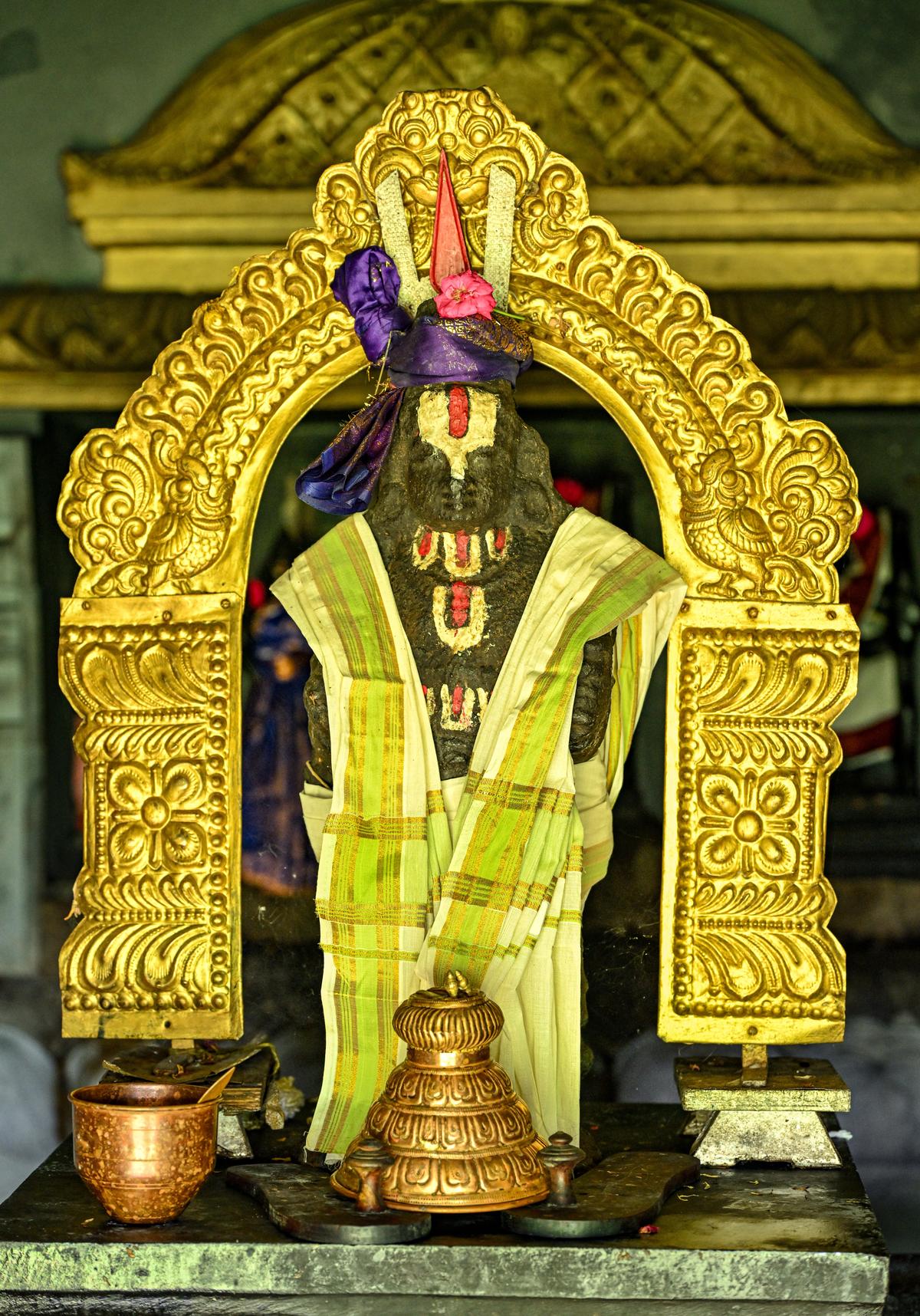
Around the year 2000, the idol of Nathamunigal was found buried in a field.
| Photo Credit:
R. VENGADESH
Mr. Gnanasundaram, a noted authority on Vaishnavite literature, citing S. Krishnaswamy Iyengar, writes that after Nathamunigal’s daughter told him that two archers and a monkey had visited their house, he went in search of them, believing them to be Rama, Lakshmana, and Hanuman. “He went up to the gates of Gangaikonda Cholapuram. When the locals told him that they had not seen anyone, Nathamunigal, longing to see them, collapsed and died,” Mr. Gnanasundaram records. These accounts confirm that Nathamunigal was in Gangaikonda Cholapuram during his final moments.
Recovering the ‘pasurams’
There are, however, multiple accounts of the place and circumstances under which Nathamunigal recovered the 4,000 ‘pasurams’. Vaishnavites accept only the Guruparampara narration. Gopinatha Rao writes that Nathamunigal once heard Vaishnavite pilgrims reciting 10 verses from Thiruvaimozhi, the work of Nammalvar, before the deity at the Kattumannarkoil temple. In contrast, Kalki Krishnamurthy, in his historical novel Ponniyin Selvan, presents a different version to emphasise the character Alwarkadiyan. In the novel, Alwarkadiyan recites Nammalvar’s verses beginning with Poliga Poliga Poyitru Valluyir Sabam at the Kattumannarkudi temple, where the priest was Isvaramunigal, Nathamunigal’s father. “Tears welled up in the eyes of Isvaramunigal. As Nathamunigal listened to the recitation, he wanted to know about them. His father wiped his tears and asked Alwarkadiyan about the remaining verses of the thousand. Alwarkadiyan replied that he knew only some ‘pathukal’ (sets of 10 verses). Isvaramunigal then requested him to teach them to his son,” the novel narrates.
An encounter at Kumbakonam
According to the Guruparampara account, Nathamunigal encountered Vaishnavite pilgrims at the Sarangapani Temple at Kumbakonam, where he heard them recite 10 verses beginning with Aravamudhe Adiyen. After hearing them, Nathamunigal asked whether they knew the entire Sathakopa, another name for Nammalvar, since the recitation ended with a line indicating that the 10 verses were part of a thousand. They said they had not learnt all the verses but told him that he could find them at Alwarthirunagari, known as Thirukurugur, now in Thoothukudi district. At Thirukurugur, Nathamunigal met Parankusadasar, a descendant of Madhurakavi Alwar, who had composed verses in praise of Nammalvar. He advised Nathamunigal to recite Kanninun Siruthambu, the work of Madhurakavi Alwar, 12,000 times before the tamarind tree under which Nammalvar had been placed by his parents. Legend holds that Nammalvar appeared before Nathamunigal and bestowed on him not merely 1,000 verses but all 4,000. The Guruparampara confirms that Nathamunigal compiled the entire corpus. A master of music, he set the prabandham to musical metres. He also standardised Vaishnavite temple worship and organised the Raapathu and Pagalpathu festivals.
Published – January 02, 2026 05:30 am IST