
- Antibiotic resistance is not just a product of modern antibiotic use but rather an ancient survival strategy.
- Microorganisms in glacier ice cores dating back millions of years have been found to carry antimicrobial resistance genes.
- Global warming and melting glaciers are releasing antibiotic resistance genes into the environment. Combined with antibiotic misuse, this could worsen the global antimicrobial resistance crisis.
Ancient ice from glaciers and permafrost reveals that antimicrobial resistance is not just fuelled by the overuse of antibiotics.
Microorganisms and free DNA, that have been preserved for thousands, even millions, of years, beneath the layers of ancient glacier ice, have been found to carry antimicrobial resistance genes. This suggests that resistance may, in fact, be an ancient biological trait.
Antimicrobial resistance (AMR), the resistance microorganisms develop to antibiotics, has been classified as one of the top 10 global public health threats. According to the WHO, antimicrobial resistance accounted for 1.27 million global deaths in 2019. In fact, the United Nations termed it a ‘silent pandemic’ and noted that the leading cause of antimicrobial resistance is the overuse and misuse of antibiotics.
However, various studies have unearthed evidence that challenges whether antimicrobial resistance is truly a modern problem.
An ancient trait
About 20% of the Earth’s surface is covered with ice. This includes the polar ice caps, glaciers in high-altitude regions, and permafrost.
The Kabru mountain peak makes up a part of it. Extending south from Kanchenjunga, it is part of the Himalayan range in Sikkim. In 1883, after a mountaineering expedition, the English barrister William Graham described Kabru as “little more than a pillar of ice”.
Nagendra Thakur, as part of a team of researchers from Sikkim University, extracted and studied 1.5-metre ice cores from the Kabru glacier at different levels. In these samples, collected in 2021, they found a rich, diverse microbial population in the glacier that became denser and more diverse in the deeper layers of the glacier. When they sequenced and studied the DNA of the major microbial populations, they found that many carried genes resistant to antibiotics. The team’s findings from the Kabru glacier ice cores have been published in a study this year in Frontiers in Microbiology.
“Antimicrobial resistance genes (ARGs) found in microbes in ancient glacier ice, some of which date back millions of years, demonstrate that resistance is a natural biological phenomenon rather than a product of contemporary medicine. Microbes have developed these genetic capabilities during billions of years of evolution, long before the ‘Antibiotic Era’, which started in the 1940s,” says Thakur.
“Resistance was a weapon one microorganism used against others in the biological warfare for resources, fought in water, soil, and in every other niche imaginable. Hence, it is least surprising that we discover resistance everywhere,” says Shraddha Karve, an assistant professor at Ashoka University, where she and her team study antimicrobial resistance in tertiary healthcare centres. Karve was not associated with the Kabru glacier study.
In another part of the world, researcher Christina Purcarea and her team trekked across the Apuseni Mountains of Romania to get to the Scărișoara Cave that has about 13,000-year-old untouched ice deposits. They extracted 5,000-year-old ice cores from depths of about 25 metres below the surface of the ice and studied the microbial populations isolated from the ice. They identified a unique strain of bacteria, Psychrobacter SC65A.3, that was not only 5,000 years old, but also had antibiotic resistance against 10 classes of modern antibiotics.
Their findings echo what the Indian researchers have also found that antibiotic resistance is an ancient trait. “Microbes were able to produce natural antibiotics for millions of years, while other microbes evolved ways to survive them. Therefore, resistance genes are part of a long-standing natural protection mechanism, not just a modern problem,” says Purcarea, reflecting what Karve also said about nature having microorganisms that manufacture their own antibiotics naturally to give them an edge against other microorganisms in the competition for food and space. She adds that extreme environments like glacier and permafrost landscapes “push” the microorganisms to develop more efficient survival strategies to cope with the stress conditions, including an increased resistance to antibiotics.
Microorganisms are highly adaptive and are found everywhere. In fact, some bacteria and archaea prefer living in extreme environments (extremophiles). So, it doesn’t come as a surprise that microorganisms have found a way to thrive in the icy landscape of glaciers and permafrost. In fact, the cold temperatures of glacier ice provide the perfect conditions for these microorganisms and their DNA to be preserved intact for thousands of years, maintaining an untouched record of evolutionary strategies. “As a ‘genetic deep-freezer,’ the cryosphere maintains functional resistance mechanisms that haven’t changed in eons,” says Thakur.


Some glaciers, like the Kabru glacier, are constantly exposed to seasonal changes and temperature fluctuations that lead to melting and refreezing of the ice. Microorganisms carrying antibiotic resistance genes may settle on the surface of the ice and over time, move deeper inside due to seasonal changes, exposing the microbial population in the deeper levels to antibiotic resistant genes.
Avinash Sharma, a scientist at the National Centre for Cell Science, Pune, who worked on a part of the study conducted by Thakur and his group, says, “Atmospheric transportation of microorganisms that carry resistance genes get deposited on the surface of the glacier and even if they do not survive there, the genetic material (DNA) can still be transferred to other microorganisms that live in the glacier by a process called horizontal gene transfer.”
Melting glaciers spread resistance genes
With increasing temperatures due to global warming, glaciers around the world are melting. Along with a rise in sea levels, this poses another problem — the release of antibiotic resistant genes and microorganisms into the current environment.
Till date, none of the microorganisms identified in glacier ice cores can directly cause infection in humans. However, while the microorganisms themselves are harmless, the spread of their antibiotic resistance genes to other microorganisms through horizontal gene transfer is a real risk.
“While environmental AMR genes are not automatically dangerous, in combination with widespread antibiotic use and pollution, they could increase the public health challenge by encouraging more gene exchange between environmental microbes and those that affect humans,” says Purcarea.
The rate of glaciers melting has only increased in the past decade. Between 2000 and 2003, 273 billion metric tonnes of glacier ice have been melting every year on average. As meltwater from the Himalayan glaciers runs into the streams and rivers that connect civilizations all over India, there is potential for antibiotic resistance genes to spread the same way. Although this wouldn’t immediately cause a global health crisis, experts suggest it will ultimately contribute to the ‘silent pandemic’ that is antimicrobial resistance.
Citation:
- Tamang, Sonia, et al. “Exploring the Bacterial Diversity and Its Antibiotic Resistance in Kabru Glacier Ice Cores, Sikkim Himalaya.” Frontiers in Microbiology, vol. 16, 28 Jan. 2026, https://doi.org/10.3389/fmicb.2025.1672943.
- Paun, Victoria Ioana, et al. “First Genome Sequence and Functional Profiling of Psychrobacter SC65A.3 Preserved in 5,000-Year-Old Cave Ice: Insights into Ancient Resistome, Antimicrobial Potential, and Enzymatic Activities.” Frontiers in Microbiology, vol. 16, 17 Feb. 2026, https://doi.org/10.3389/fmicb.2025.1713017.
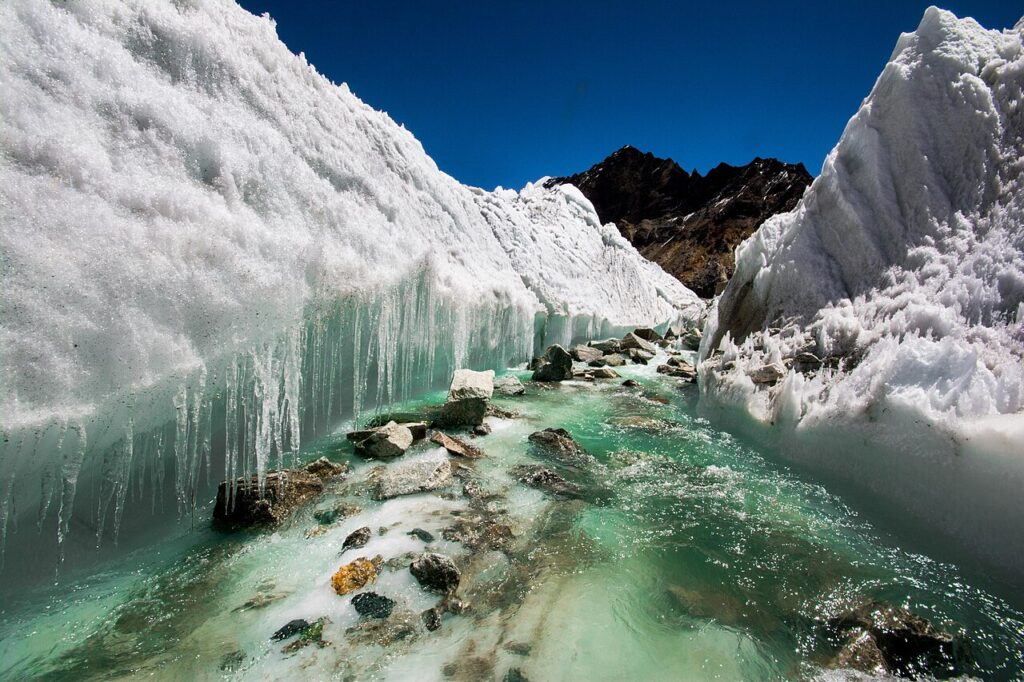
Banner image: Representative image of melting glaciers in Uttarakhand. Global warming and melting glaciers are releasing antibiotic resistance genes into the environment. Image by Sharada Prasad via Wikimedia Commons (CC BY 2.0).

