
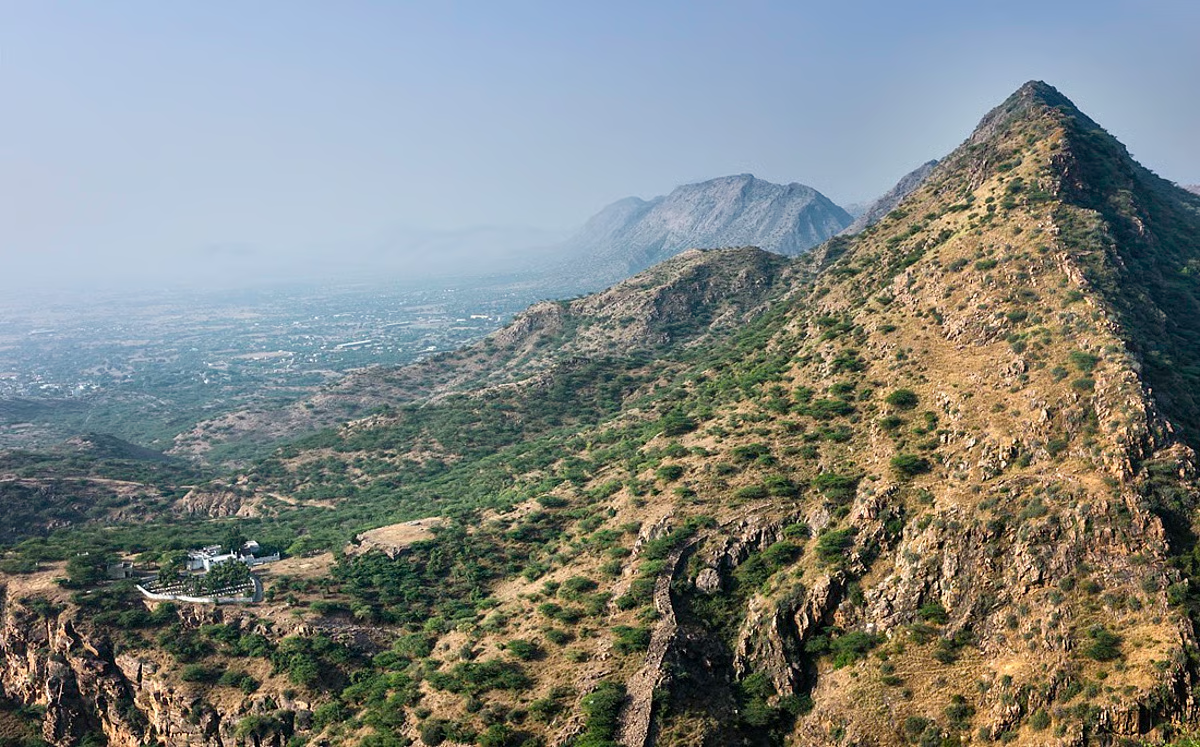
The Supreme Court’s directives to the central government and its claim that ‘No new mining leases be granted’ for the Aravallis is not entirely true.
This particular direction of the apex court and the recommendation of the Union government only apply with respect to general minerals.
According to the report of the panel tasked by the Supreme Court with defining the Aravalli hills titled Uniform definition of Aravalli Hills and Ranges, the members were of the view that these restrictions on mining projects should only be applied to grant of new leases for general minerals and are not applicable for critical strategic and atomic minerals.
These atomic minerals are notified in the First Schedule of Mines and Minerals (Development and Regulation) Act (MMDR Act, 1957). This exception is recommended considering their strategic and defence significance and national security considerations and the fact that they are critical for overall economic growth and development.
Moreover, the clause of ‘No new mining leases be granted’ is temporary as the mining for general minerals would also be granted eventually, once guidelines are laid out.
The committee noted that the Aravalli hills are host to several important major minerals such as lead, zinc, silver, copper ore, etc., which are deep-seated and critical minerals and are essential for the economic development of the country and its transition to cleaner sources of energy.
“These deep-seated and critical minerals are site specific, and the country is presently reliant on imports to meet the demands of these minerals. Therefore, these minerals are important from the national security point of view,” the committee observed.
In addition, the Aravalli-Delhi system has been identified as having significant potential for critical minerals such as tin, graphite, molybdenum, niobium, nickel, lithium, and rare earth elements (REEs), all of which are of growing strategic relevance for energy transition, high-technology manufacturing, and national security, according to the report.
The chief secretary of the Union Ministry of Environment, Forest & Climate Change’s (MOEFCC) Survey & Utilisation Division said in a letter dated December 24 to the governments of Haryana, Rajasthan and Gujarat that no new mining leases be granted till the finalisation of the Management Plan for Sustainable Mining (MPSM) for the entire Aravallis.
The task to lay out the MPSM has been assigned to the Indian Council of Forestry Research & Education (ICFRE) and will be finalised by the MoEFCC.
The chief secretary also wrote to ICFRE to identify permissible areas for mining — ecologically sensitive, conservation-critical and restoration-priority areas within the Aravalli landscape where mining shall be strictly prohibited or permitted only under exceptional and scientifically justified circumstances.
But this MPSM will be based on the Saranda wildlife sanctuary template, identifying it as a successful precedent for balancing industrial needs with ecological preservation.
The apex court, in its order dated November 20, said, “Sustainable Mining in Saranda and Chaibasa, Singhbhum District, Jharkhand was carried out. In the said matter, we had noticed that ICFRE’s geo-referenced ecological assessment enabled the identification of areas suitable for mining, areas requiring strict ecological protection and zones where biodiversity values necessitated conservation priority.”
Taking cue from its previous judgement on November 13, the court observed, “This court has directed the Wildlife Sanctuary to be established insofar as the compartments which were identified as conservation areas/no mining zones. However, this Court explicitly excluded the compartments wherein the MPSM found that sustainable mining could be permitted.”
Saranda is aimed to act as a blueprint, as the method was crucial for identifying critical wildlife habitats, corridors and rich forest areas that are to be kept inviolate for posterity.
Noting that the Aravallis are one of the oldest geological features of planet Earth, it said, “We are, therefore, of the considered opinion that if such an MPSM is carried out for the Aravali Hills and Ranges, it can also identify the areas where sustainable mining activities could be permitted.”
Meanwhile, existing mining is expected to continue and renewals would be allowed under strict regulations.