David SilverbergTechnology Reporter
 Getty Images
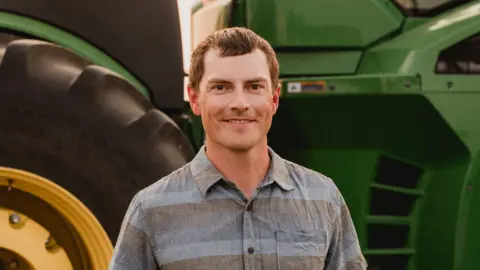
Jake Leguee is a third-generation farmer in Saskatchewan, Canada.
Since his grandfather bought the 17,000 acres in 1956, the Leguee family has grown canola, wheat, flax and green lentils.
As a child, he watched his father and grandfather spending hours riding their tractor to sow seeds and spray crops. Sweat would coat their shirts after those long, hot days.
“It was a lot less efficient back then,” says Leguee. “Today, technology has vastly improved the job that we do.”
To keep his farm competitive, Leguee has made several innovations, particularly when it comes to crop spraying.
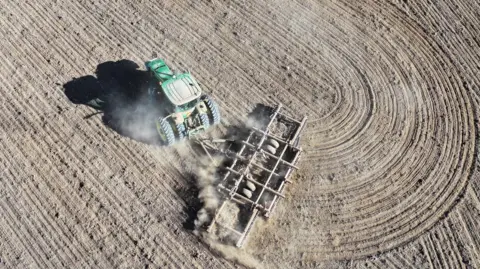
With software and remote cameras attached to his John Deere tractor, he can kill the weeds much more efficiently, a practice every farmer has to do before planting seeds.
“It can look down and spray a nozzle when the sensors pick a weed, while we’re going around 15 miles an hour,” Leguee says.
He adds that he saves on pesticide spray since the nozzles only turn on when weeds are detected, as opposed to the kind of blanket spraying he used to do.
The return-on-investment for adding these new layers to his farm operations are often high, Leguee adds.
“There are low-cost solutions that won’t be as expensive as new spraying tech, and they could be an app to help you better keep your records, for example,” he says.

 Jake Leguee
It’s a lesson that farmers across North America are taking on board.
A 2024 McKinsey survey found that 57% of North American farmers are likely to try new yield-increasing technologies in the next two years.
Another report, from 2022, by the US Department of Agriculture said that while the number of farms in the country is shrinking, the farms that remain are becoming “tech dense”.
Norah Lake, the owner and farmer at Vermont’s Sweetland Farms, says to get a successful harvest, “there’s a lot of looking forward and then backwards and then forwards and then backwards in crop farming”.
She once used Microsoft Excel to plug in the figures for, say, their yields from a recent harvest, or a given year, and see how they compare to years prior.
“I’d want to know that if we planted 100 bed feet of broccoli, what did we actually produce?” she says.
More recently, Lake, who grows vegetables such as asparagus, tomatoes and zucchini, as well as pastured meat, has been using software and an app from a company called Tend.
She wanted to digitise and streamline those laborious tasks into a piece of tech that she can view on her cellphone or computer.
Now she can input those harvest numbers into Tend, and the software can give her details, and advice, on how to manage her crop best for the coming harvest.
“We can use Tend to calculate the quantity of seed that we need to order based on the row feet of a particular crop that we want to harvest,” she says.
 Syngenta Group
There’s no shortage of tech for farmers to choose from.
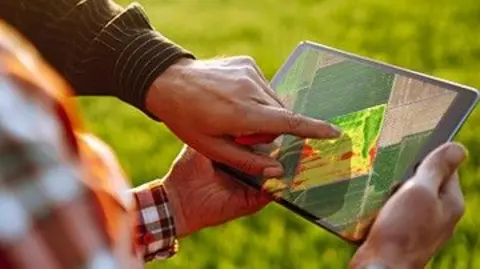
Sygenta, the argri-tech giant based in Switzerland, offers farmers the software Cropwise, which uses AI and satellite imagery to guide farmers on what to do next with their crops, or alerts them to emergencies.
“It can tell the farmer that you need to visit the southeast corner of your field because something is not right about that section, such as a pest outbreak,” says Feroz Sheikh, chief information office of Syngenta Group. “And the system also has 20 years of our weather pattern data fed into a machine learning model, so we know exactly what kind of conditions lead to what outcome.”
With that data, farmers can cover their crops before, say, an incoming snap frost that could kill a large portion of their acreage.
In Germany, Jean-Pascal Lutze founded NoMaze to give farmers a deeper understanding of how different crops will perform under climate conditions.
Its software is rolling out this year. “We did field tests in a variety of environments and then created simulations through our computer model to give clients better insight into, say, how much water to use, how to get the maximum yield,” he explains.
 Getty Images
The impact of these technologies might be felt by the consumer, says Heather Darby, an agronomist and soil specialist at the University of Vermont.
Bringing more food to market could translate to lower prices at the register, she says.
“When farmers get help to avoid crop failures, that could lead to a more controlled farm environment and a reliable and secure food system,” says Darby.
Back in Saskatchewan, Darby notes younger farmers are turning to technology while older tillers might resist major change.
He says that farmers need to be open to change.
“After all, when you think about it, some of these farms are multi-million-dollar businesses that are supporting multiple families. We need to embrace technology that works for us.”
“I heard someone say once: ‘If you treat farming as a business, it’s a great way of life, but if you treat your farming as a way of life, it’s a horrible business.'”