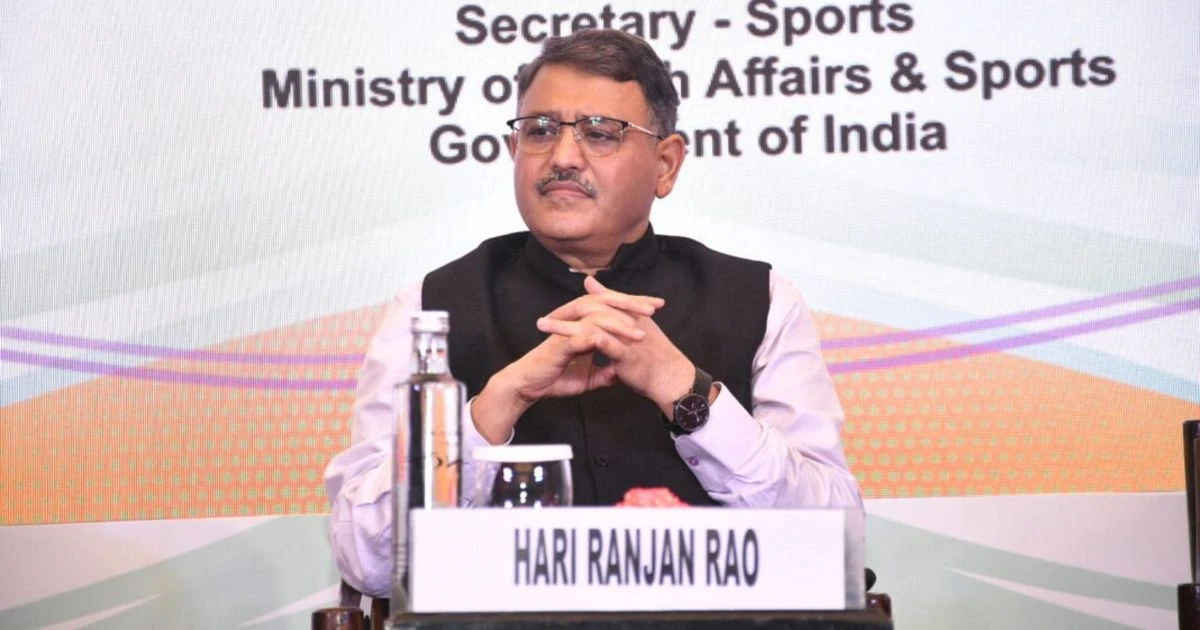
India’s ambition to host the 2036 Olympic Games must be matched by a fundamental expansion of its sporting depth and administrative seriousness, Sports Secretary Hari Ranjan Rao said on Friday, warning that current participation levels across disciplines paint a worrying picture for a prospective host nation.
“This is a painful scene. We think we will host the Olympics and not even participate in half the disciplines. With these kinds of statistics, are we ready to host the 2036 Olympics?” Rao said, underscoring the gap between India’s aspirations and its present capabilities in high-medal Olympic events.
Speaking at the Sports Governance Conclave in Ahmedabad, Rao made it clear that hosting the Olympics cannot be reduced to infrastructure creation or political intent alone, but must be backed by sustained athlete development, long-term planning and accountable sports administration.
2036 Olympics bid needs deeper sporting ecosystem
Rao noted that countries which have successfully hosted the Olympics have used the opportunity to dramatically lift their medal tallies by investing years in building strength across multiple disciplines. China, he said, was a prime example.
Ahead of the 2008 Beijing Games, China launched ‘Project 119’, focusing on five disciplines — athletics, swimming, rowing, kayaking-canoeing and sailing — areas where it was not traditionally dominant. The outcome was a haul of 48 gold medals overall, including eight from those five focus sports.
“That kind of strategic clarity and discipline is what is expected from us as well. We need to ask where we stand today,” Rao said, adding that hosting the Olympics without competitive representation across disciplines would undermine India’s global sporting credibility.
He pointed out that at the 2028 Los Angeles Olympics, which will feature 353 events, India’s participation is expected to be significantly lower than that of sporting powerhouses such as the US and China, which field large squads across most disciplines.
Government’s 10-year medal roadmap
Rao outlined a 10-year medal strategy that has received the approval of Prime Minister Narendra Modi, setting ambitious but measurable targets for India’s Olympic performance.
According to the roadmap, India must aim for 35 to 40 gold medals and around 100 total medals at the 2028 Los Angeles Games to enter the top-10 bracket. Looking further ahead, the goal for the 2036 Olympics is 12 to 14 gold medals and 30 to 35 overall medals to remain competitive among leading sporting nations.
“Only then can we realistically talk about being in the top-10 club. Hosting the Games should accelerate that journey, not expose our limitations,” Rao said.
Structural reforms to support Olympic ambition
To bridge the gap, the sports secretary outlined a set of structural reforms that could prove transformative if implemented effectively. These include the establishment of Olympic Training Centres for every sport, an AI-driven athlete monitoring system to identify and track talent, and the creation of a National Institute of Sports Science and Research to support evidence-based training and recovery.
Rao also revealed that a committee led by former badminton player and coach Pullela Gopichand has recommended sweeping coaching reforms. The government plans to introduce a national coaching certification board that will provide tiered accreditation for coaches at grassroots, intermediate and elite levels.
Such reforms, he said, are essential to ensure quality coaching pipelines and consistent athlete preparation across states and federations.
Warning to federations: athletes come first
Beyond long-term planning, Rao also issued a sharp warning to sports administrators, urging them to prioritise athletes over personal convenience at multi-sport events.
Cracking the whip on federations, he cautioned officials against treating international competitions as family outings and stressed that administrators must be available for athletes at all times.
“It would be shameful if a large contingent of officials goes and not one is available when the athlete needs them. They have to be there 100 per cent of the time. If you think this is an outing with relatives, please don’t go. We don’t need you,” Rao said.
The conclave was attended by Union Sports Minister Mansukh Mandaviya, Gujarat Deputy Chief Minister and Sports Minister Harsh Sanghavi, and senior officials from the Indian Olympic Association and national sports federations.
Asian Games and CWG targets under scrutiny
Rao also reviewed India’s short-term performance outlook, placing the Asian Games medal estimate at 111, an improvement over the best-ever tally of 106 at the previous edition in Hangzhou.
However, expectations for the Commonwealth Games have been revised downwards to around 20 medals after the omission of sports where India traditionally excels, including badminton, hockey, shooting and wrestling. Officials are projecting three gold medals and 22 overall medals due to the truncated programme.
As preparations intensify for events in Japan, Rao emphasised that athletes must also be trained in social and cultural etiquette, warning that even minor lapses could reflect poorly on the country.
“We can’t afford even one mistake,” he said, reinforcing that professionalism on and off the field will be critical as India pushes towards its Olympic ambitions.
Taken together, Rao’s message was unambiguous: without urgent reforms, wider participation and administrative accountability, India’s dream of hosting the 2036 Olympics risks running ahead of its sporting reality.