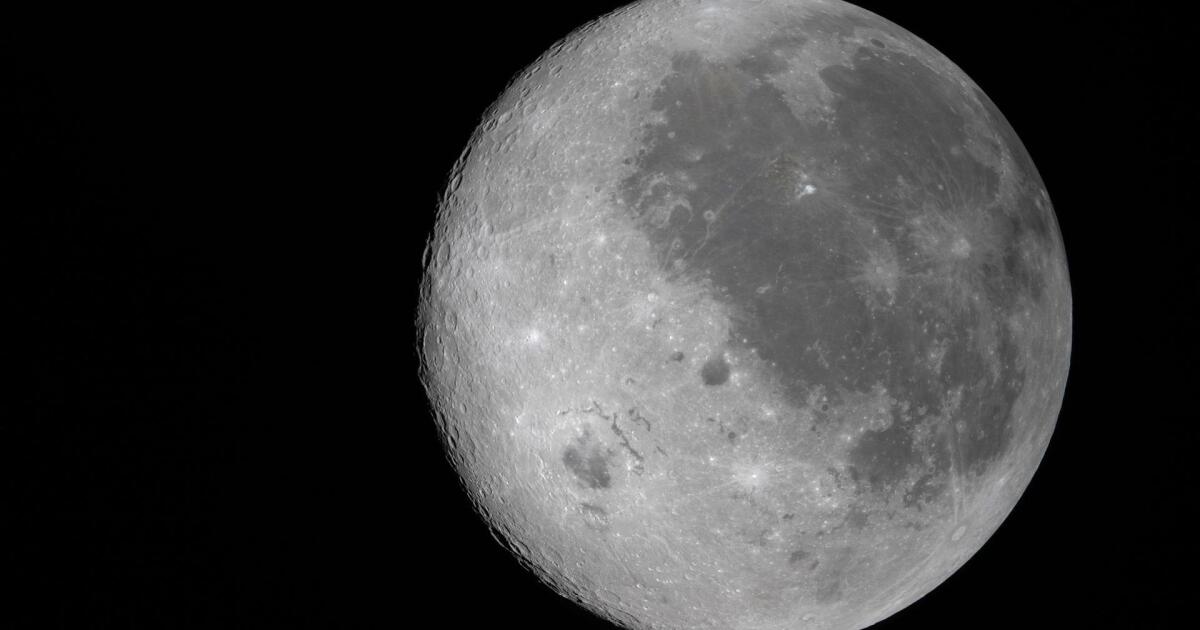
NASA’s Artemis II crew, farther from Earth than any humans before them, are preparing for their event-filled six-hour flyby of the moon after five days traveling through space.
At approximately 11 a.m. Pacific time, the crew reached another milestone: At more than 248,655 miles from our pale blue dot, no humans have ever traveled farther from our home planet.
“We do so in honoring the extraordinary efforts and feats of our predecessors in human space exploration,” said Canadian astronaut and Artemis II mission specialist Jeremy Hansen. “We will continue our journey even further into space before Mother Earth succeeds in pulling us back to everything that we hold dear. But we most importantly choose this moment to challenge this generation and the next to make sure this record is not long lived.”
The previous record holders were the Apollo 13 astronauts, who accidentally set the mark after an oxygen tank on their spacecraft exploded shortly after they reached space, forcing them to slingshot around the moon and back without landing on it.
Over the next few hours, the crew will begin making observations of the far side of the moon. With the near side of our natural satellite permanently locked facing Earth in an eternal staring contest, the far side has been viewed many times with space-based telescopes and sensors, but seldom with the naked human eye.
At approximately 3:45 p.m. Pacific time — about an hour after the crew’s lunar observations begin — NASA expects the spacecraft to lose communication with Earth for roughly 40 minutes as it passes behind the moon. During this eclipse of Earth, the crew members will reach their closest point to the moon at about 4,070 miles, with the moon appearing about the size of a basketball held at arm’s length. Shortly after, the crew members will reach their farthest point from Earth at roughly 252,760 miles.
The crew will then experience an Earthrise — the sight of our home planet rising above the moon’s horizon, memorialized in a famous photo from the Apollo 8 crew — as it regains a signal from Mission Control at approximately 4:25 p.m. Pacific time.
At about 5:35 p.m. Pacific time, it will be the sun’s turn to get eclipsed by the moon, with the spacecraft plunging into the darkness of the moon’s shadow for an hour.
NASA is livestreaming the flyby across the internet, including on YouTube, X, Netflix and HBO Max.
The Artemis II mission is one in a series of international efforts spearheaded by NASA to return humans to the lunar surface for the first time in over a half-century.
Artemis I in 2022 was an uncrewed flyby of the moon to test out the vehicle. Artemis II is primarily focused on assessing the life support systems. Artemis III, in Earth’s orbit, aims to test docking procedures with SpaceX’s and Blue Origin’s lunar landers next year, and Artemis IV, slated for 2028, hopes to put boots on the dusty lunar surface.
After a powerful liftoff Wednesday, Artemis II’s journey to the moon has been about as mundane as a deep space mission can get.
The crew spent some time troubleshooting the toilet, with NASA astronaut and Artemis II mission specialist Christina Koch proudly embracing the title of “space plumber.” The team suspected that a vent had frozen over, so they gently turned the ship so that the vent faced the sun, warming it up.
At another point, NASA astronaut and Artemis II commander Reid Wiseman called down to Earth to NASA’s IT specialists on the ground to report that both versions of Microsoft’s email program Outlook installed on his computer were not working.
The crew’s back and forth with Mission Control also included a complaint that, after playing Chappell Roan’s “Pink Pony Club” to wake up the crew, Mission Control annoyingly cut off the song right before the chorus. The crew also called Mission Control to ask whether they could see the spacecraft wiggling as Wiseman rocked the ship while exercising on the flywheel (which both agreed was not an issue).
After the lunar flyby, the crew has another four days of (hopefully) mundane travel before a high-energy reentry and splashdown off the coast of San Diego on Friday.