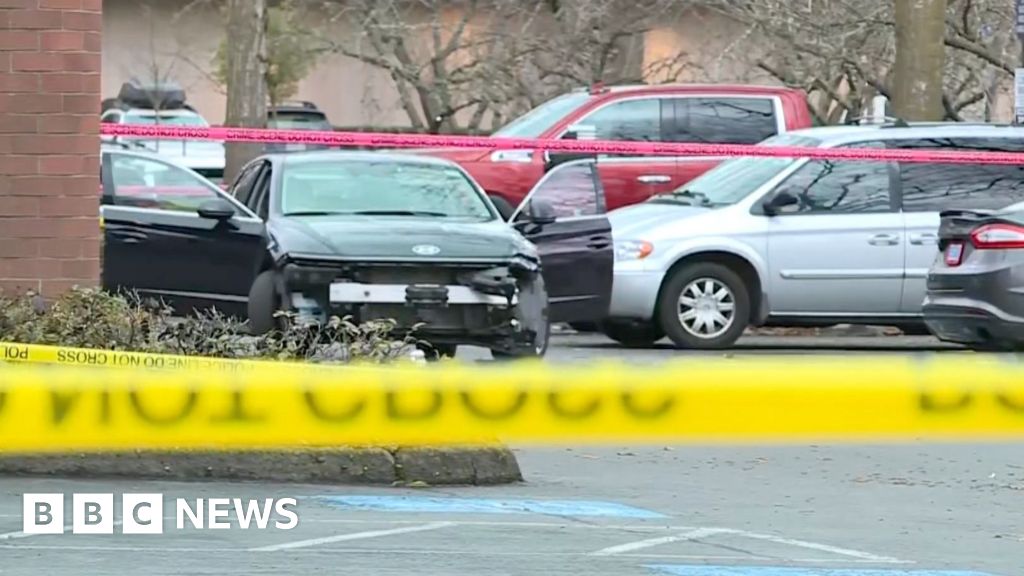
For more than a decade, activist Mark Baumgartner has protested peacefully against abortion outside a women’s health clinic near the South Carolina state Capitol in Columbia, wearing an official-looking traffic vest – and carrying a pistol.
But in November, he and another man got into a confrontation at one of the protests, and video footage shows the two men scuffling. A few moments later, as the men move off-camera, a gunshot is heard.
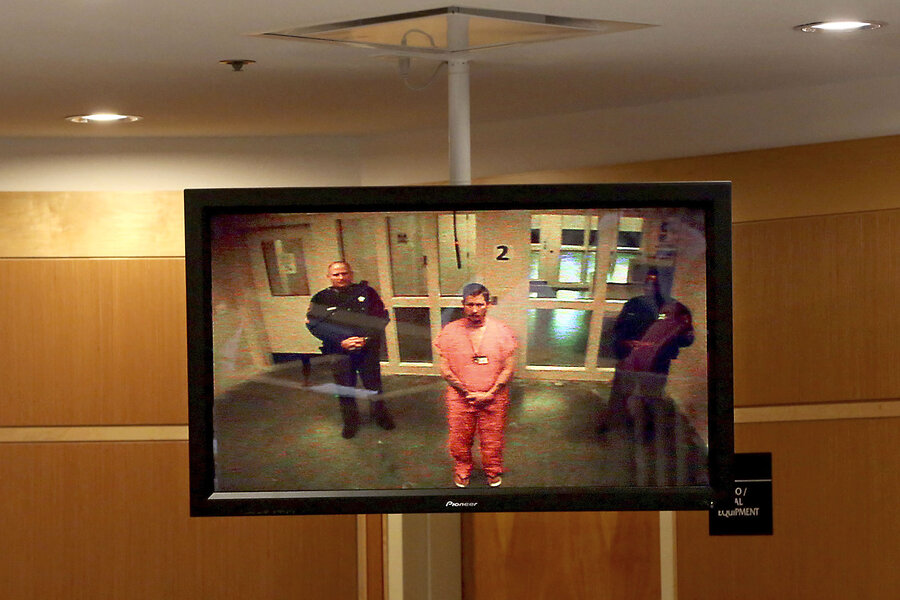
Later, when police arrested Mr. Baumgartner for assault with a deadly weapon, his lawyer called the non-fatal shooting an open-and-shut case of self-defense under South Carolina’s stand-your-ground law.
Why We Wrote This
After 20 years of stand-your-ground laws, spreading to most U.S. states, experts see an accompanying rise in shooting deaths. South Carolina offers a lens on the issue.
Clear-cut or not, the case symbolizes how America’s legal landscape around gun use has been shifting because of laws that reinforce and expand the ability of citizens to use lethal force to protect themselves.
Twenty years after launching in Florida in October 2005, stand-your-ground laws have spread across the United States, including here in South Carolina.
In Mr. Baumgartner’s case, in addition to citing the state’s 2006 law, his defense will likely be bolstered by new rules that make it more likely a judge, not a jury, will determine the outcome. Under a new immunity-hearing system, in more than half of cases in South Carolina, shooters claiming self-defense under the stand-your-ground law go free, according to Joshua Dressler, a law professor at Ohio State University.
“In South Carolina, people are walking around in gas stations and restaurants with guns stuck to their hips,” says Morgan O’Bryan Martin, a South Carolina attorney who specializes in stand-your-ground defenses. “The old school common law [where stepping away from violence if possible was required] … is a little bit outdated in the world that we live in.”
At the same time, adds Mr. Martin, stand-your-ground laws are fueling uncertainty about when to retreat and when to shoot. “There is no bright-line rule,’’ he says. “That causes a lot of confusion and can lead to very tragic results.”
A shifting calculus of self-defense
Currently, more than half of U.S. states have passed some form of stand-your-ground law. Those laws are associated with a roughly 8% increase in firearm homicides, according to a 2022 study published in the Journal of the American Medical Association. Those are “deaths that could potentially have been avoided,” concluded the study’s co-authors, including Douglas Wiebe, a professor at the University of Michigan School of Public Health. Alabama, Missouri, and Florida – all states with these laws – have seen homicide rates rise by about 30% in recent years.
Separate research, co-authored by Professor Wiebe and focused on Florida, found that both “justifiable” and unlawful homicides rose significantly after the change in law.
Nationwide, experts say the laws have shifted the calculus of self-defense.
South Carolina’s law, for example, removes a person’s traditional common law “duty to retreat” before using deadly force in response to a threat. It expands what’s known as the “castle doctrine” to allow citizens to use lethal force not just to protect themselves in their homes but also in places like their vehicles and businesses.
Weapons, particularly a proliferation of guns, also play a role in current shifts. Since 2024, the Palmetto State has transitioned from a permit-based system to a permitless one. That means that people 18 and older can buy and carry guns, openly or concealed, without a permit or training. South Carolina also now allows guns in some places that serve alcohol if the gun holder isn’t drinking, and offers a legal pathway for people with prior gun-possession charges to get their criminal records expunged.
These changes here have come alongside rising fatalities. From 2014 to 2023, the number of overall gun-related deaths and homicides in South Carolina increased by 23% and 60% respectively.
This is where stand-your-ground defenses come into focus.
A robbery, a tussle, and a deadly car chase
In November, a Columbia shop owner named Rick Chow lost a stand-your-ground hearing after shooting someone he said was trying to rob his store. Mr. Chow chased the man out of the store and shot him in the back, claiming he acted in self-defense.
That same month, a South Carolina judge absolved a teenager charged with murder after a stand-your-ground hearing, ruling that the young man was justified in shooting another teen following a struggle between the two outside a convenience store. While the shooter was too young at the time to carry a gun legally, the slain man “initiated the confrontation that led to his demise,” the granted motion reads.
Then there was the 2023 road-rage case involving a nine-mile car chase on a rural road near Myrtle Beach. A local businessman, Weldon Boyd, and a friend were pursuing a truck driven by a man who they said had waved a gun at them. Narrating the chase to a 911 operator, Mr. Boyd stopped when the alleged gun-waver’s truck in front of him stopped. In the ensuing confrontation, Mr. Boyd says he fatally shot the other driver in self-defense.
He was quickly cleared under the state’s self-defense law. But the Wall Street Journal later reported that Mr. Boyd, in a recorded phone call with a friend, called the chase “a good time.”
The Journal also reported that a police deputy – who knew Mr. Boyd – scribbled a note to him at the scene: “ACT LIKE A VICTIM. Camera.”
Mr. Boyd and his co-defendant now face a hearing next month that could determine the future of a wrongful death civil lawsuit filed by the sister of the man who died during the altercation.
“Dead men don’t get to tell their tale, so the truth becomes whatever the shooter wants it to be,” says Douglas Cornelius, a barber in Port Royal, who, in response to a rash of shootouts in the Low Country near the South Carolina coast, now displays a “no weapons” sign in his barbershop window. “These laws should never have been changed. They should be repealed.”

Patrik Jonsson/The Christian Science Monitor
Varied public views on guns and safety
On the other side of the debate, many U.S. citizens believe an armed society can help discourage violent crime. A 2023 NPR/PBS NewsHour/Marist poll found that 58% of Americans support stand-your-ground laws.
But public attitudes are nuanced. In the same poll, 6 in 10 respondents said it is more important to control gun violence than to protect gun rights. And people are much more likely to say that their first thought after news of a mass shooting is that the nation needs stricter gun laws (62%), not that more people should carry guns (35%).
Over the past 20 years, homicides and gun violence have increased in states with stand-your-ground laws, prompting critics to insist that such laws embolden gun carriers and lead to unnecessary deaths. But a RAND analysis of stand-your-ground studies, while acknowledging evidence of a rise in gun deaths, says the laws may deter crime.
The push to immunize defendants in self-defense cases is, meanwhile, tapping into social and political currents in contemporary America, says Eric Ruben, a law professor at Southern Methodist University and an expert on the regulation of weapons and violence in the U.S.
“The public view of self-defense has shifted in certain parts of the country to almost view it as just a public good, one that should not be exposed to ordinary criminal processes,” he says.
That shift – and its effects – are now playing out in courtrooms across the country.
The expansion of self-defense laws, as well as of gun access – has become an “invitation to violence,” says Caroline Light, a Harvard University historian and author of “Stand Your Ground: A History of America’s Love Affair With Lethal Self-defense.”

“Their proliferation – and the mentality that gives them fuel – has become more strongly rooted in our culture,” she says.
Stand-your-ground laws, while concentrated in the South and in Republican-dominated states, also exist in some liberal or battleground states such as Washington, Nevada, and Michigan.
The trend has continued. In 2012, Indiana legislators allowed the use of force against police, if they unlawfully enter a citizen’s home or car. And a Missouri appeals court this year interpreted the state’s stand-your-ground law to justify a deadly response even if the provocation wasn’t more than a shove. Prosecutors protested, urging the state Supreme Court to intervene.
A pivot from judicial traditions
In theory, stand-your-ground laws protect regular citizens from prosecution for defending themselves from unprovoked attacks.
But in practice, studies show wide disparities in outcomes. The laws are more likely to protect armed white men than armed Black men, lawyers say. Women also tend to face a greater degree of scrutiny in cases where they claim self-defense against an alleged aggressor.
Immunizing self-defense claimants also distances private violence from citizen juries, upsetting an intentional constitutional balance, some legal experts say. After all, juries don’t just seek the truth. They also help define a community’s values.

America’s traditional self-defense laws, based on the English common law-based duty to retreat, hinge on the idea that killing an aggressor is a last resort and should only employed if there’s no other way to save your own life.
“If you can retreat to a safe place, you’re expected to do that,” says Professor Dressler from Ohio State. “‘Stand your ground’ … changes that basic principle about human life.”
Early critics of stand-your-ground laws worried about a Wild West mentality taking hold. But the fact is that legendary Old West towns such as Tombstone, Deadwood, and Dodge City had strict gun-control laws, based on a perception that guns, by their presence, fuel conflict, writes Adam Winkler in his book “Gun Fight,” about the evolution of gun laws.
Hannah Hill, executive director of the National Foundation for Gun Rights in Loveland, Colorado, concedes that poor decisions around guns might be part of the bigger problem. “Most of us have various moments of non-brilliance,’’ she says. “It’s a messy world out there.”