Although it wasn’t dangerous, the consistent excessive seam movement throughout the match made batting very difficult as it was the first Test in Australia since 1932 where no individual batter reached 50.
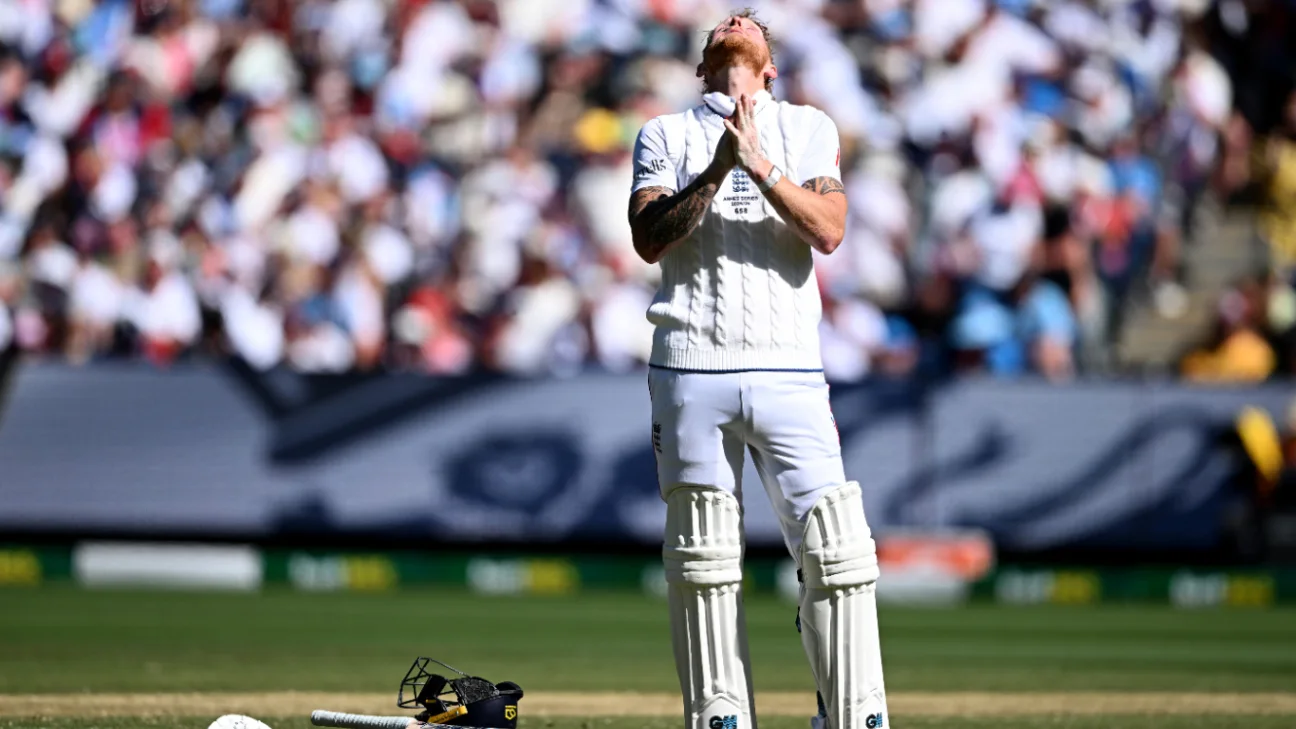
Stokes was blunt in his assessment of the surface post match.
“Being brutally honest, that’s not really what you want,” Stokes said. “Boxing Day Test match. You don’t want a game finishing in less than two days. Not ideal. But you can’t change it once you start the game and you’ve just got to play what’s in front of you.
“But I’m pretty sure if that was somewhere else in the world, there’d be hell on. Not the best thing for games that should be played over five days. But we played a type of cricket that ended up getting the job done.”
Stokes was asked if he was referring to what the reaction would be if a two-day Test had been played on a pitch on the subcontinent.
“It’s your words, not mine,” Stokes said.
He was also asked what his feedback would be to the match referee about the pitch.
“It won’t be the best,” he said.
MCG curator Matt Page had elected to keep 10mm of grass on the surface despite cool and damp weather in Melbourne in the lead in, having presented a pitch with 7-8mm of grass in warmer conditions on Boxing Day 2024 which produced a five-day classic that ended in the final session of the match. Smith felt there was too much grass but did not want to be ultra critical.
“Obviously, it was a tricky one,” Smith said. “Thirty-six wickets over two days, it probably offered just a little bit too much. It’s tough as a groundsman. I think he’s always looking for the right sort of balance, I suppose. Last year’s wicket was an outstanding one, it went to day five last session.
“In an ideal world, every wicket does that and it’s exciting for everyone. But yeah, maybe if you took it from 10 [millimetres] to eight, it would have been a nice, challenging wicket, maybe a little bit more even, I suppose. But groundsmen are always learning and yeah, he’ll probably take something from that, no doubt.”
The Test last only 852 balls, just five more than the game in Perth, and is set to cost Cricket Australia millions of dollars as more than 90,000 were expected to attend day three and another huge crowd was expected for day four, with all tickets to be fully refunded.
It was also the first time in Test history in Australia that a game had been completed without a ball bowled by a spinner. Australia have played four seamers in two of the four Tests this series and Nathan Lyon only bowled two overs in their two-day win in Perth.
Smith said the state of Australian pitches at the moment meant spin was not really an option for a captain to turn to.
“A lot of the wickets we’re playing on now, I think spin has been … it’s the easiest thing to face on some of these wickets that are offering a lot of seam,” Smith said. “It’s almost to the point where, why would you bowl it when you could leak 30 or 40 runs quickly if they decide to play positively, and the game shifts immediately?
“Obviously Perth Stadium, we barely bowled spin, two overs maybe. We didn’t bowl a spinner in the pink-ball Test. And last week [in Adelaide] was obviously a different one. There was quite a dry surface and it offered some rough which was a nice wicket.
“And then this one, spin didn’t look like getting a chance to bowl. So I don’t know whether it’s something that can be spoken about. I love seeing spinners play a part in the game, but right now, why would you?”
Alex Malcolm is an associate editor at ESPNcricinfo