
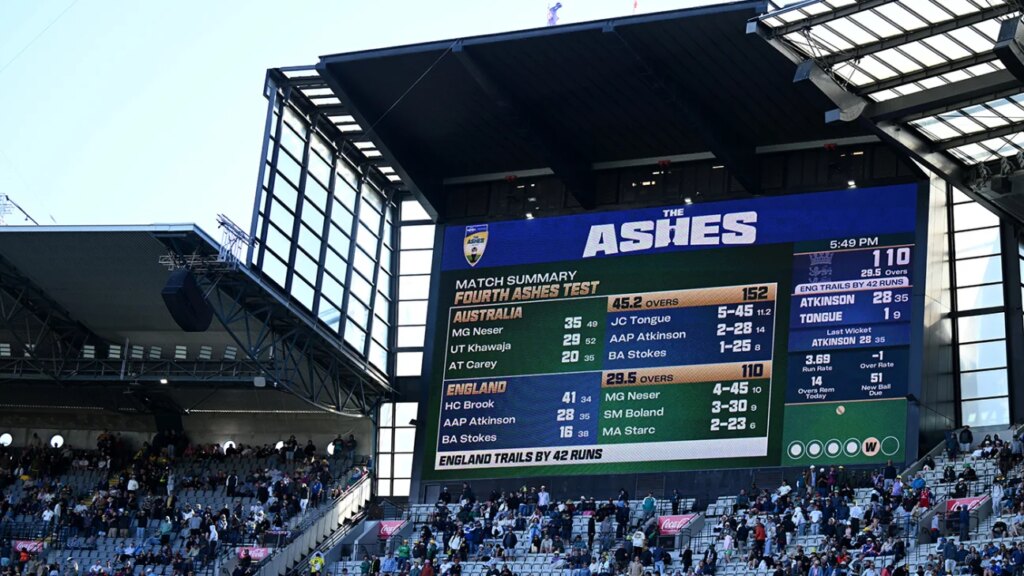
Page left 10mm of grass on the surface, 3mm more than he had last year, and fast bowlers on both sides found substantial seam movement throughout the day. England have not picked a frontline spinner all series, but Australia’s decision to play an all-seam attack was a reflection of conditions and both captains wanted to bowl first at the toss in unseasonably cool weather.
“The pitch is doing too much, if I’m brutally honest. Test match bowlers don’t need this amount of movement to look threatening,” Broad said, commentating on SEN Radio. “Great Test matches pitches, generally, they bounce, but they don’t jag all over the place.”
Glenn McGrath told the BBC: “This pitch has got far too much grass on it… That pitch has got too much life in it for Test cricket… The Australians bowled well [but] it’s hard to apply yourself on a pitch that’s doing plenty because if you’re looking to defend, one’s got your name on it. You’ve got to find that balance between somehow keeping balls out while still looking to score.”
“The bowlers didn’t have to work hard for their wickets,” Cook said. “It was an unfair contest. I don’t know how you hit it [the ball]. If this flattens out tomorrow then fine, it’s an even contest over three or four days. But I don’t think this is particularly even.”
“I think there’s a bit too much in it,” Lee said. “I wouldn’t be complaining at the end of the day if I was a [current] fast bowler. It’s a different surface: it’s that furry feeling. I rubbed my hand on the side of the wicket this morning, and you can feel the grass lift up.”
The ball appeared to deviate more off the seam at the MCG than in Perth, with several balls moving sharply after pitching – including Josh Tongue’s delivery to clean up Steven Smith, and Scott Boland’s nip-backers to Harry Brook (pinned lbw) and Jamie Smith (bowled through the gate).
Michael Neser was Australia’s outstanding performer on the opening day, top-scoring with a counter-attacking 35 from No. 8 before taking 4 for 45 to help bowl England out inside 30 overs. He suggested that the pitch might yet flatten out, and defended the attacking approach that both sets of batters took.
“The ball definitely nipped around a bit there with the new rock, so it was just a matter of trying to find ways to put pressure back on their bowlers – and knowing that, when we bowled, we had to just be patient and let the wicket do the work,” Neser said.
“Going into it, you knew it was going to nip around with the amount of grass there, but traditionally it can flatten out here, so we’ll see how it pans out… I don’t want to go into tomorrow with the preconception of ‘the wicket’s going to be doing a lot’ because it can flatten, and we’ve just got to stick to our processes.
“I think you have to change the way you approach it because bowlers are so good at just holding their length nowadays, so you have to actually put pressure back on them as a batter. I know it can look streaky at times, but at times that’s the only way to score: be brave and come at them.”
Matt Roller is a senior correspondent at ESPNcricinfo. @mroller98