
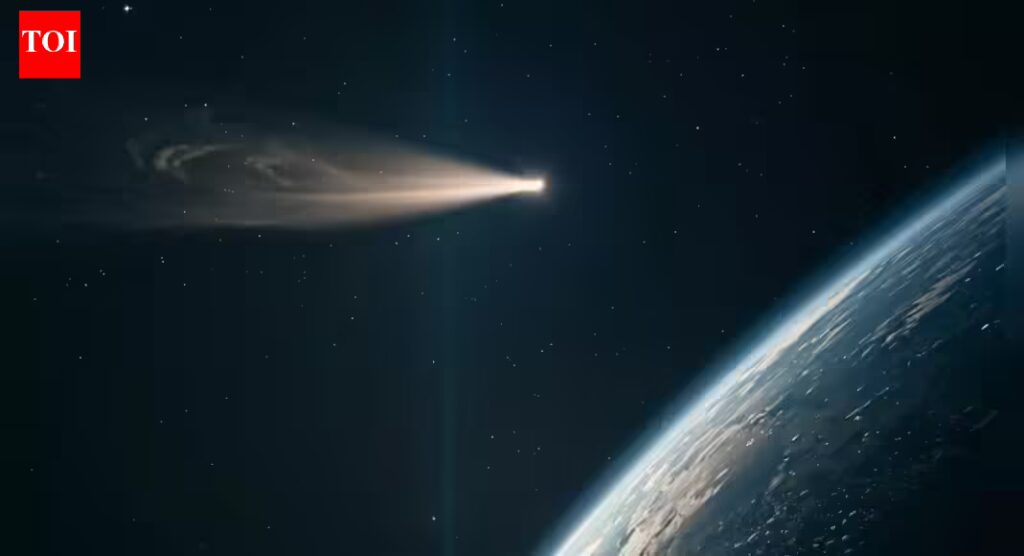
Interstellar objects usually pass through quietly, noticed only by a small group of astronomers before fading back into deep space. Comet 3I/ATLAS has followed a different path. Even as it moves away from Earth and heads out of the solar system, it keeps offering scientists new details to puzzle over. Recent observations suggest this visitor from another star system behaves in ways that are both familiar and oddly unusual. Its dust and gas do not simply trail behind it as expected. Instead, parts of the comet appear to move in shifting patterns that change over time. These movements are subtle, not dramatic, but they matter. They give researchers a rare chance to study how an untouched object, formed far beyond our Sun, reacts when exposed to solar heat for the first time.3I/ATLAS is only the third known object confirmed to have entered the solar system from interstellar space. Before it, astronomers identified the unusual object Oumuamua in 2017 and the comet 2I Borisov in 2019. Each arrival has added a small piece to a much larger picture of how other planetary systems form and evolve.
What is a sun facing antitail of comet 3I/ATLAS
Most comets develop tails that stream away from the Sun, pushed back by solar radiation and the solar wind. An anti tail is different. It appears to extend in the opposite direction, toward the Sun. This effect is uncommon but not unheard of among comets from our own solar system.In the case of 3I/ATLAS, the anti tail became especially interesting because it showed narrow jet like features. These jets were not static. Over repeated observations, they appeared to wobble, shifting position in a slow and regular way. This behaviour hinted that something more complex was happening at the comet’s core, as per a paper published on the paper repository site arXiv.
How were the wobbling jets discovered
Astronomers detected these changes after observing 3I/ATLAS across 37 nights between early July and early September 2025. The work was carried out using the Two meter Twin Telescope at the Teide Observatory in Tenerife.Over time, the team watched the comet’s coma change shape. Before August, it looked like a fan of dust facing the Sun. Later, as the comet moved closer to its October approach to the Sun, a clearer tail pointing away from the Sun became visible. Within the sun facing structure, the jets appeared on seven separate nights.By tracking their movement, researchers noticed a regular pattern. The jets seemed to shift every seven hours and forty five minutes, suggesting a slow precession rather than random motion.
What does the wobble reveal about the comet
The most likely explanation for the wobbling jets is rotation. As the comet spins, active areas on its surface release gas and dust in changing directions. From Earth, this looks like a gentle oscillation.From the data, scientists estimate that the nucleus of 3I/ATLAS completes one full rotation roughly every fifteen hours and thirty minutes. This is shorter than earlier estimates and suggests the comet’s interior structure may be more compact or uneven than first thought.Because this object formed around another star, its behaviour offers a glimpse into physical processes that may be common elsewhere in the galaxy.
Why is this discovery important
Jets and outgassing have been observed in solar system comets before. What makes this case stand out is that it is the first time such behaviour has been clearly seen in an interstellar comet.Researchers describe 3I/ATLAS as a pristine body. It likely spent billions of years in deep space before briefly encountering the Sun. Studying how it reacts to solar heating helps scientists test models of comet formation beyond our own planetary system.As the researchers noted in their paper, this is a rare opportunity that may not come again soon.
What happens to 3I/ATLAS next
On December 19, 2025, the comet came the closest to Earth, and since then it has been drifting away. It is projected to leave the solar system completely, just like other visitors from other stars.Its trip is almost ended, yet it will still be useful to science for a long time. Astronomers will keep using the information they got from this short visit to change how they think about comets, rotation, and planetary systems outside of our own. When 3I/ATLAS ultimately leaves our solar system, it will leave behind more questions than answers. This is generally how progress starts.