
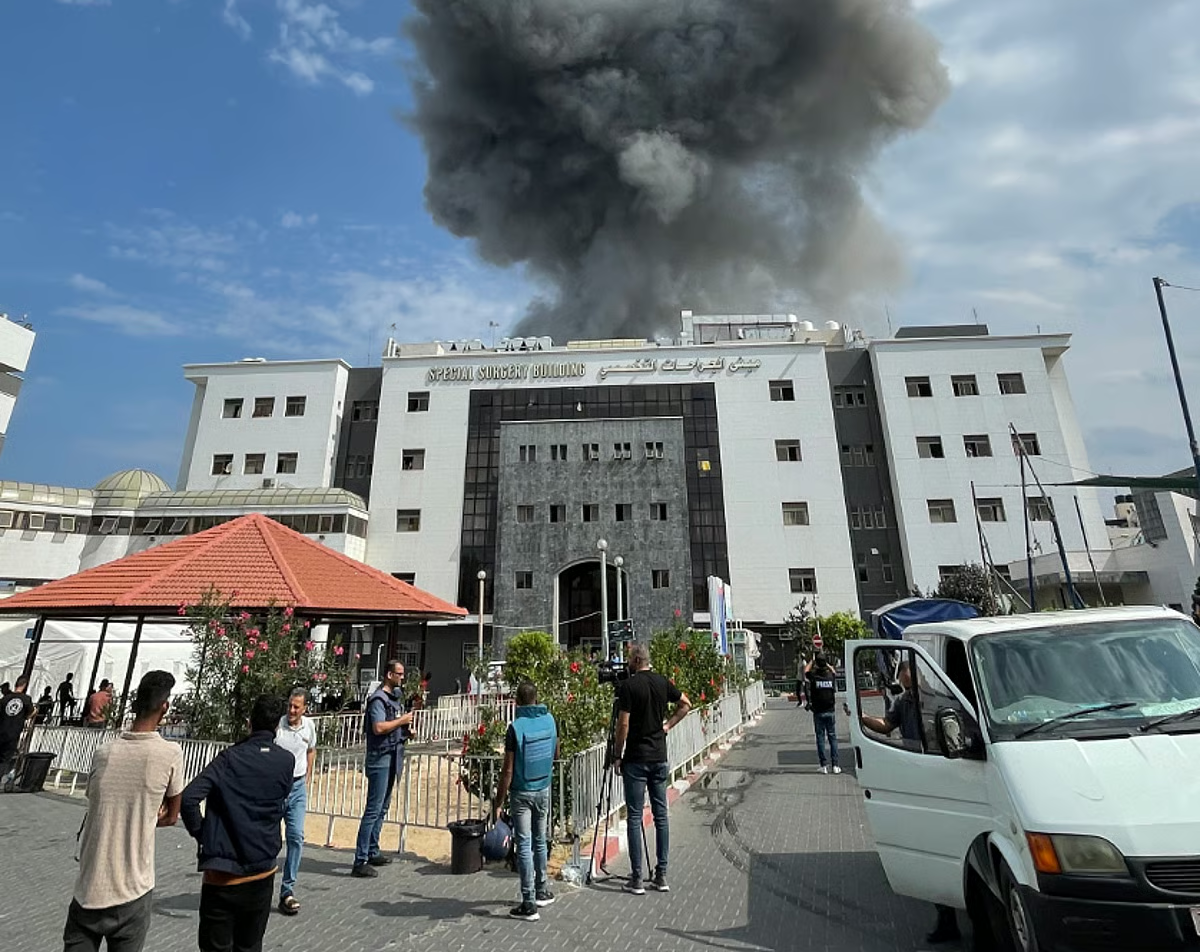
Afghanistan at least 400 people have been killed in a Pakistani airstrike on a drug rehabilitation hospital in Kabul on Monday night, with potentially hundreds more wounded.
Pakistan has deliberately targeting the health-care facility. In a statement on X, the Pakistani Information and Broadcasting Ministry the strikes “precisely targeted military installations and terrorist support infrastructure including technical equipment storage and ammunition storage of Afghan Taliban”.
Attacks on health-care facilities worldwide.
On March 14, an Israeli airstrike in Lebanon, killing 12 doctors, nurses and paramedics. The strike brought the number of health-care workers killed in Lebanon in recent days to 31.
Since early March, the has verified 27 attacks on health-care facilities in Lebanon alone, as Israeli strikes in Lebanon and joint US–Israeli operations in Iran .
The Office of the High Commissioner for Human Rights (OHCHR) and the WHO these attacks .
So, what laws protect medical facilities, staff and patients during conflict? And do they lose this protection if facilities are used to shelter combatants?
What the ‘laws of war’ say about protecting hospitals
International humanitarian law contains detailed rules to protect medical personnel, facilities and the sick and wounded during armed conflict.
Under these “laws of war”:
-
medical personnel, including doctors, nurses and paramedics, while performing their duties
-
there are for ambulances and transport used exclusively for medical purposes
-
these protections extend to the in their care. This includes enemy fighters who require treatment and are no longer taking part in hostilities
-
impartial humanitarian organisations to provide medical assistance. Consent to their work cannot be refused arbitrarily
-
medical facilities the distinctive protective emblems of the Red Cross, Red Crescent or . Medical personnel must carry identification and armlets displaying these emblems
-
misusing these symbols to shield military operations is . Doing so may amount to , a type of deliberate deception which is a war crime under international law
-
medical personnel or facilities displaying these emblems can also constitute a war crime.
Where did these rules come from?
The laws protecting medical services in war emerged in response to the enormous suffering witnessed in 19th and 20th-century conflicts.
The first treaty protecting wounded soldiers and medical personnel dates back to 1864, when states adopted .
Today, the , together with a body of customary international law, form a near-universal legal framework binding all parties to conflict. This includes non-state armed groups.
These rules require warring parties to respect and protect medical personnel, facilities and the wounded and sick in all circumstances.
Why are attacks on health care increasing?
In January, Médecins Sans Frontières (MSF) attacks on medical facilities and personnel had reached unprecedented levels around the world. In 2025 alone, there were 1,348 attacks on health-care facilities, double the number reported in 2024.
The law itself has not changed. But warfare has. Recent conflicts in , , , Iran and Lebanon are taking place in densely populated urban environments. Armed groups operate within complex civilian settings, often near hospitals and clinics.
This has shifted the narrative used by some warring parties. What were once described as “mistaken attacks” are now frequently justified on grounds of military necessity. States often claim insurgents are exploiting hospitals or ambulances to gain military advantage.
Israel, for example, has accused and of using medical infrastructure for military purposes.
Can hospitals lose their protection if fighters are hiding inside?
Yes. Hospitals can lose their special protection if they are used, outside their humanitarian role, to harm the enemy.
However, the law sets a very high threshold for this.
Medical personnel may . Armed guards may be present . The receiving treatment does not change this – protections still apply.
Protection may be lost only if such as:
-
launching attacks
-
serving as an observation post
-
storing weapons
-
acting as a command or liaison centre
-
sheltering able-bodied combatants.
Even then, in cases of doubt hospitals must be .
Importantly, verifying a hospital is being misused does not give parties a free licence to attack.
Before launching an attack on a compromised medical facility, requires a , and for the misuse to stop.
If the warning is ignored, the attacking party must still comply with the core principles of international humanitarian law:
Proportionality
The expected military advantage the humanitarian consequences of the attack. This includes long-term impacts on health-care services. If the expected civilian harm would be excessive, the attack must be cancelled.
Precautions
All feasible must be taken to minimise harm to patients and medical staff. This may include facilitating evacuations, planning for disruption to medical services, and helping restore health-care capacity after the attack.
Even when a facility loses protection, the wounded and sick must still be respected and protected.
Are attacks on health care becoming normalised?
The , , and the have expressed concern attacks on medical personnel and facilities – and the lack of accountability for them – are becoming dangerously normalised.
The legal framework protecting hospitals and health-care workers already exists.
States and armed groups must disseminate the law and train their military forces.
National legal systems are expected to investigate and prosecute those perpetrating war crimes against the wounded and sick, medical personnel and their facilities, or misusing protective emblems for military advantage.
In practice, however, investigating attacks during active conflict is extremely challenging. Territorial states are often to pursue prosecutions.
Can we reverse this trend?
Open-source investigative groups such as , , and now play a growing role in preserving satellite imagery, geo-location data, and videos uploaded to social media. These allow independent fact-finding missions to conduct credible investigations. They may pursue accountability even when territorial states are unwilling or unable to do so.
Without such accountability, places meant to save lives during conflict may increasingly themselves.
, Associate Professor (Law),
This article is republished fromunder a Creative Commons license. Read the .