
Lee, renowned for his express pace, first set his sights on crashing through the 160kph/100mph barrier and wearing the baggy green, when he was nine years old. But it was as a teenager that Lee had his first encounter with Lillee at a fast-bowling camp.
“You’re the quickest here, but if you don’t change your [bowling] action, in two years I reckon you’ll have a broken back,” Lee, now 49, recalls Lillee saying.
At the time, Lee ignored the advice.
“When you’re 16 you think you’re invincible, and two years later I broke my back,” he said.
Cricket Australia (CA), then known as the Australian Cricket Board, was desperate to nurture Lee’s talent and flew him to Perth to work with Lillee.
“Throughout my whole career he’s been incredible in modifying my action, changing my action and allowing me to play – I wouldn’t say pain-free – but to get to the speeds I did,” Lee said.
One of three brothers, Lee recalls he couldn’t bat or bowl legspin as a kid, and always dreamed of bowling fast.
He treated the 160kph mark like runners did the four-minute mile, idolising the likes of Lillee and Jeff Thomson. Lee’s fastest delivery in international cricket was clocked at 161.1kph – among the fastest balls ever bowled.
“I wanted to bowl quick and to have that thrill of being able to run in and see the stumps fly, it became this obsession,” Lee said. “That’s what I wanted to do. I think back to the age of nine or 10 and I wanted to break that 160kph barrier.
“Jeff Thomson was a guy I looked up to through the 70s and 80s and 160.45kph was his record. I thought, ‘I want to have a crack at that one day’ – and I was lucky to achieve it.”
Lee was a key figure in an era of Australian dominance, contributing to ODI World Cup titles in 2003 and 2007, as well as multiple Ashes campaigns.
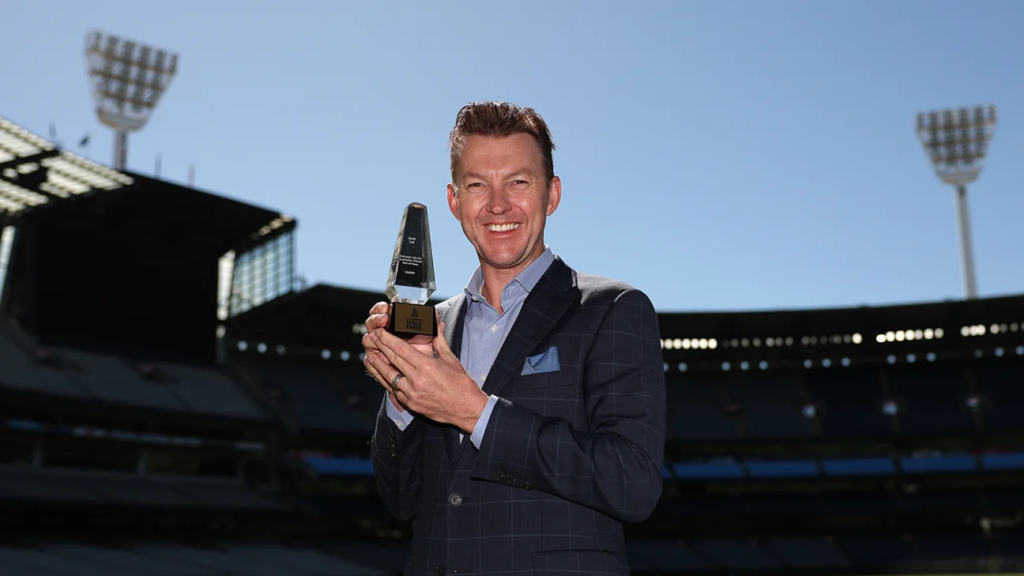
Fittingly, he was unveiled as a Hall of Fame inductee on Sunday at the foot of Lillee’s statue outside the MCG, after a Boxing Day Test that was dominated by bowlers.