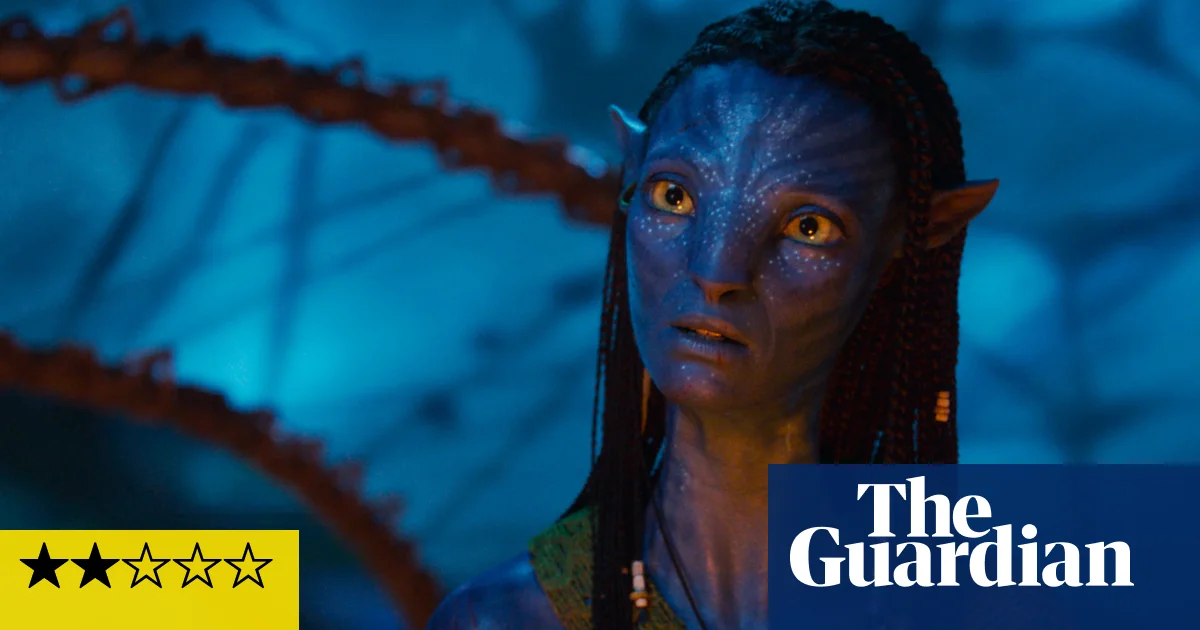
On and on and on it goes. The planet-sized movie franchise of Avatar continues to spin massively in the cosmos – yet without affecting the tides in any other world. Maybe Avatar is the cosmos and its originator James Cameron is the new L Ron Hubbard; the creator, or rather prophet, of a new belief system involving big blue creatures with pointy ears that flap and twitch when they talk, to whom we will all one day be required to bow down when they float past. And while the rest of the cinema industry has quietly abandoned 3D without ever quite admitting it, theatres showing James Cameron’s giant new three-hour hunk of nonsense are still handing out the 3D specs to the customers.
The first film was about human invaders seeking to exploit and colonise the weird tall blue Na’vi people in another galaxy for their mineral resources by piloting “avatar” replicants into their midst. One of these pilots was Cpl Jake Sully, played by Sam Worthington, who fell in love with Neytiri, played by Zoe Saldaña, and stayed behind as a Na’vi – thus infuriating his commanding officer, Col Miles Quaritch, played by Stephen Lang, who since then has died in battle but is now resurrected as a Na’vi avatar, looking scarily as if Vinnie Jones had joined the Blue Man Group. Quaritch’s teen son Spider (Jack Champion) has turned against him and lives with Jake and Neytiri as their adoptive child. In the second film, the Na’vi people found a new world of water. Now in this third film they face the new element of … fire. For the proposed fourth and fifth films, they will presumably tackle earth and wind.
So the Na’vi have come into contact with a new and apparently quite unexpected leader: Varang, played by Oona Chaplin, who provides the film with a kind of witchy sex interest. She is the leader of the Mangkwan clan, who live in a volcano and are possessed by the spirit of fire and ash, a fierce destructive belief that survival can only be achieved by dominance. The bullish Quaritch makes common cause with Varang in his need to divide and subdue the Na’vi and gain revenge over Jake, whose treachery he can’t forgive, and so he gives Varang weapons. The film makes it clear with a post-coital shot that they are having bedroom relations, to which the only response is a mixture of “wow” and “eww”.
As ever, the look of this film is impressive and yet strange. Billions upon billions of pixels have been crunched to create its huge, infinitesimally detailed digital world. Like Middle-earth, it is probably the key to the franchise’s great success but, presented as it is in motion-smoothed high-definition, it looks to me like a “making of” featurette projected on to the white cliffs of Dover. And when ordinary human faces appear, they seem bizarrely out of context, as if Photoshopped in, like seeing American movie stars’ faces on a poster advertising a panto. Edie Falco again plays the general, her face set in an unvarying expression of pop-eyed annoyance at everything that presents itself to her senses. As an actor, she probably thinks it’s the only way to get through this. Jemaine Clement has a cameo that oddly humanises the film.
What we are heading for is yet another mighty struggle between the Na’vi and the evil human invaders, the “pink-skins”, and (as ever) it needs to be conveniently resolved by calling on the assistance of huge undersea creatures whose presence certainly levels the playing field. There are, admittedly, some dramatic moments that prevent this third Avatar from being quite the bland screensaver the second one was: we get an Abraham-and-Isaac-type crisis that makes Jake question what leadership really is, and also a Holmes-v-Moriarty-at-the-Reichenbach-Falls-type confrontation. Yet audiences may find Quaritch’s decision-making a touch eccentric, and the beginning of the fourth film is now going to be bogged down with a long and contrived explanation about what happened to him. Avatar is as gigantically uninteresting and colossally impervious to criticism as ever: a vast, blank edifice that placidly repels objection.