
However, they are the only one of the three concerned parties to have shown urgency. The BCB, mainly represented by its president Aminul Islam, has shown reluctance to patch up with the clubs that have taken up a protesting stance due to the board elections held in October last year.
The Dhaka clubs are the most represented part of the BCB’s board of directors. Twelve directors are selected from the 76 councillors, who then vote the directors into the board during the BCB elections.
The Dhaka club cricket scene is a four-tiered professional league set-up with the Premier League at the peak, followed by the First, Second and Third Division leagues.
What happened to the Dhaka leagues?
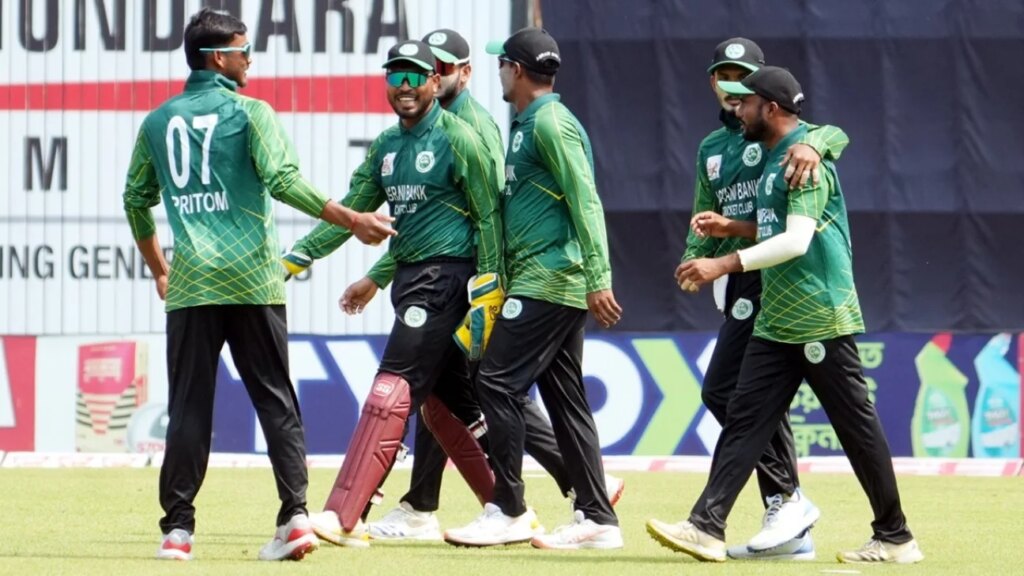
Because of all the clubs that threatened to withdraw from their respective tournaments, the Dhaka leagues started belatedly with the First Division in mid-December. But it ran into trouble. On the opening day, eight clubs enforced a boycott, rendering their matches as a “walkover” on the scorecard. The 20-team competition was reduced to twelve teams.
The farce was repeated in January, when the BCB decided to start the Second Division league even though half of the 24 teams were going to boycott the league.
Then, in late March – when the BCB called for a coordination meeting of the league’s fourth tier, the Third Division league – only five teams contacted the BCB. Following in the steps of the tiers above them, fifteen clubs in the Third Division have reportedly said they will boycott their matches too.
There is also growing concern that the Dhaka Premier Division – the pinnacle of the league system – is unlikely to go ahead. It was supposed to take place at the start of the 2025-26 season.
Why did the Dhaka clubs refuse to play?
Thirty-nine clubs have so far boycotted the Dhaka league. They have one demand. “We consider this cricket board as illegal,” Sabbir Ahemd, president of Pragati Seba Sangha and one of the leaders of the clubs’ movement, told ESPNcricinfo.
“We could see that there was going to be malpractice and manipulation in the BCB elections. More than 40 out of the 76 clubs withdrew from participating in the polls. We asked the sports adviser at the time to run the board under an ad-hoc committee, to have free and fair elections. Instead, there were manipulations in the election process.
“We will not play the Dhaka League under a board which we consider as an illegal body. We are ready to play under any legal body, which could even be an ad-hoc committee that runs the board,” said Sabbir, who also pulled out from the BCB elections.
What did the board do to bring back clubs?
There was hope that the newly-elected board directors, led by Aminul Islam, would put cricket front and centre, ahead of the BCB’s policies and off-field activities. It was far from the case.
CWAB president Mithun had to pursue both the clubs and Aminul on several occasions to get them to agree on a date to start the leagues. The clubs stuck to their decision, while Aminul also remained evasive.
Mithun said: “It wouldn’t be fair to blame just the one side in this case. It started with the BCB elections and over time, both sides have become bitter with each other. There was another party involved in the elections. They have to take the blame too. It is the players who are suffering.
“The clubs withdrew from the elections, and later said that they wouldn’t play the league under this board. In that case, the BCB should have [been] more flexible and active to solve the dispute.
“I recognize that the clubs have supported Bangladesh cricket since the birth of the nation… Rather than stopping the leagues, they could have participated in the greater interest of cricket and cricketers,” said Mithun.
Sabbir said that there was precedence for a more amicable approach from the previous season, when the then BCB president Faruque Ahmed resolved a dispute between the clubs and board.
“Shortly after the board changed in 2024, Faruque Ahmed appointed Nazmul Abedeen Fahim in the constitution review committee. The first thing he proposed was to reduce the Dhaka representation in the board. It was clear that he was against the Dhaka league.
“We stopped the First Division league in protest of Fahim’s move. Faruque bhai boldly met us to discuss our concerns. We were back [on] the field shortly afterwards,” he said.
However, Sabbir said Aminul has mostly ignored the Dhaka clubs since he took over as president in June last year. “Bulbul bhai (Aminul) has ignored the clubs since he was made the president. He didn’t invite the clubs in even one event. We heard whispers that they couldn’t find the time or the budget to invite the club officials. These club officials have made a lot of personal sacrifices to run the teams. They do all the running for sponsors. There was [a] lack of respect towards the clubs.”.
Earlier this week, BCB director Faiazur Rahman, who is also the vice-chairman of CCDM – the committee that runs the Dhaka leagues – expressed his frustration with the BCB too.
“Before becoming the BCB director, my main identity [was] as a cricket organiser. It is not desirable for the Dhaka League to be held back. I have made every possible effort to start the league. It has to be admitted that the cricket board is not running as it should be. The board’s activities are not progressing at full speed. There is no rhythm in the activities,” he told the Bengali daily Kaler Kantho.
What happens to the players?
As the standoff continues, the cricketers remain unpaid across the country. It is estimated that at least 1200 male and female cricketers are currently facing financial crisis because of the clubs’ boycott. Club official Sabbir, however, said that many clubs had already paid their main squad members well in advance.
“Those who know the club cricket scene properly, they will know that most of the clubs do their players contracts at the end of a season,” he said. “We don’t do the contracts when the BCB announces the schedule. It is done nearly 12 months beforehand. This time too, most of the clubs have prepared their team in the previous season. We have already made advance payments to the players, and we will pay them the rest of the amount when the league progresses.”
Mithun, who was elected CWAB president in September last year, also sees hope. “When we were elected into CWAB’s central committee, we were committed to become the players’ voice,” he said. “We are accessing all avenues [to get the leagues up and running], so I am hopeful of finding a solution.”
Mohammad Isam is ESPNcricinfo’s Bangladesh correspondent. @isam84