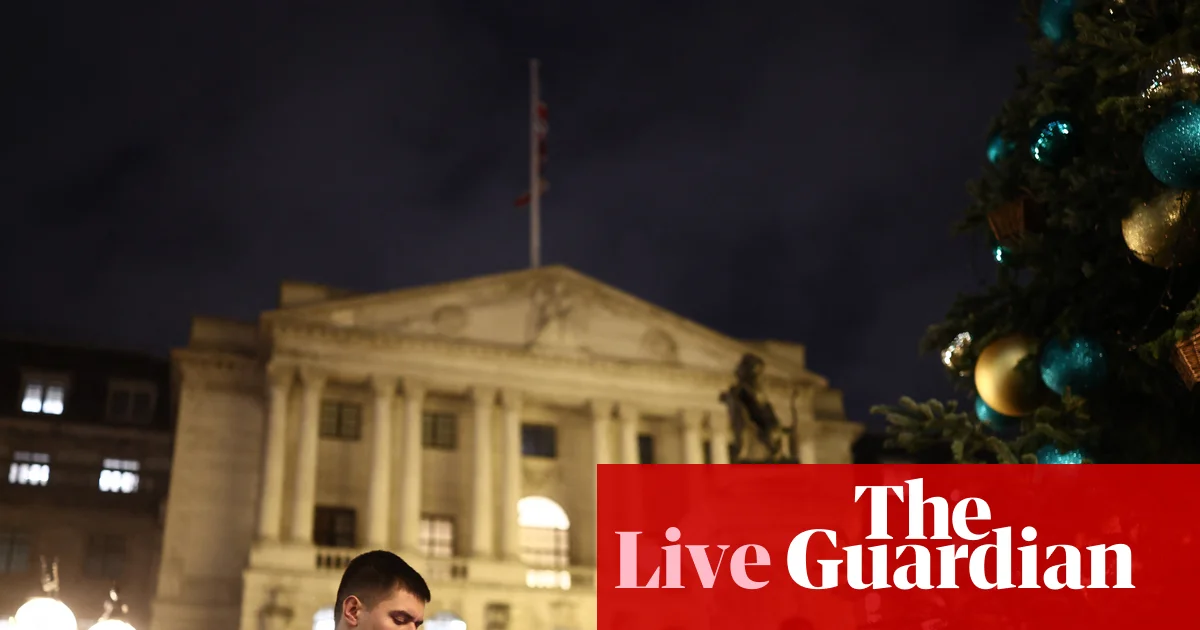
Introduction: Bank of England expected to cut interest rates today
Good morning, and welcome to our rolling coverage of business, the financial markets and the world economy.
The wise men and women at the Bank of England could bring gifts for borrowers today, in an attempt to stave off a UK economic downturn.
The BoE is widely, and confidently, expected to cut UK interest rates at noon, from 4% to 3.75%. That would take borrowing costs down to their lowest level since January 2023.
The money markets indicate there is a 97.5% chance of a quarter-point rate cut, and only a 2.5% possibility that rates are left at 4%.
Wednesday’s drop in inflation, to 3.2%, suggests the cost of living squeeze is easing, which could reassure BoE policymakers that the consumer prices index is heading back towards its 2% target.
More worryingly, Tuesday’s rise in unemployment to a new five-year high suggests the UK needs easier monetary policy, especially as wage growth slowed too.
With the economy shrinking in October, investors are confident that at least five of the Bank’s nine policymakers will plump for a rate cut.
Sanjay Raja, Deutche Bank’s chief UK economist, says:
With disinflation progress on track, the labour market showing added signs of loosening, and GDP growth missing expectations, a Christmas rate cut looks all but certain.
More rate cuts will likely follow in 2026. But much will depend on forward looking indicators of price pressures – including firms’ CPI expectations, price expectations, and wage expectations – and the evolution of the labour market.
Lingering weakness in the quantities side of the labour market could elicit a more dovish reaction function in 2026.
In a busy day for central bankers, we’ll also get decisions from Norway, Sweden and across the eurozone – they are all expected to leave interest rates on hold, though.
The agenda
-
8.30am GMT: Sweden interest rate decision
-
9am GMT: Norway interest rate decision 9am
-
12pm GMT: Bank of England interest rate decision
-
1.15pm GMT: European Central Bank interest rate decision
-
1.30pm GMT: US inflation report for November
-
1.45pm GMT: European Central Bank press conference
Key events
Currys grows profits by 144% despite ‘unhelpful’ cost headwinds
UK electricals retailer Currys has more than doubled its profits in the first half of the year, despite rising costs in the UK.
Currys, which sells computers and gaming products, and white goods such as televisions, fridges, washing machines and tumble driers, reported a 144% rise in adjusted pre-tax profits to £22m.
Group revenue rose 8% to £4.23bn in the six months to 1 November 2025, with like-for-like revenue up 4% in both the UK and Ireland division and the Nordics.
Alex Baldock, chief executive of Currys, says the company had healthy growth in sales, profits and cash flow.
In the Nordics, being the clear leader in an improving market, combined with strong execution, has driven another notable step forward in profits. It’s pleasing that strong top-line growth is translating into improved profitability.
In the UK&I, the consumer environment is more muted, and cost headwinds are unhelpful. Still, we’re the growing market leader, gaining share, and our margin and cost discipline is going a long way to mitigate headwinds and protect profits. In all markets, our big growth initiatives are paying off, our omnichannel model continues to win, and our growing services and solutions are great for customers and valuable to us.
Yesterday’s larger-than-expected drop in UK inflation, from 3.6% to 3.2%, made an interest rate cut at noon today even more likely.
Danni Hewson, head of financial analysis for AJ Bell, explained:
“Although 3.2% is still way above the Bank of England’s target, it is expected to be the final piece in the puzzle which will enable rate setters to deliver their own festive gift to borrowers with an interest rate cut on Thursday.
There are still massive question marks about what 2026 will bring and markets don’t expect the Bank of England to cut interest rates more than once or twice over the next year, so borrowers hoping to see a return to the ultra-low levels many people had become used to will have to adapt.”
ING: Bank of England deeply divided, but rate cut expected
Today’s decision isn’t expected to be unanimous; indeed, it could be another 5-4 vote.
That’s because the Bank’s monetary policy committee consists of four dovish committee members who worry about the weaker jobs market and slowing wage growth, and four hawks concerned about supply-side constraints in the economy and inflation persistence, plus likely swing voter Andrew Bailey.
But unlike in November, when five policymakers wanted to hold interest rates and only four favoured a cut, those numbers could flip at noon today.
Bailey is most likely to shift from the hawks to the doves, economists believe.
James Smith, ING’s UK economist, explains:
Stuck in the middle of it all is Governor Andrew Bailey. He sits between those two camps and almost certainly holds the deciding vote this week. Crucially, though, he wrote in the November meeting minutes that he has more sympathy with the doves.
It sounded like he was edging towards voting for a cut last month, but wanted more evidence that inflation was coming down. On the basis that inflation has largely come in line with the Bank’s forecasts since then, and if anything a tad below, we suspect he will favour a cut this week. That sets up a 5-4 vote in favour of lowering rates to 3.75%.
Introduction: Bank of England expected to cut interest rates today
Good morning, and welcome to our rolling coverage of business, the financial markets and the world economy.
The wise men and women at the Bank of England could bring gifts for borrowers today, in an attempt to stave off a UK economic downturn.
The BoE is widely, and confidently, expected to cut UK interest rates at noon, from 4% to 3.75%. That would take borrowing costs down to their lowest level since January 2023.
The money markets indicate there is a 97.5% chance of a quarter-point rate cut, and only a 2.5% possibility that rates are left at 4%.
Wednesday’s drop in inflation, to 3.2%, suggests the cost of living squeeze is easing, which could reassure BoE policymakers that the consumer prices index is heading back towards its 2% target.
More worryingly, Tuesday’s rise in unemployment to a new five-year high suggests the UK needs easier monetary policy, especially as wage growth slowed too.
With the economy shrinking in October, investors are confident that at least five of the Bank’s nine policymakers will plump for a rate cut.
Sanjay Raja, Deutche Bank’s chief UK economist, says:
With disinflation progress on track, the labour market showing added signs of loosening, and GDP growth missing expectations, a Christmas rate cut looks all but certain.
More rate cuts will likely follow in 2026. But much will depend on forward looking indicators of price pressures – including firms’ CPI expectations, price expectations, and wage expectations – and the evolution of the labour market.
Lingering weakness in the quantities side of the labour market could elicit a more dovish reaction function in 2026.
In a busy day for central bankers, we’ll also get decisions from Norway, Sweden and across the eurozone – they are all expected to leave interest rates on hold, though.
The agenda
-
8.30am GMT: Sweden interest rate decision
-
9am GMT: Norway interest rate decision 9am
-
12pm GMT: Bank of England interest rate decision
-
1.15pm GMT: European Central Bank interest rate decision
-
1.30pm GMT: US inflation report for November
-
1.45pm GMT: European Central Bank press conference