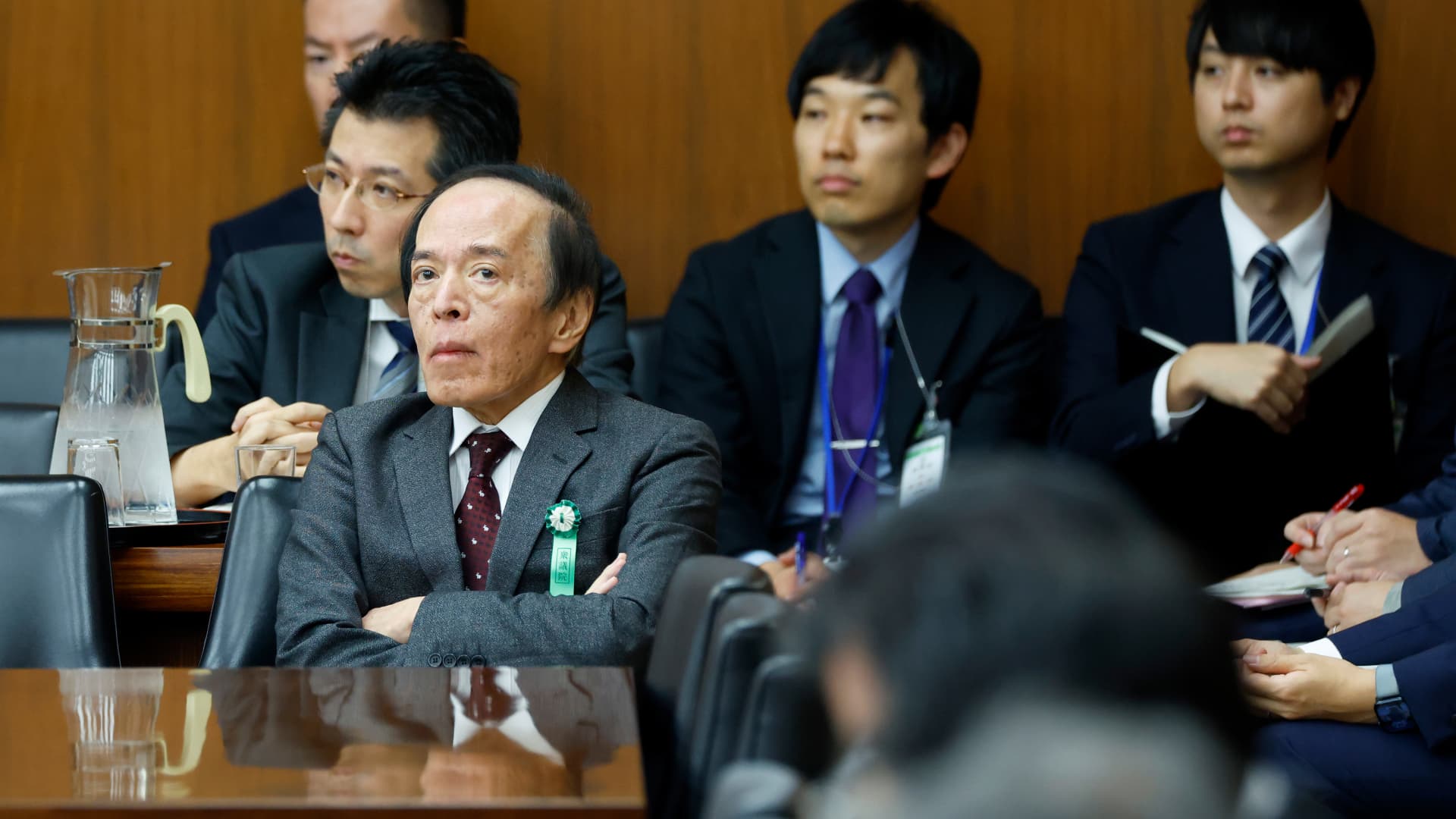
Kazuo Ueda, governor of the Bank of Japan (BOJ), during a committee on financial affairs meeting at the lower house of parliament in Tokyo, Japan, on Friday, Nov. 21, 2025.
Bloomberg | Bloomberg | Getty Images
Japan’s central bank on Friday raised its policy rate to a three-decade high, marching ahead with its policy normalization, as inflation has stayed above its target levels for nearly four years now.
The Bank of Japan raised benchmark rates by 25 basis points to 0.75%, their highest level since 1995, and in line with expectations of economists polled by Reuters.
Despite the move, the BOJ said that real interest rates are expected to remain “significantly negative,” adding that accommodative financial conditions will continue to firmly support economic activity.
Japan embarked on policy normalization last year, abandoning the world’s only negative interest rate regime that had been in place since 2016. Since then, the BOJ has consistently maintained its stance on gradually lifting rates, stating that its goal was to see a “virtuous cycle” of rising wages and prices.
The BOJ said that it was “highly likely” that firms will continue to raise wages steadily next year, following the solid wage increases in 2025. The bank said that “underlying inflation had continued to rise moderately,” with firms moving to pass on wage increases to selling prices.
Inflation has run above above the BOJ’s 2% target for 44 straight months, with the data released earlier in the day showing consumer price growth at 2.9% in November. High inflation has pressured real wages that have been declining for 10 months in a row, according to labor ministry data.
Higher rates risk exacerbating the downturn in the Japanese economy. Revised GDP numbers for the third quarter showed that economy shrank more than initially estimated, contracting 0.6% quarter on quarter, and 2.3% on an annualized basis.
The rate hike also comes at a time when Japanese government bond yields have been hitting multi-decade highs, raising the risk of higher borrowing costs for Japan and increasing fiscal strain.
Asia’s second-largest economy already boasts of the world’s highest debt-to-GDP ratio, standing at almost 230%, according to data from the International Monetary Fund.
The yen has been trading around 154-157 against the dollar since November, having weakened over 2.5% since Prime Minister Sanae Takaichi, a proponent of looser monetary policy, took office in October.

After this hike, the BOJ is likely to raise its policy rate in mid-2026, taking it to a terminal rate of 1%, Shigeto Nagai, head of Japan Economics at Oxford Economics, said in a statement to CNBC before the BOJ decision. Terminal or neutral rate refers to one that balances inflation and economic growth — it neither overheats, nor slows down the economy.
BOJ Governor Kazuo Ueda reportedly said earlier this month that it was difficult to estimate the terminal rate, with the central bank pegging it at 1% to 2.5%.
Nagai warned that another rate hike by the BOJ could cause friction with Takaichi, if inflation declines smoothly towards 2% in the first half of 2026.
Takaichi during her leadership contest had staunchly opposed rate hikes by the BOJ, but has since softened her stance.
Nagai said that the reasons that Takaichi would accept this rate hike was because of the weak yen, and that “addressing the cost-of-living crisis has become an urgent policy issue.”
In November, Japan’s cabinet approved a stimulus package totaling 21.3 trillion yen ($135.5 billion) as Takaichi seeks to boost the country’s slowing economy and offer support to inflation-hit consumers.
This is breaking news, please check back for updates.