
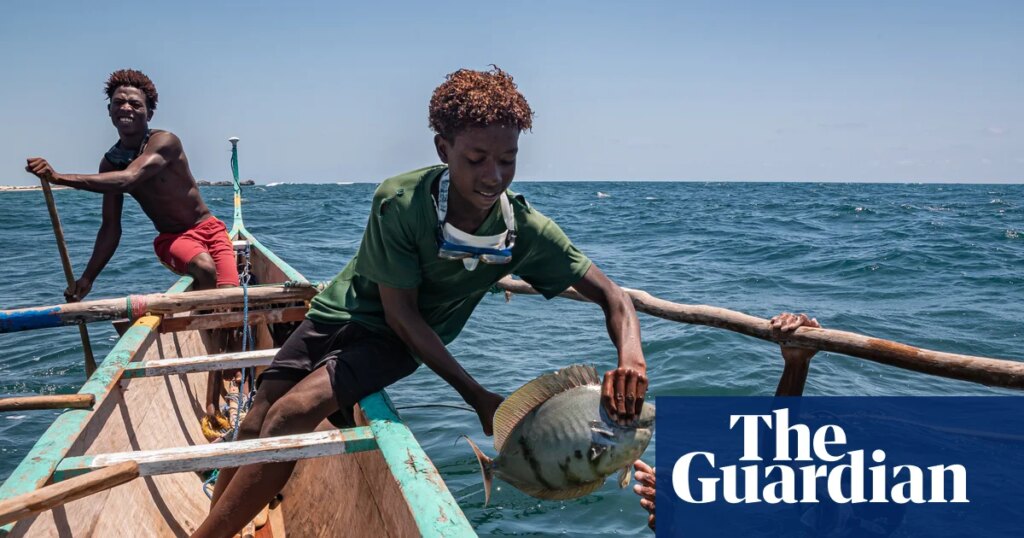
Along Madagascar’s south-west coast, the Vezo people, who have fished the Mozambique Channel for countless generations, are defined by a way of life sustained by the sea. Yet climate change and industrial exploitation are pushing this ocean-based culture to its limits.
Coastal villages around Toliara, a city in southern Madagascar, host tens of thousands of the semi-nomadic Vezo people, who make a living from small-scale fishing on the ocean. For centuries, they have launched pirogues, small boats carved from single tree trunks, every day into the turquoise shallows to catch tuna, barracuda and grouper.
“We rely solely on the ocean,” says Soa Nomeny, a woman from a small island off the south-west coast called Nosy Ve. “Whatever we catch today, we eat today. If we catch nothing, we don’t eat.”
-
A boat near lines of seaweed, which has become a main source of income for Ambatomilo village as warmer seas, bleached reefs and erratic weather accelerate the decline of local fish populations
That dependence is becoming precarious for the 600 or so residents of Nosy Ve. Michel “Goff” Strogoff, a former shark hunter turned conservationist from the Vezo hamlet of Andavadoaka, says fish populations began collapsing in the 1990s and have declined sharply over the past decade.
Rising sea temperatures, coral bleaching and reef degradation have destroyed breeding grounds, while erratic weather linked to warming oceans has shortened fishing seasons. “There’s no abundance near shore any more,” he says. “We’re forced to paddle farther.”
-
Soa Nomeny, wearing traditional sunblock, prepares the family’s main meal of rice and fish or octopus. The Vezo only eat that day’s catch, ensuring their meals are connected to the sea’s bounty
-
In Nosy Ve, fish are often cooked with tomato, onion and garlic; salted sardines are laid out to dry before being sold in Andavadoaka; Soa Nomeny applies tabake, traditional sunblock made from ground taolo, a fragrant bark; and the catch is taken to market from Bevohitse village by zebu-drawn cart, the main form of transport in remote areas
Local fishers echo the same concern. “There are simply too many nets out there,” says Hosoanay Natana, who now travels hours beyond traditional grounds to make a viable catch for him and his fellow fishermen.
Industrial trawlers – Malagasy and foreign – often enter near-shore waters despite a national ban on the ships coming within two nautical miles (3.7km) of the coast. Weak enforcement means violations are common, leaving small-scale fishers with dwindling returns.
The environmental group Blue Ventures, which has worked in the region for two decades, reports that reef fish biomass across south-west Madagascar has fallen by more than half since the 1990s. The organisation supports locally managed marine areas (LMMAs) that help communities set their own fishing rules, restore reefs and look for alternative ways to make a living.
Some of the most promising of these include imposing temporary closures, which have allowed octopus stocks to rebound, and the new practice of seaweed farming, which acts as a commercial buffer against overfishing and climate shocks.
-
Hosoanay Natana tightening the net around a school of barracuda. Divers direct boats to form a circle with the net. Once the fish are trapped, the divers retrieve them and bring them to the boat, ensuring more sustainable fishing
Farther down the coast, the village of Ambatomilo, known locally as Seaweed Village, has embraced this shift. Overseen by its LMMA committee, it is among several communities cultivating seaweed as a supplementary income for fishers whose traditional grounds are overexploited. Families lay freshly harvested seaweed out to dry before selling it to local cooperatives.
Fabricé and his wife, Olive, who began farming five years ago, harvest every couple of weeks. “The market pays around 1,500 ariary [25p] per kilo,” says Olive, spreading red seaweed across bamboo racks. Depending on the season, families can produce up to a tonne a month, offering significant extra income that helps cushion households’ living standards when fishing falters.
“We still depend on fish for daily needs,” she says, “but the seaweed helps us plan ahead.”
Seaweed farming is now one of Madagascar’s fastest-growing coastal industries. The crop is exported mainly for carrageenan – a gelling agent used in food, cosmetics and pharmaceuticals – but also serves locally as fertiliser and livestock feed.
-
Fabricé gathers in the seaweed harvest. Depending on the season, they can harvest up to a tonne a month. With his wife, Olive, he carries the seaweed to prepare it for market. It is also eaten or used as seasoning, and serves as fertiliser or animal feed when dried. Soa Nomeny with an octopus she has speared to supplement the fish catch
Environmental studies have shown that seaweed farms also help stabilise coastlines by reducing wave energy and absorbing carbon dioxide, contributing to erosion control and carbon sequestration.
The Vezo people’s adaptability, once a source of pride, has become a condition of survival. Outside the cyclone season, some families still undertake long fishing migrations, camping on sandbanks and uninhabited islets as they follow fish along the coast. “Extended migrations are always an option,” says Natana. “Whether we embark or not depends on the fish stocks nearby.”
Such journeys can last weeks or months, depending on catches and resources. The lure of high-value commodities – such as shark fins or sea cucumbers bound for Chinese markets – draws some to more distant waters up to 1,000 miles (1,600km) away.
“Some even venture all the way to the Seychelles,” says Strogoff, a nod to the Vezo people’s enduring nomadic spirit: always chasing the next opportunity to make a living.
-
Villagers gathered for the Tromba ritual, performed to invoke blessings, honour ancestors and seek protection, good health and plenty. People are possessed by spirits, a goat or even a zebu is sacrificed, and other offerings made, such as rice, bread or rum. The ritual is also performed at times of crisis, before a journey, or for marriages
Cultural traditions remain central to community life. On Nosy Ve, families still gather for annual blessing rituals, seeking protection and prosperity. During one such ceremony, elders invoke ancestral spirits in a Tromba possession rite while villagers sacrifice a goat or make other offerings to ensure safety at sea.
Life on the island reflects both endurance and fragility. Homes built from pounded seashells and palm fronds line the beach; nights are lit by torches instead of electricity.
After a day at sea, the fish catches are shared equally among crews, with the surplus sold or traded for rice or solar batteries. Meals rarely change: rice, beans and grilled fish.
For now, the Vezo people continue to depend on the ocean that shaped them. Yet each year, the distance they must travel grows and the risks mount.
As industrial fleets expand and reefs decline, an ancient seafaring culture faces an uncertain horizon. Their struggle reflects a wider challenge across coastal Africa: how small communities can endure when the sea that sustains them is changing so fast.
-
The daughter of Hosoanay Natana and Soa Nomeny plays with her ‘sunglasses’. When she is older, she will help the other girls and women to look for octopuses, sea urchins and sea cucumbers