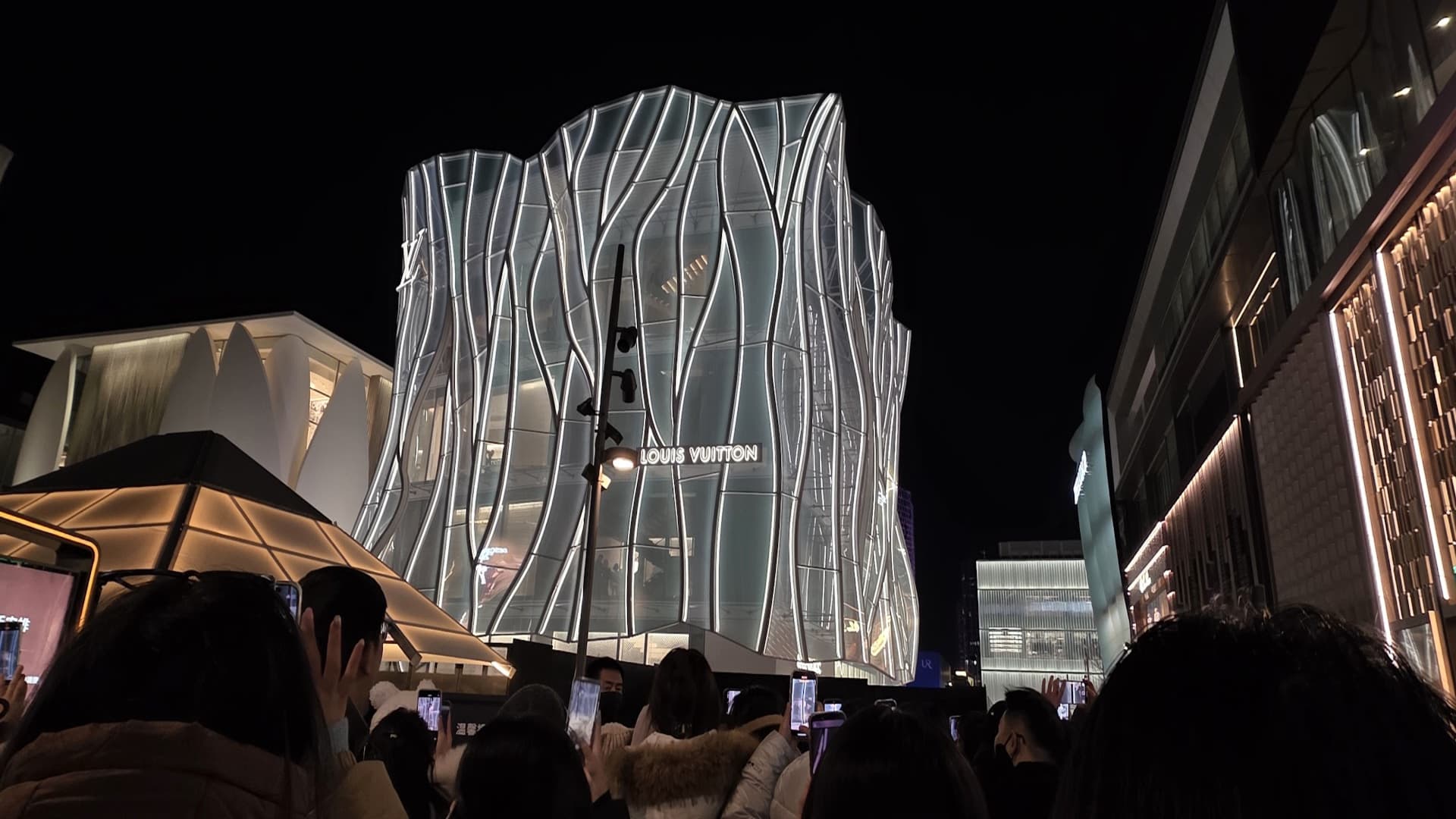
Louis Vuitton officially opened a new flagship in downtown Beijing on Jan. 13, 2026.
CNBC | Evelyn Cheng
This report is from this week’s CNBC’s The China Connection newsletter, which brings you insights and analysis on what’s driving the world’s second-largest economy. You can subscribe here.
The big story
For the last few weeks, a new row of luxury stores in downtown Beijing has started to shake up a long-muted consumer scene.
The anticipation grew as Tuesday night approached. Crowds of young people screamed as they caught glimpses of celebrities climbing the stairways inside the translucent, bubble-shaped exterior of Louis Vuitton’s newest store. I could see others lingering on the upper levels of the adjoining mall with their phones out.
The buzz topped one of the more exciting events of late — Apple‘s annual iPhone releases in a nearby shopping complex. It was a reminder that celebrities can still draw aspirational crowds in China, and that luxury houses remain among the few brands able to command them.
After all the shouting and long waits in freezing temperatures, the official opening of the Louis Vuitton store finally arrived. Invited guests could wander through the five main floors of the new store, ending at a café upstairs.
There were no speeches. No choreographed fanfare. Few discernible foreign faces. It was a far cry from Fendi’s 2007 fashion show on the Great Wall.
The art of restraint
Western brands entering China, especially its high-security capital city of Beijing, have long had to straddle a fine line between local marketing ambitions and reputational risks to the brand back home.
When Canada Goose opened its first China flagship in the same Beijing shopping complex in 2018, its CEO was tight-lipped throughout my 20-minute interview. The event was overshadowed by diplomatic tensions with Ottawa following the high-profile arrest of a Huawei executive in Canada. This time, LVMH declined executive interviews around the Beijing store opening altogether.
Yet revenue from China remains difficult to ignore.
Disney CEO Bob Iger visited Beijing last week, following the success of “Zootopia 2” in China. More Western executives typically visit around the annual China Development Forum in late March. Google Cloud is advertising its own event aimed at helping Chinese firms expand globally, with a rare building-sized poster on the facade of a hotel overlooking downtown Beijing’s main thoroughfare.
The political backdrop helps. A fragile U.S.-China truce remains in place. And after nearly a decade of strained bilateral ties, Canada’s Prime Minister Mark Carney is in China this week.
There are also signs that the consumer market is finally picking up after a sluggish post-pandemic recovery.
In November, executives from Prada, Coach, EssilorLuxottica and Value Retail reported that demand in China was stabilizing. In October, LVMH said mainland China was seeing significant growth in fashion and leather, even as the category had yet to see a recovery in spending by Chinese tourists abroad.
A recovery takes shape?
Drizzie Zuo, a Shanghai-based luxury critic, said stock market gains in recent months have created a wealth effect that has helped luxury demand recover — a trend she expects to continue.
Hong Kong outpaced Wall Street last year in funds raised from new stock listings. On the mainland, the Shanghai Composite rose 18% in 2025 and extended its rally into 2026, marking its longest winning streak since the local stock market was re-launched more than 30 years ago.
Flanking the new Louis Vuitton store are distinct flagships for Tiffany and Dior, bringing three LVMH brands into one shopping complex. The buildings had long been under wraps, with reports of delays amid sluggish consumer spending.
Opening the stores now, Zuo said, “reinforces people’s confidence in the outlook of luxury,” which is critical to get Chinese consumers to open their wallets.
But she warned that Western brands now face stiffer competition from domestic newcomers like Laopu Gold. According to a Rothschild forecast, Laopu’s 2025 sales are estimated to have surpassed Richemont’s jewelry sales in China last year, including those of Cartier.
After a decade of refining their branding and storytelling skills, Zuo said, Chinese luxury players are “really ready to compete with their international peers.”
Top TV picks on CNBC
CEO of Xpeng Motors, He Xiaopeng, discussed the automaker’s shift to in-house chips this year, starting with the launch of the P7+. He also shared plans for future partnerships and further investments in AI.

Leland Miller, China Beige Book CEO, joined “Squawk Box” to discuss the state of China’s economy, 2026 outlook, China’s top economic priorities and more.

UBS’s Thomas Fang said China equities still offer meaningful upside after a strong 2025, supported by earnings growth, attractive valuations and policy support.
Need to know
China’s annual trade surplus hits a record. Exports for the full year grew 5.5% while imports stayed flat, taking Beijing’s trade surplus to $1.19 trillion, up 20% from 2024. That’s despite shipments to the U.S. declining by 20%.
Property drags on. Growth in new industries such as AI and robotics is far from enough to offset the economic impact from the real estate slump, Rhodium Group said Monday.
Chinese AI IPOs. Leading AI startups Zhipu and Minimax were listed in Hong Kong late last week, with the latter doubling on its first day of trade. Alibaba-backed PixVerse released a real-time AI video tool.
Quote of the week
If we start to hear more opportunities around … stronger consumer stimulus packages, then we can consider to look at some of those opportunities as well. But now I think it’s still a little bit too premature.
— Laura Wang, Chief China Equity Strategist, Morgan Stanley
In the markets
Chinese and Hong Kong stocks were mixed on Wednesday.
Mainland China’s CSI 300 was down 0.4% while Hong Kong’s Hang Seng Index — which includes major Chinese companies — rose 0.56%.
The benchmark 10-year Chinese government bond yield is at 1.843%.

The performance of the Shanghai Composite over the past year.
Coming up
Jan. 13-17: Canada’s Prime Minister Mark Carney to visit China and meet with Chinese President Xi Jinping
Jan. 19: 2025 GDP and population figures; December retail sales, industrial production and investment data
Jan. 20: People’s Bank of China’s monthly decision on benchmark loan prime rate