Hello, and welcome to Best of BS Opinion, our wrap of the day’s Opinion page.
What happens when a society has all the material goods it needs? Does it fall into decay or does it do even better on key measures? Michael R Strain says that in a new book, The Permanent Problem: The Uncertain Transition from Mass Plenty to Mass Flourishing, author Brink Lindsey suggests that wealthy liberal democracies are experiencing a nervous breakdown after solving the problem of material provision, suggesting that democratic capitalism is now an obstacle to the flourishing of the human condition. Strain argues that this actually the opposite of what is happening, pointing to continuing innovations in medicines and software, and noting that goods and services considered necessities will only grow and expand.
Devangshu Datta ponders contrasts between political systems and economic growth, and how different models have behaved. The US had open democracy, free speech, and economic freedoms that allowed it to get the best minds, build top-notch institutions, and foster innovation that touched people’s lives. In contrast, Russia had culture and tech but none of it made any difference to its citizens’ lives, eventually leading to its collapse. China and some Asian nations adopted a hybrid model, where quasi-capitalism co-existed with strict state controls. Now, the US seems to be gravitating towards a Russian and post-Russian closed system, shutting down intellectual dissent and closing its doors to immigrant talent. While its capitalistic instincts are unlikely to unravel, the possibility of a multi-polar world seems all too possible. Other economies should consider scenarios where trade is not default-denominated in the greenback and the global economy consists of multiple blocs.
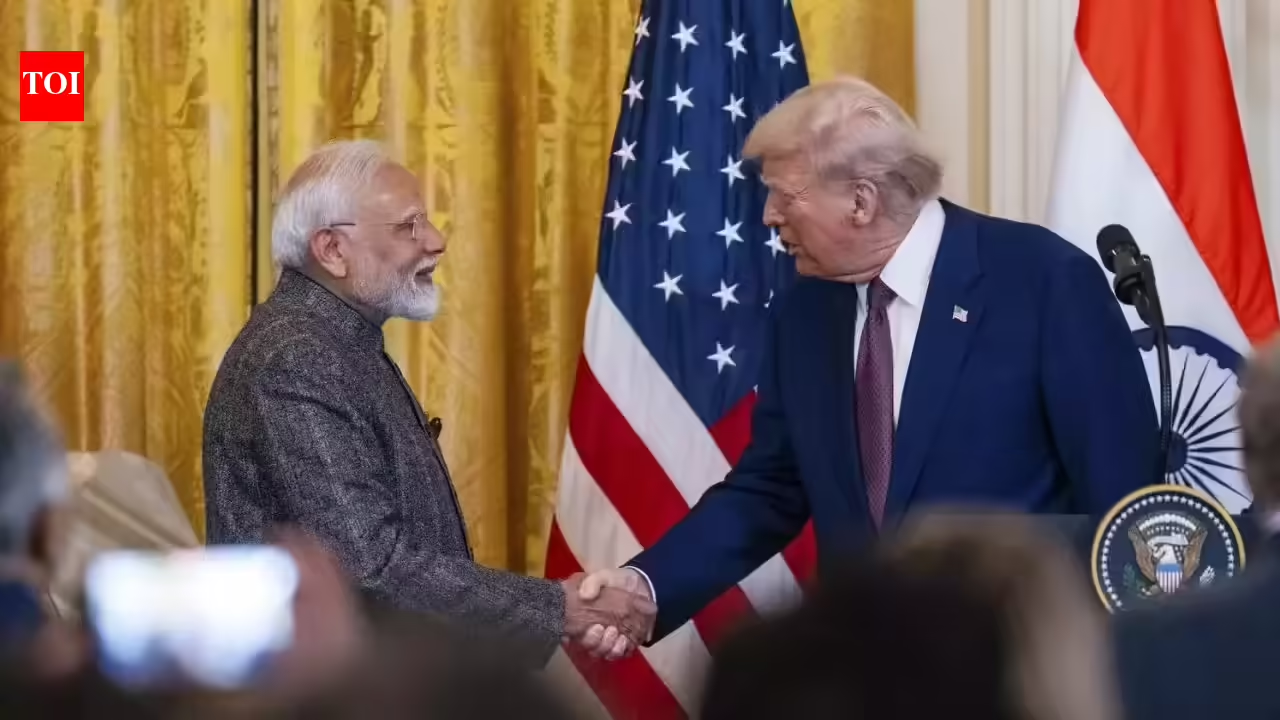
When Narendra Modi became prime minister in 2014, one of his first strategic moves within a year was to ratify land and maritime boundaries with Bangladesh, perhaps still the greatest strategic achievement of his government since, writes Shekhar Gupta. What’s more, he has stuck with it despite his partymen’s (and his own recent mention in the Rajya Sabha) rhetoric over ‘ghuspethiyas’. Now, as Bangladesh readies for national elections, albeit minus the Awami League, will PM Modi show the same large-heartedness and move to restore normal relations with our eastern neighbour? This will bring back strategic stability to India’s east, failing which it will have to live with a Bangla-speaking Pakistan there.
What the end of the American empire, so to speak, means for the rest of the world is the question Mihir S Sharma grapples with. Since WW-II, the US was created a powerful client class, provided a security umbrella, and occupied crucial spaces in the hierarchy of power that others would not compete for. Now, as it focuses its gaze inwards towards more domestic issues, it is creating a power vacuum that no other bloc is capable of replicating. He argues that insofar as security goes, nations need to have a clear picture of what the absence of an American security guarantee actually means.
The Union Budget 2026 breaks with previous editions in how it approaches the issue of disability. Instead of paternalistic support, it struck a note of being inclusive, focused on employment, focused on integrating the disabled into the economy. The emphasis is on skilling, employment and integration into sunrise sectors, but as Ayushi Singh writes, this hides a deeper problem. The whole venture seems to sidestep a more basic issue: that of public infrastructure that continues to fail persons with disabilities. Instead, the focus is on the kind of employment that doesn’t need the person to leave their home workstation. In short, disability is welcome when it can be trained and contained, less so when it asks the world to build enabling infrastructure.