
- Birds collide with glass structures across India, but the scale of the problem remains largely unseen and undocumented.
- Low awareness and the absence of coordinated data from citizens, rescue centres, and researchers mean India lacks the evidence needed to understand how serious the threat is.
- Although bird-friendly building solutions already exist globally and with companies in India, limited regulation, high costs, and weak demand make their adoption difficult.
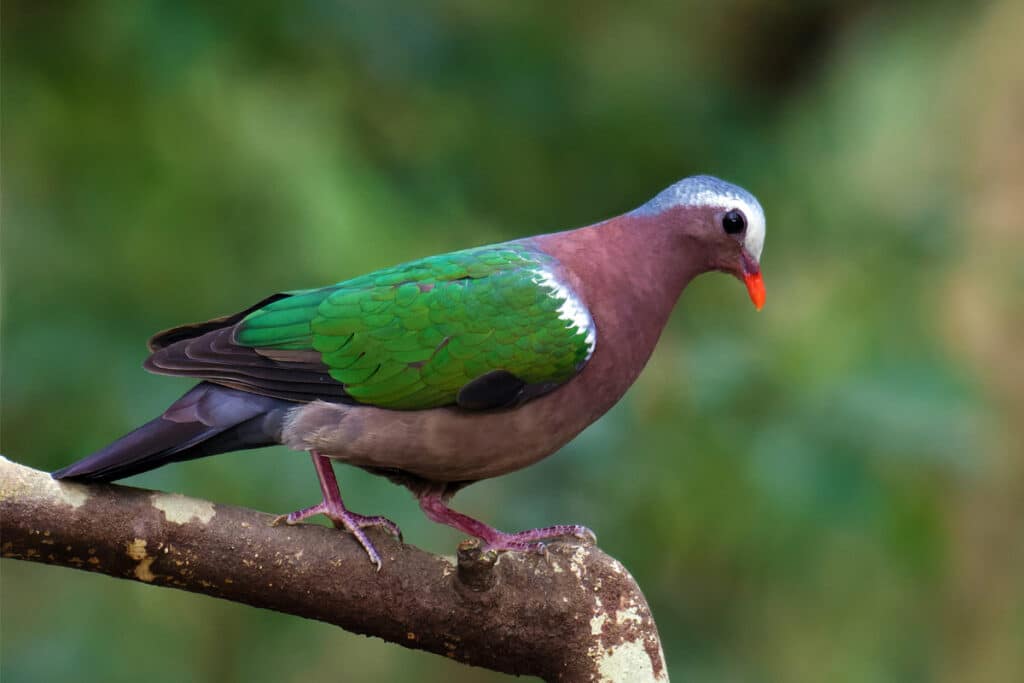
A flying emerald dove is a flash of metallic green, weaving low through trees. To the bird, a glass surface reflecting sky or foliage looks like open air.
Then comes the impact.
Architect and birdwatcher Peeyush Sekhsaria remembers hearing a “blast-like sound” at a tourist lodge in Coorg in 2007 when an emerald dove slammed into a window. The building was not a modern glass tower but an ordinary structure.
Nearly two decades later, the incident still stays with him. What troubles him more is that India has little systematic documentation of birds dying after colliding with glass.
Unlike North America, where building collisions are estimated to kill more than a billion birds annually, India has no national assessment.
An invisible hazard
Glass creates a danger birds cannot recognise. Transparent panes appear as open flight paths, while reflective surfaces mirror vegetation or sky. Birds attempting to fly through these illusions collide at high speed.
Reports surface sporadically. In Gujarat, migratory rosy starlings fell after hitting glass. In Meghalaya, long-tailed broadbills struck an automobile showroom façade. Many incidents circulate only within birdwatching groups or on social media: a stunned barbet beneath a building, or a thud against an apartment window.
“We really don’t know the scale of this issue,” says Ashwin Viswanathan, an ecologist at the Nature Conservation Foundation.
Collisions occur wherever reflective glass exists, in cities, small towns, resorts and rural homes.


Wildlife rescue workers increasingly suspect mortality may be higher than it appears.
In earlier years, rescuers often released birds once they regained movement after an impact, says Jayanthi Kallam of Bengaluru’s Avian and Reptile Rehabilitation Centre (ARRC). Over time, she began noticing that birds that initially seemed recovered sometimes died days later.
Research elsewhere supports this concern. Studies analysing wildlife rehabilitation records in the United States found roughly 60% of collision cases ended in death. Another estimated that nearly 70% of birds stunned by collisions likely die afterward.
How these figures translate to India remains unknown. The country’s ecological context differs sharply: bird diversity is higher, migration routes vary widely, and many species move through vegetation embedded within human settlements.
Local data, researchers say, is missing.


Early clues from scattered data
Small studies are beginning to offer glimpses.
A 2025 study in the Nilgiri Biosphere Reserve documented 35 bird-glass collisions involving 22 species at two locations with two-storeyed buildings over a single year. Victims included migratory Kashmir flycatchers and greenish warblers alongside endemic birds such as the Nilgiri wood pigeon.
Research globally shows most collisions occur not at skyscraper heights but at lower storeys, a pattern Sekhsaria has also observed.
“Tall glass skyscrapers are not the only culprits,” he says.
Many birds move between vegetation layers up to roughly the fourth floor, placing residential apartments, offices, and resorts directly in their flight paths.
To better understand the problem, Sekhsaria and Viswanathan began assembling evidence. Drawing from Facebook posts, iNaturalist observations, eBird records and interviews with wildlife rescue organisations, they compiled around 500 collision reports involving over 80 species.
Most came from Bengaluru and cannot represent India as a whole. Still, the exercise revealed an important insight: wildlife rescue centres may already hold the most valuable data, if it were systematically recorded.


Citizen science and its limits
Since 2020, Sekhsaria and Viswanathan have run a citizen science project called Bird Collisions India on iNaturalist. As of April 2026, it includes nearly 88 documented cases across 47 species.
The Indian pitta, a brightly coloured migratory bird travelling across the subcontinent each winter, appears frequently among reports. Its long seasonal journeys are sometimes abruptly halted by glass facades along the way.
But citizen science alone cannot reveal true mortality levels.
Awareness remains low, many collisions go unseen, and scavengers quickly remove dead birds. Major bird-monitoring platforms such as eBird also do not allow reporting of dead birds, limiting data collection.
Viswanathan notes that rescue and rehabilitation centres could fill this gap by documenting every injured bird, not only confirmed collision cases.
Recording species, date, location and cause of injury would allow scientists to compare collisions with other threats such as electrocution, predation or disease.
Since October 2025, ARRC has begun logging collision incidents through a standardised reporting form. The aim is to develop a protocol that other centres can adopt.
Yet implementation remains challenging. Many rescue organisations operate with limited staff and funding, keep handwritten or digital logs, or have none at all. Moreover, India lacks a national network linking rehabilitation centres, says Kallam.
Without coordinated monitoring, collision hotspots and vulnerable species remain largely unknown.

When the fallen birds advance science
Since 1978, Chicago’s Field Museum has collected more than 100,000 birds killed by window collisions, collected by researchers and volunteers, enabling studies on species vulnerability, drivers of collisions, and even bird gut microbes.
In India, researcher Esha Munshi is attempting something similar through the Feather Library, a nonprofit housed at the National Centre for Biological Sciences.
Working under permits from Gujarat and Karnataka forest departments, she collects bird specimens from rescue organisations, since Indian wildlife law otherwise prohibits possession of bird remains.
Many of the specimens are collision victims.
Researchers study feather structure, colouration, and chemical signatures preserved within feathers, which can reveal information about evolutionary history, habitats and health.
Building such collections, however, requires coordination and collaboration between rescuers, scientists and institutions, along with sustained funding that remains scarce.


Solutions exist but adoption lags
Bird-friendly building solutions already exist globally.
Patterned decals, etched designs and specialised coatings make glass visible to birds without significantly altering its appearance to humans. Cities such as New York and Chicago now mandate bird-safe design in certain buildings.
India has barely experimented with these measures.
According to Shailee Goswami, Building Science R&D Lead at Saint-Gobain, bird-safe glass products are already manufactured, but demand remains negligible. Regulations typically drive adoption, she says. But regulators require scientific evidence before acting.
Tariq Kachwala of FG Glass echoes the thoughts. The company exports bird-safe glass to countries where standards are mandatory, but in India, inquiries are rare, with only one implemented project at a Kolkata mall.
Cost remains a barrier: bird-friendly glass can cost two to four times more than conventional material. But Kanchwala notes it need not be installed everywhere. Targeting high-risk areas, such as lower floors facing vegetation, can significantly reduce collisions while limiting costs.
Sekhsaria adds that Indian green-building standards focus largely on energy efficiency while overlooking biodiversity impacts.


Sekhsaria, Viswanathan, and Munshi are among those organising a national symposium on bird–window collisions in Delhi in May to initiate conversations among scientists, architects, policymakers, and industry on how to understand and reduce the problem.
A 2023 petition before the National Green Tribunal directed the Ministry of Environment, Forest and Climate Change to develop bird-safe building guidelines, expected in 2025. As of April 2026, no public update has followed.
Viswanathan believes data collection and experimentation must proceed together. Demonstrating successful mitigation, he says, could help draw attention from policymakers, industry and the public.
For now, most collisions might remain in private records — the memory of a sudden thud against glass or a stunned bird on the ground.

Banner image: An emerald dove. Image by Shiv’s fotografia via Wikimedia Commons (CC BY 4.0).

