Some discoveries arrive quietly, without fireworks or clean endings. Astronomers were watching a distant flare from a galaxy far away, the kind that appears when a star wanders too close to something it should not. The data looked strange, not wrong, just unsettled. Signals rose and fell when they normally stay steady. Over time, a pattern began to show itself. Something was moving that should not move so easily. Space itself seemed to be shifting. What followed was not a sudden rewrite of physics but a slow confirmation of an old idea. Einstein suggested it more than a century ago. Only now has the universe offered something close to proof.
Universe seems to be twisted by the black holes
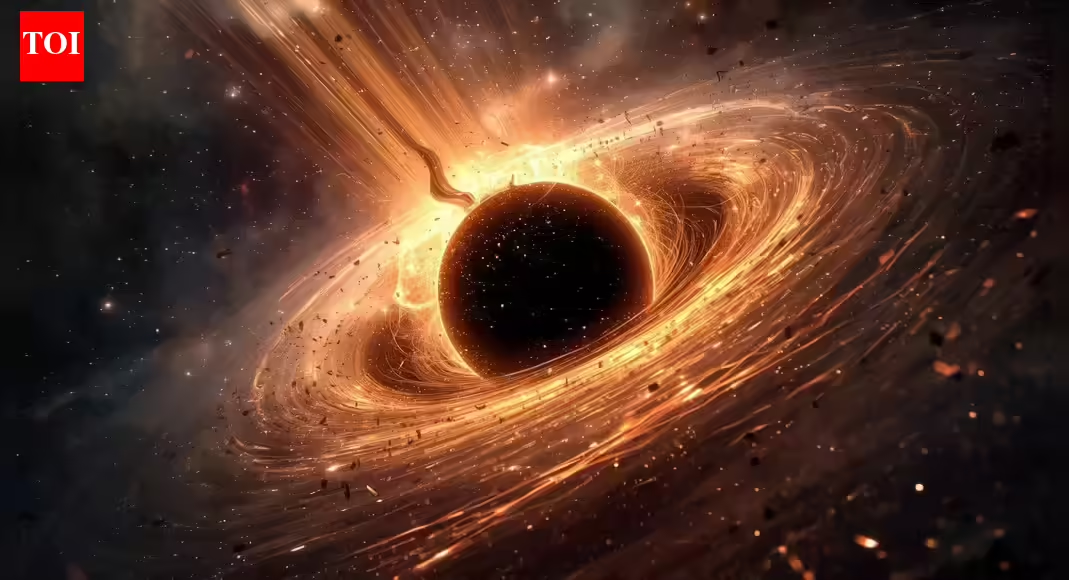
The event began with a star being pulled apart. It drifted too close to a supermassive black hole and was torn into streams of gas. That material did not fall straight in. It circled, heated up, and formed a bright disc. Jets of matter were thrown outward at extreme speed. This is known as a tidal disruption event, and astronomers have seen others before. What made this one different was motion. The disc and the jets did not sit still. They wobbled together, slowly and repeatedly, on a cycle of about twenty days. This shared movement suggested an external influence. Not a collision or explosion, but a steady pull caused by rotation itself.
Why does this twisting of space matter so much
Einstein predicted that a spinning object should drag space and time along with it. The idea sounds abstract, but it has physical consequences. Near a black hole, the effect should be extreme. Until now, it had only been inferred, never clearly observed. In this case, the wobble matched what theory expected from a spinning black hole twisting spacetime around it. This effect is known as frame dragging. It means space is not just a backdrop. It can move, bend, and flow when mass and spin are strong enough. Seeing this happen in a real cosmic setting gives weight to equations written long before modern telescopes existed.
How did telescopes manage to spot something so subtle
The signal was not visible in one type of light alone. Researchers, who published a study on Science Advances, combined X-ray data from a NASA space telescope with radio observations from a large ground-based array. Together, they noticed changes that did not fit earlier events of the same kind. The light flickered in a way that hinted at movement rather than chaos. Spectral analysis showed that the disc of debris and the jets were precessing together. That shared rhythm mattered. It ruled out simpler explanations and pointed back to spacetime itself being dragged by the black hole’s spin. This was not a guess. It was a pattern that held across instruments and time.
What does this tell us about black holes and the wider universe
Black holes are often treated as ends of the story. Places where matter disappears. This observation suggests something more active. Spin shapes behaviour. It influences how matter falls in, how jets form, and how energy escapes. The twisting of spacetime affects everything nearby. Understanding this helps refine models of how galaxies evolve and how black holes interact with their surroundings. It also shows that some of the universe’s most extreme predictions are not just mathematical curiosities. They can be observed if patience and timing line up.The finding does not close a chapter. It leaves things slightly open. Space twists. Time shifts. And far away, a star’s destruction quietly confirms an idea that waited more than a hundred years to be seen.