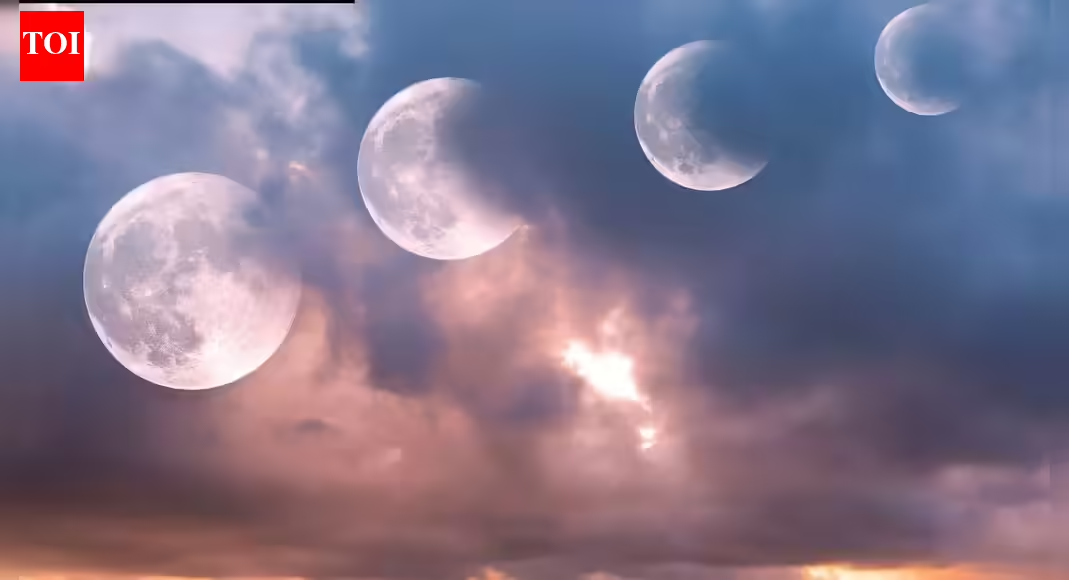
While the term new moon is well established in astronomy, the phrase black moon is far more informal, yet it has gained steady popularity among skywatchers and space enthusiasts. A black moon does not describe a visible event in the night sky. Instead, it refers to a rare timing quirk in the lunar calendar. Much like the better-known blue moon, it highlights the mismatch between the Moon’s natural cycle and our calendar months and seasons. Although you cannot see a black moon with the naked eye, it plays an important role for astronomers, photographers, and anyone who enjoys dark skies. Knowing what a black moon means, how it occurs, and when new moons fall can help people plan stargazing, astrophotography, and deep sky observations with greater accuracy.
What astronomers mean by a black moon and their types
A black moon is not an official scientific term recognised by astronomical bodies. Instead, it is a popular label used to describe certain rare new moon patterns. According to Time and Date, there are two commonly accepted definitions. One is based on calendar months, while the other is based on seasons.A monthly black moon happens when two new moons occur within the same calendar month. The second new moon in that month is called a black moon. Since the Moon’s cycle lasts about 29.5 days, this situation arises roughly once every 29 months. This is the most widely used and recognised definition of a black moon today.A seasonal black moon is defined as the third new moon in a season that contains four new moons instead of the usual three. Earth’s seasons last around three months, but occasionally they are long enough to fit in an extra new moon. In these cases, the third new moon earns the black moon title. This definition mirrors the original seasonal definition of a blue moon and occurs about once every 33 months.
Why black moon dates vary worldwide
A new moon occurs at a precise moment when the Sun, Moon, and Earth line up. Because this moment is exact, the calendar date of a new moon can differ depending on your time zone. A black moon that happens late at night in one region may fall on the following day elsewhere, meaning different countries may record it in different months.
2026 new moon calendar with IST times
Below are the key new moon dates for 2026, shown with both US Eastern Time and Indian Standard Time.January 18, 2:52 p.m. EST / January 19, 1:22 a.m. ISTFebruary 17, 7:01 a.m. EST / February 17, 5:31 p.m. ISTMarch 18, 9:23 p.m. EDT / March 19, 6:53 a.m. ISTApril 17, 7:52 a.m. EDT / April 17, 5:22 p.m. ISTMay 16, 4:01 p.m. EDT / May 17, 1:31 a.m. ISTJune 14, 10:54 p.m. EDT / June 15, 8:24 a.m. ISTJuly 14, 5:43 a.m. EDT / July 14, 3:13 p.m. ISTAugust 12, 1:37 p.m. EDT / August 12, 11:07 p.m. ISTSeptember 10, 11:27 p.m. EDT / September 11, 8:57 a.m. ISTOctober 10, 11:50 a.m. EDT / October 10, 9:20 p.m. ISTNovember 9, 2:02 a.m. EST / November 9, 12:32 p.m. ISTDecember 8, 7:52 p.m. EST / December 9, 6:22 a.m. IST
Why you cannot see a black moon
Like any new moon, a black moon is invisible from Earth. During this phase, the Moon sits between Earth and the Sun. The side facing Earth receives no sunlight, while the illuminated side faces away. The Moon also appears very close to the Sun in the sky, making it lost in the Sun’s glare and impossible to observe safely.
Why black moons matter to observers
Although black moons cannot be seen, they create the darkest night skies of the lunar cycle. These conditions are ideal for viewing faint stars, galaxies, and the Milky Way. Meteor showers also appear more vivid without moonlight interference. For astrophotographers, new moons are often the most valuable nights of the month.Knowing these dates allows observers to plan sessions when the sky is at its darkest. Combined with a dark sky location, new moon nights offer the best chance to see fine details in the universe, from distant galaxies to faint star clusters.