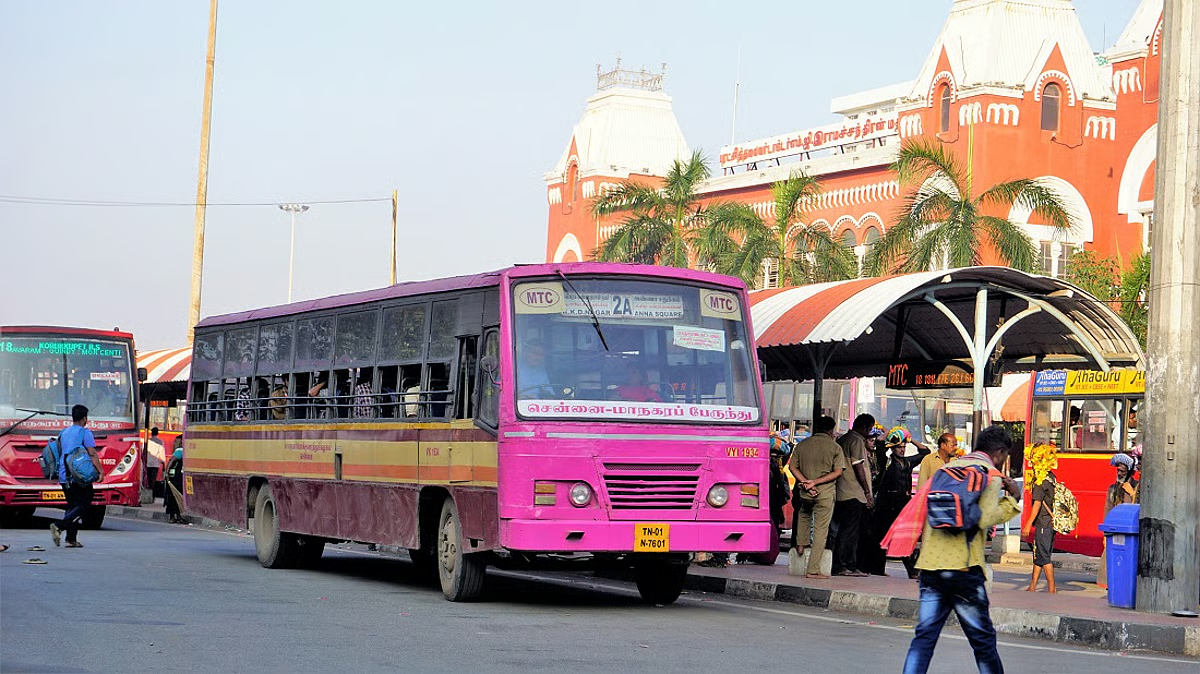
In recent years, it has become a popular strategy of political parties in India to provide free public bus services to women or to a certain section of the population and hope to secure votes and thereby win elections.
Indian politicians grant ‘boons’ to potential voters without voters asking for or dreaming about them. Women voters do not demand them. But politicians have provided free bus services, not out of generosity but due to self- interest and to impress upon the voters that they are interested in their welfare and pretend as if they are paying the amount out of their pockets. Incidentally, free bus services may benefit women traders who commute to the nearby urban centres from their villages to sell their homemade and home-grown products like vegetables and flowers. It may help students who commute to urban centres to attend coaching classes to prepare for competitive examinations, thereby hoping to secure government jobs.
But as is well-known, every coin has two faces. A ‘boon’ given to a section of the population is likely to become a curse to many others. As a result of free bus services to women passengers, the business of private auto-rickshaw and taxicab drivers, who are generally poor, is adversely affected. In additon this, it adversely affects the receipts of the government and at the same time increases its expenditure. To reduce the subsidy burden, the government may hike the bus fare for other sections of the population. In other words, men have to pay for women passengers. It is ĺike robbing Peter to pay for Paul. In other words, a boon for some can become a curse for others. Providing subsidy to only a section of a population can be justified only when the gains of the beneficiaries outweigh the loss incurred by the non-beneficiaries.
To reduce subsidy burden, the government may either impose new taxes or hike the tax rates. In this connection, it is worth recollecting the views of Kautilya on taxation:
As a gardener plucks the flowers and fruits from a tree without damaging the tree: as a bee sucks the honey from the flower without harming it, so also a king should collect taxes from the people without increasing their suffering.
Taxation should not be so heavy to make firms bankrupt resulting in their closure. It may be noted that by killing a goat one may at the best may have one meal. Instead, if the goat is fed well, it gives milk for several years.
Will people protest if there is a reduction in bus fare? The question itself may appear to be ridiculous. An incident in Scotland would throw light on this issue. A long time ago, it is said that the residents of a community in Scotland, in spite of the availability of bus facility, used to walk to their workplace and return home on foot. Bus operators had fixed bus fare as 2 shillings per trip. But no one availed the bus facilities. So, to encourage people to utilise bus services, the bus operators reduced the bus fare to 1 shilling per trip. In response, the residents protested and demanded that the bus fare should be restored to the original level. The argument of the residents was that by daily walking to their workplace and returning home they could save 2 shillings. Now, with the reduction in the bus fare, they would be able to save only one shilling daily. Further, the people argued that their health improved by walking.
In this context, it may surprise one to know that Luxembourg is the only country which provides free public transport services (i.e. buses, trams and trains) to all its people and foreign tourists. The main reason for such a move is to motivate private vehicle owners to avail public transport instead of using their personal vehicles and thereby reducing traffic congestion and carbon emission. It also boosts tourism and retail business at tourist places. Such activities are likely to bring additional revenue to the government and thereby compensate the government expenditure for providing free transport.
It may work well in an economy like India, where all households own private vehicles and are used to traveling in their own vehicle. Air pollution has reached alarming proportions in Delhi. Some states of India like Telangana are encouraging the use of electric battery-driven vehicles to reduce air pollution by exempting life tax on such vehicles. As a result, the number of battery-driven two-wheelers has considerably increased. To motivate the general public, the government-owned road transport corporation is purchasing substantial numbers of electric buses. Further, charging points are being opened at important places to encourage the use of electric vehicles. To discourage the use of a second vehicle by a household, the tax on such vehicles has been enhanced. Such measures, no doubt, would curtail the comforts enjoyed by people traveling in their own vehicles.
Thus, free transport policy for a certain section of population is a boon for some but a bane for many others. Food to some may become poison to many. So, one has to take a comprehensive view while designing a public policy. People at the helm of affairs should have a long-term vision and not crave for short-term benefits.