
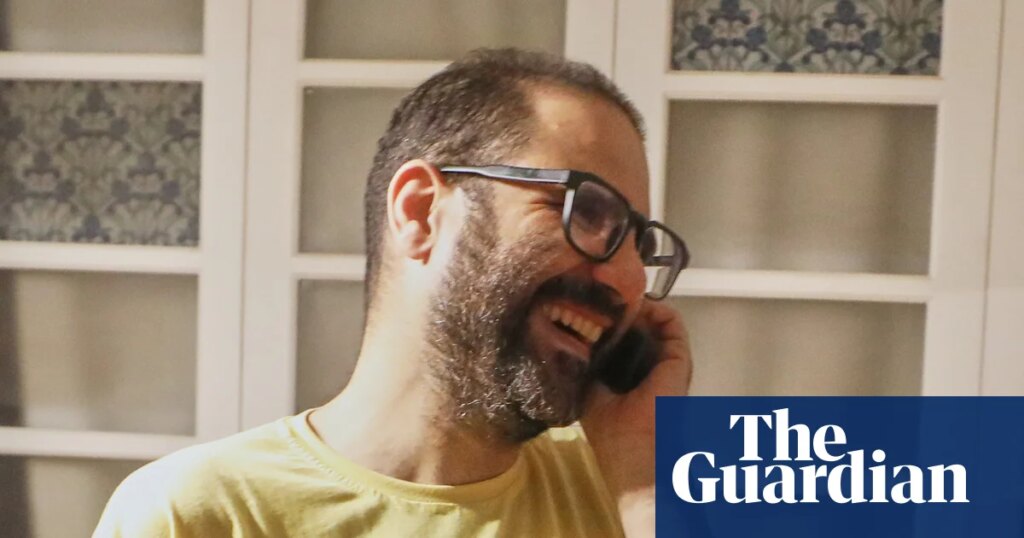
The British-Egyptian dissident Alaa Abd el-Fattah has arrived in London after the Egyptian government lifted a travel ban that it had imposed on him despite releasing him from jail in September.
Abd el-Fattah had been held in jail nearly continuously for 10 years, mainly due to expressing his opposition to the treatment of dissidents by the Egyptian government. He had been detained in jail two years beyond his five-year sentence as the Cairo authorities refused to recognise the period he held in pre-trial detention as part of his time served.
A previous attempt by Abd el-Fattah to leave Cairo for London in November after his release from jail, was blocked by the security forces a month ago. He has since been trying to negotiate an agreement whereby he is allowed to travel freely between Cairo and London and not be permanently excluded from Egypt if he came to the UK.
His arrival in London was announced by his mother, Laila Soueif, on Facebook.
His sister Mona Seif said: “I can’t believe it’s finally happened and Alaa has made it to London. We thought it was impossible, but here he is. Hundreds of people around the world did so much to help bring this moment about. Alaa is free and we can finally begin to heal as a family.”
The family believe the agreement will allow him to travel back and forth between the UK and Egypt.
James Lynch of FairSquare, a human rights organisation that has worked alongside Abd el-Fattah’s family for several years, said: “I’m delighted that Alaa has safely returned to the UK to be reunited with his son after such a lengthy ordeal lasting well over a decade. After everything Alaa and his family have been through, I’m hopeful this marks the beginning of a new chapter for them.”
His mother twice came close to death when she was admitted to hospital during an extended eight-month hunger strike designed to put pressure on the UK Foreign Office to do more to secure his release.
The British prime minister, Keir Starmer, made three calls to his Egyptian counterpart, Abdel Fatah al-Sisi, and the UK national security adviser, Jonathan Powell, also personally urged the Egyptians to end his detention. But the Egyptians never allowed British consular visits to jail, saying they did not recognise his dual citizenship status.
Changes in the Egyptian embassy in London may have helped produce a less inflexible stance.
Abd el-Fattah, a member of a family of human rights activists, became a leading voice during the Arab spring. He has a direct perceptive non-sectarian writing style that has won him awards.
He has a teenage son, Khaled, who lives in Brighton and attends a special educational needs school. The boy visited him in Cairo soon after his release, in what was regarded as a successful reunion.
Abd el-Fattah’s sister, Sana, explained at the time he had been blocked from flying out of Cairo: “We’re really glad to have [Alaa] back in our lives partially free, but he needs to have freedom of movement to live with his son, reunited with him properly.”
“Khaled needs his father. My nephew … is very, very comfortable in his school and his setup in Brighton. We can’t change. We can’t keep creating instability.”
He had already served a five-year jail sentence passed in September 2019 on charges of “spreading false news” after a much-criticised trial, yet last year his family were told he would not be released until January 2027.
Keir Starmer made no criticism of the justice of Abd El-Fattah’s sentencing. “I’m delighted that Alaa is back in the UK and has been reunited with his loved ones, who must be feeling profound relief,” the prime minister wrote on social media.
“I want to pay tribute to Alaa’s family, and to all those that have worked and campaigned for this moment.
“Alaa’s case has been a top priority for my government since we came to office. I’m grateful to President Sisi for his decision to grant the pardon.”