
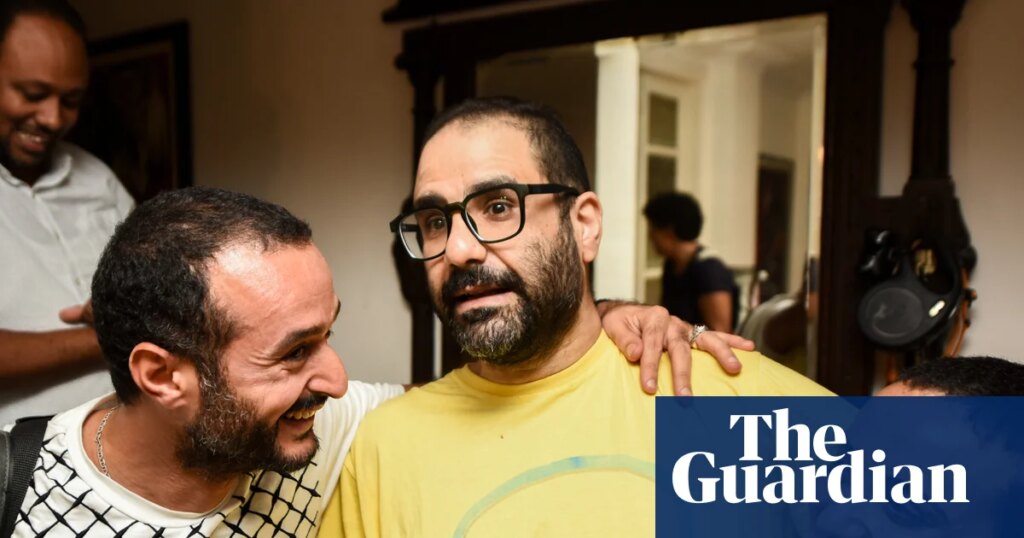
Alaa Abd el-Fattah, the British-Egyptian human rights campaigner, has apologised unreservedly for what he accepted were shocking and hurtful tweets that he wrote more than 10 years ago in what he described as heated online battles.
He said he was shaken by the criticism that has rained down on him since the tweets were highlighted by shadow ministers challenging Keir Starmer’s support for him since he was released by the Egyptian government to travel to the UK after his release from more than 10 years in prison.
There have been calls for Abd el-Fattah’s British citizenship – granted by a Conservative government in 2021 – to be revoked, while within Labour ranks there is regret that more was not done to check on his past.
In a statement issued in the early hours of Monday morning, after a day of frantic consultations, he wrote: “Looking at the tweets now – the ones that were not completely twisted out of their meaning – I do understand how shocking and hurtful they are, and for that I unequivocally apologise.
“They were mostly expressions of a young man’s anger and frustrations in a time of regional crises (the wars on Iraq, on Lebanon and Gaza), and the rise of police brutality against Egyptian youth. I particularly regret some that were written as part of online insult battles with the total disregard for how they read to other people. I should have known better.”
In some of the tweets he describes the killing of Zionists as heroic, adding “we need to kill more of them”. He also once described British people as dogs and monkeys.
“Looking back, I see the writings of a much younger person, deeply enmeshed in antagonistic online cultures, utilising flippant, shocking and sarcastic tones in the nascent, febrile world of social media. But this young man never intended to offend a wider public and was, in the real world, engaged in the non-violent pro-democracy movement and repeatedly incarcerated for calling for full equality, human rights and democracy for all.
“Today, this middle-aged father firmly believes all our fates are entwined and we can only achieve prosperous and safe lives for our children together. All the initiatives I’ve led reflect this”.
Abd el-Fattah admitted it was painful that the tweets had forfeited him support in the UK and asked for people to judge him by his real-life record in standing up for minorities, gay people and freedom of speech in Egypt.
He claimed some of the tweets had been deliberately misconstrued.
He wrote: “I must also stress that some tweets have been completely misunderstood, seemingly in bad faith. For example, a tweet being shared to allege homophobia on my part was actually ridiculing homophobia. I have paid a steep price for my public support for LGBTQ rights in Egypt and the world. Another tweet has been wrongly interpreted to suggest Holocaust denial – but in fact the exchange shows that I was clearly mocking Holocaust denial.”
Abd el-Fattah also challenged claims that he was antisemitic, saying: “I take accusations of antisemitism very seriously. I have always believed that sectarianism and racism are the most sinister and dangerous of forces, and I did my part and paid the price for standing up for the rights of religious minorities in Egypt. I faced a military tribunal and imprisonment for defending Christians in Egypt falsely accused of violence.”
Most of the tweets were written between 2010 and 2012 during the Arab spring, when he was turning 30.
Abd el-Fattah was automatically granted British citizenship in 2021 under an immigration law that allows mothers to transmit their UK citizenship to their children, even if they are outside Britain. His mother was born in London while his grandmother was studying in the UK.
Kemi Badenoch, the Conservative leader, has demanded Abd el-Fattah’s deportation, saying: “I do not want people who hate Britain coming to our country.” Nigel Farage said he had reported Abd el-Fattah to the counterterrorism police.
In his statment, Abd el-Fattah said: “This weekend was supposed to be the first time I celebrated my son’s birthday with him since 2012, when he was one year old. I have been imprisoned in Egypt for almost his entire life for my consistent promotion of equality, justice and secular democracy.
“That included publicly rejecting anti-Jewish speech in Egypt, often at risk to myself, defence of LGBTQ rights, defence of Egyptian Christians, and campaigning against police torture and brutality – all at great risk. And, indeed, my freedom was stripped from me for these defences of human rights. These values are core to my identity.”
It is understood that Abd el-Fattah thought he had addressed the issue of his tweets after his nomination was withdrawn in 2014 for a Sakharov prize when the tweets first emerged, and he was criticised by the Wall Street Journal.
He included a chapter in his book of essays setting out why he had written about armed struggle against Israel. The book had been sent to most MPs, including the prime minister and the then foreign secretary, David Lammy, but the chapter in the book did not fully address some of the most aggressive and shocking tweets, or their sheer volume.
He insisted in the chapter he had made a distinction between killing Israeli civilians and combatants in a discussion about an anti-colonial struggle.