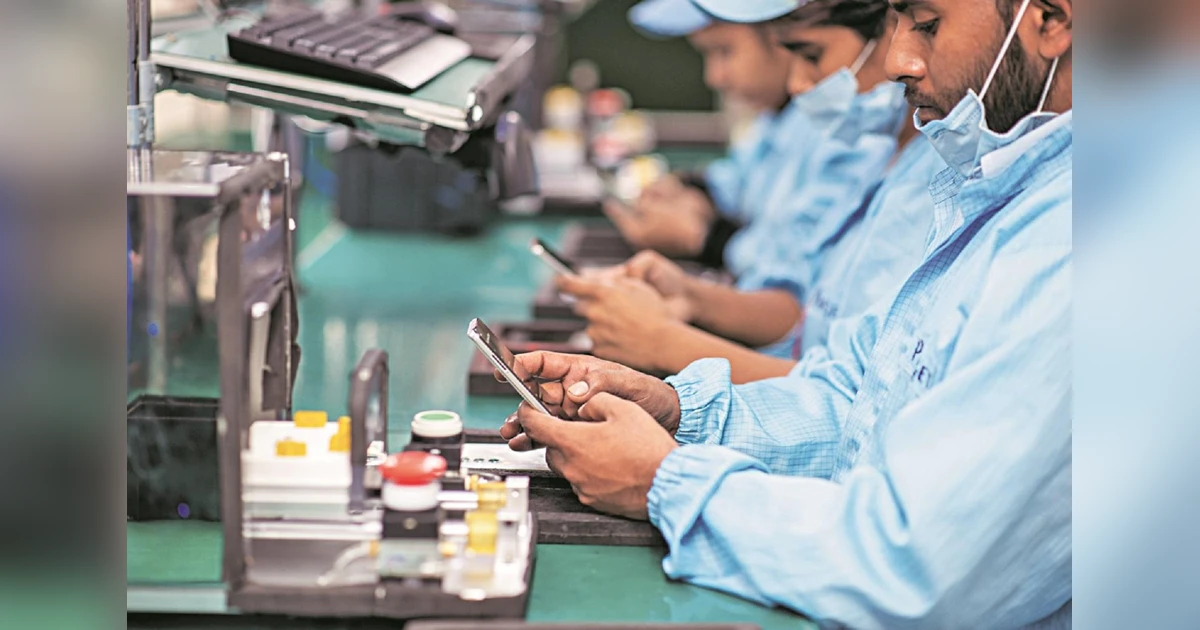
The PLI scheme for large-scale electronics manufacturing (largely smartphones), which ends in 2025-26 (FY26), will see the government fork out ₹19,908 crore in incentives by the end of the scheme, based on actual disbursements and Budget
allocations. This has helped boost Indian smartphone exports.
However, this accounts for only 58 per cent of the original allocation of ₹34,193 crore for the scheme. The government has already disbursed ₹11,603 crore up to March 2025. It has allocated ₹6,960 crore for FY26 under the Revised Estimates (RE) and ₹1,345 crore for FY27.
The large gap is due to several eligible companies under the PLI scheme failing to meet incremental production targets and therefore not receiving incentives. These include Bharat FIH and several domestic players. Smartphone companies argue that the outlay left unused by such firms was expected to be redistributed proportionately among companies that exceeded their maximum incremental production targets. That has not happened.
At the same time, several other PLI schemes have received a sharp boost. An allocation of ₹1,003.54 crore has been earmarked for white goods and light-emitting diode (LED) manufacturing in FY27 — more than a threefold increase over the FY26 revised allocation.
The Ministry of Heavy Industries (MHI), which administers the automobile (auto) and auto components PLI scheme with a total outlay of ₹25,938 crore, has also seen a sharp rise in FY27 allocations. The government has earmarked ₹5,939.87 crore for FY27, a jump of 184 per cent over the FY26 RE of ₹2,091.26 crore. This is expected to benefit electric vehicle makers such as Tata Motors and Mahindra & Mahindra, as well as two-wheeler companies including Bajaj Auto, TVS Motor Company, and Ola Electric.
However, another PLI scheme under the MHI — advanced chemistry cell (ACC) battery storage — has seen weak performance, despite a total allocation of ₹18,100 crore. Of the three eligible players under the scheme, only Ola Electric has claimed incentives. The modest allocations in successive Budgets suggest that the scheme is off track. Major players such as Amara Raja and Exide are not among the eligible participants.
This is reflected in the numbers. The FY26 Budget had initially earmarked ₹155.76 crore for the ACC scheme, but the RE slashed it to ₹13.31 crore. For FY27, the budgeted allocation stands at ₹86.01 crore — nearly half the original budgeted amount for the previous year.
In information technology hardware, the government has also taken a cautious approach. While the FY26 Budget provided ₹115 crore, the RE cut this by nearly two-thirds to ₹40 crore. For FY27, the allocation has been raised to a more realistic ₹182 crore.
In textiles PLI, the revised allocation for FY26 was cut by nearly a third to ₹400 crore from the budgeted ₹1,148 crore. For FY27, the government has made only a marginal increase, allocating ₹405 crore.
The smartphone PLI shortfall
* ₹20,000 crore likely payout as scheme ends in FY26, well below the outlay
Autos, white goods, LEDs take the lead
* Sharp rise in FY27 allocations
The battery bet that stalled
* ACC PLI remains weak despite a ₹18,100 crore headline outlay
Textiles on the sidelines
* Only a nominal increase in allocation