- India’s annual budget presentation did not have major announcements on tackling climate change and environmental concerns.
- The budget prioritised carbon capture, critical minerals, battery storage, and clean energy manufacturing, reflecting a strategy driven by energy security.
- The finance minister made several announcements for urban financing and planning reforms, but experts warn that weak institutions and governance gaps may limit their impact.
In her ninth consecutive Union budget speech on February 1, Finance Minister Nirmala Sitharaman did not mention “climate” even once. She mentioned “environment” but in the context of infrastructure projects such as high-speed rail and dedicated freight corridors. This reflects the overall thrust of the budget, which focused more on infrastructure expansion, reducing import dependence, and strengthening domestic manufacturing, while remaining muted on environmental concerns. Experts say external factors, including climate finance constraints, economic conditions, and geopolitical tensions, may be influencing this tone that the budget has taken.
A similar tone was also seen in the Economic Survey tabled on January 29, which analyses the state of the economy and sets the context for the budget which then announces the government’s actual spending and policy proposals. The Survey noted that capacity constraints and a widening gap between ambition and operational reality have marked the global climate agenda. It highlighted climate finance as a key challenge and said India should approach the transition as part of a broader energy system strategy linked to growth and security.
Rohit Azad, Assistant Professor at Jawaharlal Nehru University’s Centre for Economic Studies and Planning, said external constraints, such as climate finance, cannot justify inaction.
“Climate change is going to affect India far more than the Global North, given our tropical climate and high levels of poverty. Livelihoods will be impacted, and disasters will become harder to manage. It is in our own interest to act,” he said.
Azad also pointed to global political shifts. “There is now a contest between oil and green energy. Donald Trump wants to bring oil back on the agenda because the U.S. is lagging in green energy, while China and European countries have taken the lead (on green energy). India seems to be positioning itself somewhere in between. But trying to balance two opposing directions can be risky,” he said.
Duttatreya Das, Energy Analyst (Asia) at Ember, an energy think tank, said the slowdown in energy demand is an emerging concern. Usually, energy capacity is added, based on expected growth in demand. This issue was also discussed at a recent session in Delhi with power sector leaders, attended by Pralhad Joshi, the Minister of New and Renewable Energy.
In the recent years, energy capacity has increased rapidly but it has not aligned with the growth in the demand for energy, which has remained low in comparison.
This year, energy demand has remained weak, said Das, while there are concerns around future energy demand projections. “There is a power surplus at present, which is affecting expectations around new capacity addition,” Das said. “This is why the government is focusing on manufacturing and data centres to drive future demand.”
Azad also highlighted that urgent issues like climate adaptation and pollution control were missing in the budget. “Adaptation is just not there, even though climate change is already affecting agriculture,” he said. “This time, pollution had become a political issue. There were protests in Delhi, and the international media were reporting on it. I expected this budget to include something significant on pollution,” he added.
The budget for air quality management under the environment ministry has been cut by nearly 10% from the previous year’s budget estimate. At the same time, funding for the Pradhan Mantri Fasal Bima Yojana has marginally fallen from ₹122.67 billion to ₹122 billion compared to the revised estimate of the previous year, even as farmers face growing climate risks.
Energy security gets priority
The budget allocates significant funds towards Carbon Capture, Utilisation and Storage (CCUS), an expensive and limited-use technology that intends to capture carbon dioxide from large industrial sources but is not yet proven at scale. Sitharaman proposed an outlay of ₹200 billion over five years and allocated ₹5 billion for the initiative in the current budget to focus on five industrial sectors, including power, steel, cement, refineries, and chemicals.
Vikram Vishal, Professor at Indian Institute of Technology Bombay, said that carbon capture is needed for these sectors to achieve deep emissions cuts. “The ₹200 billion allocation is a welcome move. While it may not be sufficient on its own, it provides a much-needed initial push for technology adoption,” he said. The budget addresses policy support and funding to some extent, added Vishal. These have, so far, been major constraints to the growth of carbon capture technologies.
Sitharaman also announced customs duty exemptions on capital goods used for manufacturing lithium-ion cells for batteries and energy storage systems, equipment for processing critical minerals, and imports for nuclear power projects.

This approach is reflected in the Economic Survey, which warned that the global green transition is becoming increasingly expensive for developing countries. It noted that sustainability requirements are raising mineral prices without adequate support for finance, technology, and capacity building.
“A transition that is clean but unaffordable is neither rapid nor just,” the Survey said.
It also noted that resource-rich regions in Africa, Latin America, and Asia must be treated as co-producers of value, rather than merely sources of raw materials, and called for greater cooperation on technology transfer and investment.
Experts say this partly explains the government’s focus on building domestic capacity in critical minerals and clean energy supply chains, amid geopolitical pressures and supply chain disruptions.
As a result, sectors such as battery storage, solar glass, nuclear equipment, and rare earth processing have received greater attention. Sitharaman herself referred to heightened uncertainty and global disruptions in her speech.
The budget allocation for the National Critical Mineral Mission, under the Ministry of Mines, has increased from an estimate of ₹4.1 billion to ₹4.4 billion. However, the revised estimate for the previous year had fallen to ₹0.9 billion.
Under the Ministry of Power, the Energy Conservation Scheme has seen a sharp reduction in allocation, from ₹443.5 million to ₹177.5 million. At the same time, funding for the Scheme for Promoting Energy Efficiency Activities in different sectors of the Indian economy has remained stagnant at ₹400 million. In contrast, the Viability Gap Funding for the development of Battery Energy Storage Systems has increased sharply from ₹2 billion to ₹10 billion, although the previous year’s allocation had been revised down to ₹1 billion.
Ember’s Das said, “While the Budget delivered no big-ticket announcements for renewables, continued duty exemptions, support for critical minerals, and manufacturing reforms are expected to strengthen clean energy supply chains quietly. Additional capital subsidies could have further unlocked the potential of PLI-led manufacturing, particularly in upstream solar and energy storage.”

Urban development in focus
Another critical aspect of the budget was a series of announcements aimed at the urban landscape. To encourage large cities to issue higher-value municipal bonds, the finance minister proposed an incentive of ₹1 billion for a single issuance exceeding ₹10 billion. The existing Atal Mission for Rejuvenation and Urban Transformation (AMRUT) scheme, which supports issuances up to ₹2 billion, will continue for small and medium towns.
Sitharaman also announced a focus on developing infrastructure in cities with populations above 500,000 (tier II and tier III). The budget also discussed developing City Economic Regions (CERs) based on their specific growth drivers. The minister proposed allocating ₹5,000 crore (₹50 billion) per CER over five years.
Urbanisation has received increasing attention from policymakers in recent years. In the Union Budget 2023-24, the Centre announced an Urban Infrastructure Development Fund (UIDF) with an initial outlay of ₹100 billion to support tier-II and tier-III cities that lack creditworthiness but have viable infrastructure projects. This was followed by the announcement of the ₹1 trillion Urban Challenge Fund (UCF) in the 2025–26 budget to introduce competition and leverage in urban financing.
The Economic Survey dedicated an entire chapter to cities, highlighting challenges such as congestion, waste management, sewage, and water supply, and called for developing “cities as growth hubs.”
Jaya Dhindaw, Executive Programme Director for Sustainable Cities at WRI India, said that the primary challenge is implementation. While many proposals are well-intentioned, the absence of clear institutional structures, accessible funding mechanisms, and dedicated funding flows limits their effectiveness. For these initiatives to translate into meaningful outcomes on the ground, empowered planning authorities and well-defined governance frameworks are essential. The Economic Survey echoed these concerns, pointing to fragmented governance across urban local bodies, development authorities, state departments, and parastatal agencies.
Ravikant Joshi, a freelance urban policy consultant, said the focus on city economic regions and mid-sized cities is a welcome move. “Earlier, cities functioned mainly as service providers, with little economic planning. Recognising their economic role is important for generating livelihoods,” he said.
On municipal bonds, Joshi said incentives under AMRUT led cities to issue bonds based on benefits rather than needs. He warned that only a few cities can raise large bonds and that absorption capacity remains a concern.
“Only three or four cities are likely to be able to issue such large bonds. The issue is not raising money, but whether cities can use it immediately,” he said.
He added that several funds announced earlier have not been operationalised. “The Urban Challenge Fund was announced last year, but guidelines are still pending. As a result, very little has happened,” he said.
Read more: Are cities ‘smart’ enough to leverage municipal bonds?
Financial support for the new rural scheme
The latest budget announced an allocation of ₹956.92 billion for the Viksit Bharat–Guarantee for Rozgar and Ajeevika Mission (Gramin) (VB-G RAM G). Compared to the earlier Mahatma Gandhi National Rural Employment Guarantee Act (MGNREGA), this represents only a marginal increase. The government had allocated ₹880 billion to MGNREGA in the previous year and has provided an additional ₹300 billion in the current budget.
Rajendran Narayanan, Associate Professor at Azim Premji University, said the allocation suggests that the government is preparing to frame rules for implementing the new Act, but several details remain unclear. “So far, states have not been informed about how much they will be required to contribute. This could come as a surprise to them,” he said. “When the Act was introduced, an allocation of ₹950 billion was indicated. It is also not clear where the funds will be deployed or how many days of work will be approved.”
On MGNREGA, Narayanan said the ₹300 billion provision appears to be a short-term measure. “The financial year ends on March 31, and there is still one quarter left. This allocation may be meant to keep the programme running until April or May,” he said.
He added that the government may then introduce a transition period. “My sense is that the new Act will begin taking shape only after the monsoon. There could be a gap of around 60 days, during which work availability may be restricted,” he said.
Read more: What India risks by dismantling its rural safety net [Commentary]
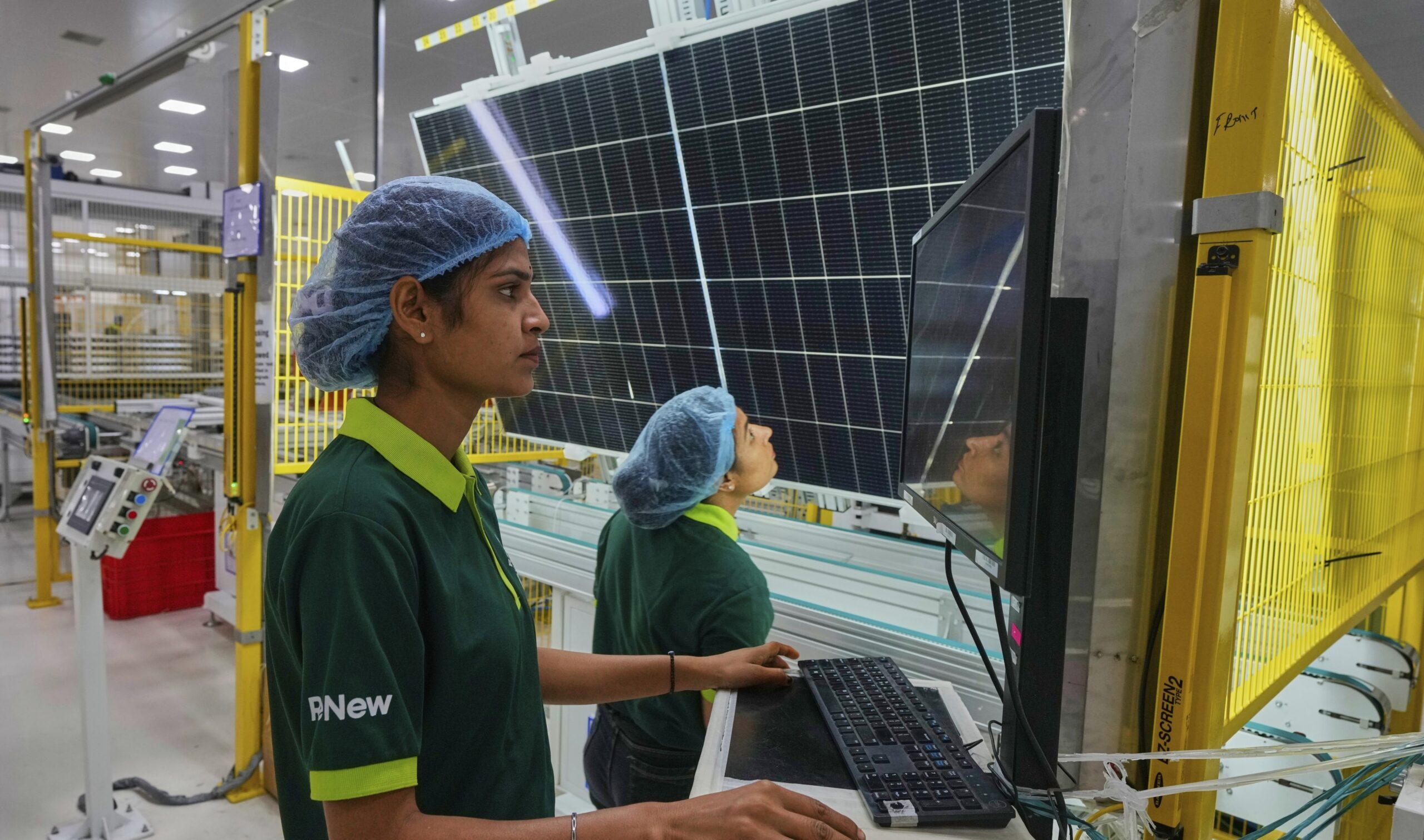
Banner image: Workers check the quality of a solar panel at the production line up at a manufacturing plant on the outskirts of Jaipur, Rajasthan. (AP Photo/Manish Swarup)